
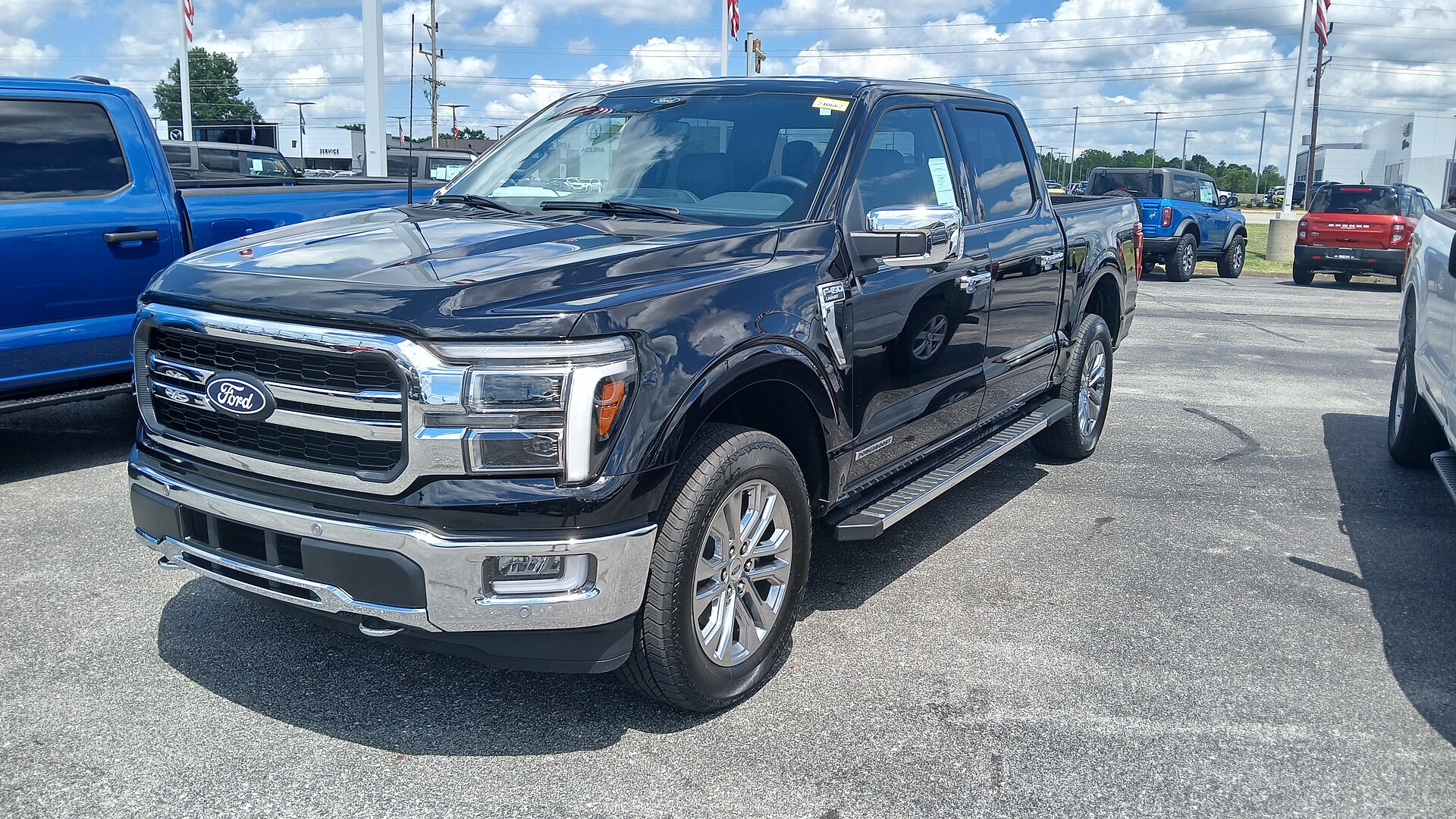
The current recall is documented in detail elsewhere on this site. On September 9, Ford told the National Highway Traffic Safety Administration that certain 2023-2027 F-150s may have a fuel tank that isn’t properly secured to the frame, with the potential to leak fuel or detach entirely while the truck is moving. NHTSA logged it as campaign 26V578000, covering 223,472 trucks. Dealers will inspect the fuel tank straps and replace them only if necessary, and owner letters go out September 21.
What hasn’t been reported anywhere is what happened the last time this exact failure showed up on this generation of truck.
On June 10, 2022, Ford filed a far smaller recall with NHTSA: campaign 22V414000, covering exactly one 2021 F-150. The agency’s public record is specific about both the count and the cause. “Potential Number of Units Affected: 1,” it reads, and the truck “may have been assembled without a fuel tank front attachment resulting in an unsecured fuel tank attachment strap.” Ford’s internal number for that case was 22S42. The remedy was the same kind of inspection Ford is running now: a dealer checked the bracket and repaired it, free of charge. Then the case closed, quietly, the way single-vehicle recalls almost always do.
Buyer’s guide: Best Accessories for Ford F-150 Owners
Both filings sit under the same federal defect category, fuel system, gasoline, and both describe a truck built without its fuel tank properly fastened to the frame. Nothing in Ford’s public filing for the 223,472-truck recall mentions the one-truck recall from 2022. That omission isn’t necessarily improper. It is, however, revealing. Either Ford never connected the two internally, or a single defective build in 2021 didn’t look statistically relevant to a defect trend that wouldn’t surface for another four years. Both explanations say something uncomfortable about how a lone bad build gets treated on a line that turns out hundreds of thousands of nearly identical trucks a year.
Most drivers assume a recall means thousands of vehicles, a wave of complaints, a press cycle. It doesn’t have to. Federal law sets no minimum population for a safety recall. A single vehicle, caught during a quality audit or a warranty claim, triggers the same disclosure machinery as a defect affecting a quarter-million trucks: a manufacturer filing, an NHTSA campaign number, an owner letter, a dealer remedy. Ford’s 2022 filing for one truck is proof the system works at that scale. It just doesn’t automatically ask whether that one truck was the leading edge of something larger.
That question falls to whoever bothers to look. NHTSA’s public recall search lets anyone pull the full history for a given year, make and model, organized by defect component rather than by root cause or supplier. Connecting two campaigns filed four years apart, describing the same failure, requires a person to sit down and decide the connection matters, because the tool itself doesn’t flag it. On a nameplate that sells in the hundreds of thousands of units every year, that kind of quiet repetition is exactly the sort of thing that’s easy to miss and expensive to catch late.
None of this means the two defects share an identical root cause. NHTSA’s public filings don’t say, and nothing here should be read as a claim that they do. What can be said is narrower, and still worth saying: the language Ford used to describe a fuel tank strap failure in 2022, and the language it used in 2026, describe the same physical failure mode, on the same generation of truck, roughly four years apart.
If you own a 2021 or 2022 F-150, outside the 2023-2027 window covered by this month’s recall, that doesn’t put you in the clear by default. It puts you outside this specific campaign. It’s worth running your VIN through NHTSA’s lookup regardless, and worth asking a dealer directly whether your truck’s build falls anywhere near the earlier bracket issue. Anyone shopping for a used 2021-2023 F-150 now has a new line item for the pre-purchase inspection: ask whether the fuel tank strap has ever been serviced under either campaign, and get the answer in writing.
A defect doesn’t need volume to be real. It only needs volume to get noticed. Ford caught this failure mode in a single truck four years before it caught it in 223,472 of them, and the distance between those two numbers is the real recall here.