
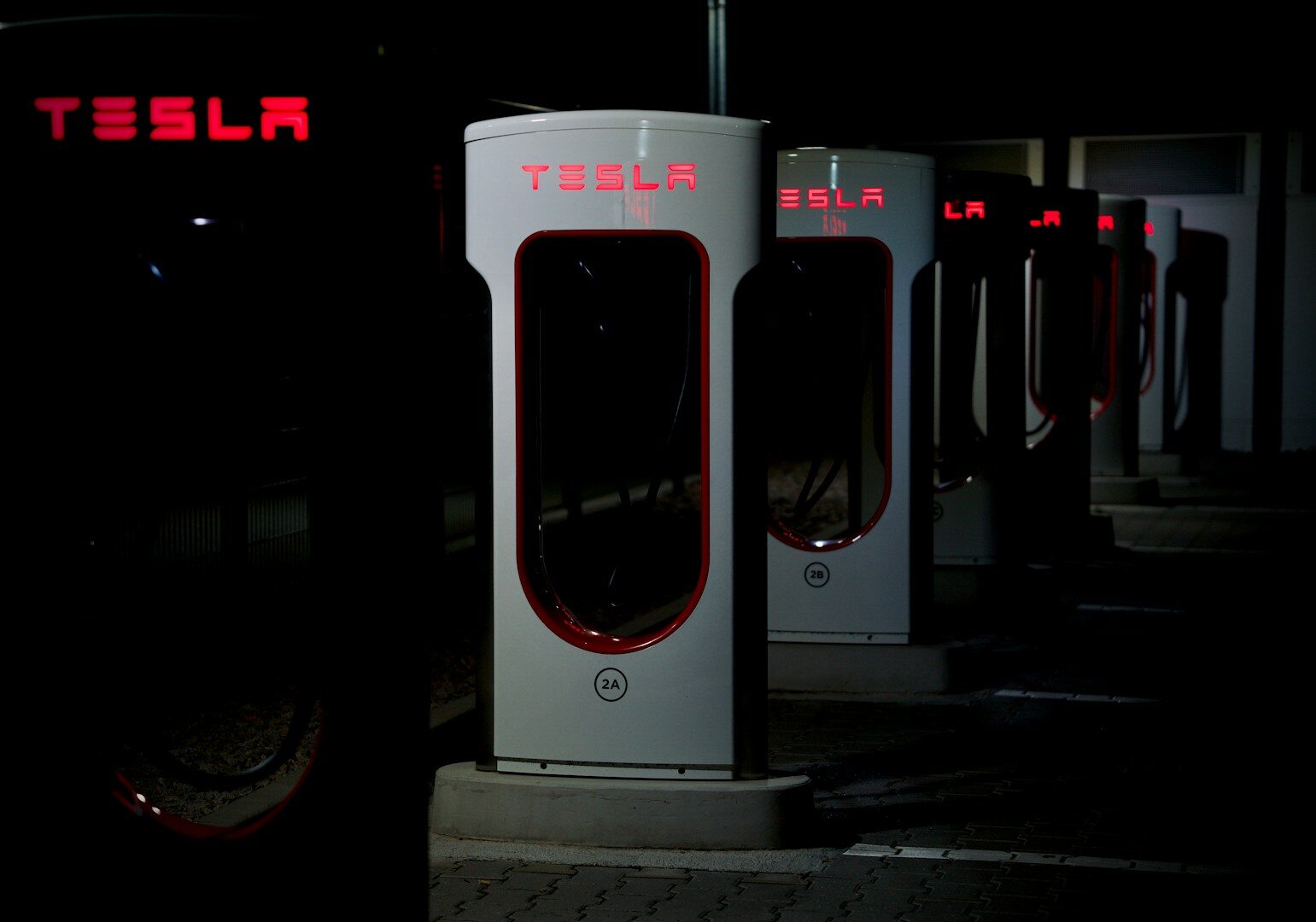
Vietnam has spent the past eighteen months assembling one of the most generous electric-vehicle tax regimes on the planet. It has also allowed its dominant fast-charging network to stay locked to a single brand. Tesla has now registered a company in Ho Chi Minh City.
Only one of those things is an invitation.
The entity itself is deliberately small. Vietnam’s national enterprise registration record lists Tesla Motors Vietnam LLC with charter capital of roughly 77.7 billion dong, about $3 million, registered to an address in central Ho Chi Minh City, with business lines covering the wholesale and retail of automobiles, parts and machinery. There is no announced showroom, no confirmed model, no launch date and no charging plan. Tesla delivered more than 480,000 vehicles in the second quarter of 2026 alone. Three million dollars is a rounding error against that.
That is the point. This is the cheapest legal structure that lets Tesla be ready.
Ready for a trade agreement that still has not been signed.
The line in the trade framework that matters more than any tariff
In October 2025, Washington and Hanoi announced a framework for a reciprocal trade agreement. Most of the attention went to the tariff math. Sitting in the U.S. Trade Representative’s own fact sheet is a commitment that should interest anyone who builds cars in America: Vietnam would remove tariffs on almost all U.S. goods, and would accept “vehicles built to U.S. motor vehicle safety and emissions standards.” The joint statement says the same thing. As of Hanoi’s own May 2026 update, the deal still is not finished.
Tariffs get the headlines. Homologation kills deals.
Here is the part most buyers never think about. Every country runs its own type-approval regime, and a vehicle that is street legal in Michigan is not automatically street legal in Hanoi. It has to be recertified against national standards: lighting and mirror geometry, glazing, braking performance, tire markings, noise, emissions labeling, sometimes child-seat anchorages and speedometer units. Each one is a test, a document and a fee, and the bill arrives before a single car is sold. Spread across 100,000 units a year, that is a line item. Spread across a pilot fleet of a few hundred, it can be the entire business case.
Accepting FMVSS and EPA certification does something a tariff cut cannot. It deletes the fixed cost of walking in the door.
Why that one clause is worth more to Tesla than to Toyota
Tesla currently retails in four Southeast Asian markets: Thailand, Malaysia, Singapore and the Philippines, according to its own location directory. Three of those drive on the left. Vietnam drives on the right, the same as the United States, which means a car built in Fremont or Austin does not need its entire interior architecture mirrored before it can be sold there. Right-hand-drive conversion is not a trim change. It is a different dashboard, a different wiring harness, different pedal-box geometry and, in many jurisdictions, its own certification work.
Now look at who Tesla would be competing against. Under the ASEAN Trade in Goods Agreement, completely built-up cars move between member states at zero import duty as long as at least 40 percent of their value originates inside the bloc. Any automaker with a plant in Thailand or Indonesia already ships into Vietnam duty free. Tesla builds cars in California, Texas, Shanghai and Berlin. It has no factory anywhere in Southeast Asia, and China-to-ASEAN trade rules do not hand passenger cars the same free pass.
So for Tesla, the trade framework is not a nice-to-have. It is the only route to price parity that does not involve building a factory.
Which makes one detail from last year easy to misread. Vietnam already cut car import duties once, in Decree 73/2025, taking two mid-displacement gasoline lines from 64 percent to 50 percent and a large-displacement line from 45 percent to 32 percent. Read the schedule and notice what is missing. Battery-electric passenger cars. A tariff cut widely understood as a gesture toward American exporters was written against engine displacement, and displacement is the one thing Tesla does not sell.
Vietnam is paying people to buy EVs. It is not guaranteeing they can charge them.
The demand-side policy is real and it is aggressive. On June 8, 2026, the government signed Decree 202/2026, holding the first-time registration fee for battery-electric cars at zero percent through the end of 2030. The special consumption tax on battery-electric passenger cars under nine seats sits at 3 percent, with the Ministry of Finance drafting an extension to keep it there until a proposed step up to 11 percent in 2031. Hanoi, separately, bans gasoline motorbikes inside Ring Road 1 starting July 1, 2026, with the restricted zone widening to Ring Road 2 by January 2028 and Ring Road 3 by 2030.
That is about as clear a signal as a government can send.
Now the other half of the equation. In March 2024, VinFast’s charging business was spun out into a company called V-Green, 90 percent owned personally by VinGroup chairman Pham Nhat Vuong rather than by the automaker, with a commitment of 10 trillion dong, roughly $404 million, over two years. That same announcement said V-Green would consider opening its stations to other manufacturers only “after about five years of operation.” VinFast’s own customer page is blunter still: charging service “only applies to customers using VinFast electric vehicles.”
Read that again. The dominant fast-charging network in Vietnam is not a utility, not a neutral third party, and not even strictly a carmaker’s asset. It is privately held infrastructure that turns away other brands by design.
Tesla has never entered a market on that footing. In the United States it owns the network and decides who gets in and when, which is why Ford’s access deal was treated as a landmark and why connector politics still shape what goes in your trunk. In Vietnam, Tesla would be the one knocking.
The rules building chargers are not the rules that let you use them
You might assume Vietnamese rulemaking will fix this, because Vietnam is genuinely moving on charging. National technical regulation QCVN 43:2024/BGTVT requires highway rest stops to set aside at least 10 percent of parking for electric vehicles, and the Ministry of Construction has pushed operators to finish installing charging systems before January 1, 2027. The Ministry of Industry and Trade has a draft national technical regulation for charging piles and stations out for public comment, covering electrical safety, fire protection, automatic shutoff during faults or flooding, and even minimum bay dimensions.
Look at what all of that governs. Capacity and safety. Not access.
Nothing in the published drafts obliges a charging operator to serve whatever vehicle pulls up, and nothing mandates a single national connector the way Europe did. Vietnam is making sure the chargers get built and that they do not catch fire. It is not, so far, making sure your car can use them.
What $3 million actually buys
Tesla’s international behavior over the past two years has looked less like conquest and more like keeping options open. First-quarter 2026 deliveries fell 6 percent year over year to 358,023 while the company pointed to demand growth across Asia-Pacific and promised to double its service footprint in Japan. Second-quarter deliveries came back above 480,000. We have watched the same pattern elsewhere, from quietly absorbing most of Canada’s Chinese-EV import quota to reading tariff schedules as carefully as it reads spec sheets.
Because $3 million in charter capital does not buy a service network, a parts depot, a homologation program or a single Supercharger stall. It buys the right to import, hire, sign a lease and open a bank account the week a trade deal is finalized, and the right to walk away quietly if it never is. In emerging markets the distance between “we have an entity” and “we have a business” is usually measured in years and hundreds of millions of dollars, as Volkswagen keeps rediscovering in India and as VinFast is rediscovering in the same country.
Tesla has not said it will sell cars in Vietnam. It has not said anything at all. That silence is entirely consistent with the size of the entity.
What to remember
A tariff is a number two governments can agree to change in a conference room. A charging network is a thing somebody already owns.
If the agreement lands on the terms the framework describes, Tesla gets the cleanest entry math it has had anywhere in Southeast Asia: right-hand traffic, U.S. certification accepted, tariffs stripped out, and a government holding the registration fee at zero through 2030. It will still have to answer the only question Vietnamese buyers will actually ask, which is where they plug the thing in.
Registering the company was the easy part.
If you were running this entry, would you spend the money on your own charging network before selling a single car, or sell first and gamble that the incumbent network opens up? And how far would a charging network have to be from your driveway before it killed an EV purchase for you?
Do you think Tesla can crack a market it can’t even charge in yet? Share your take in the comments.