
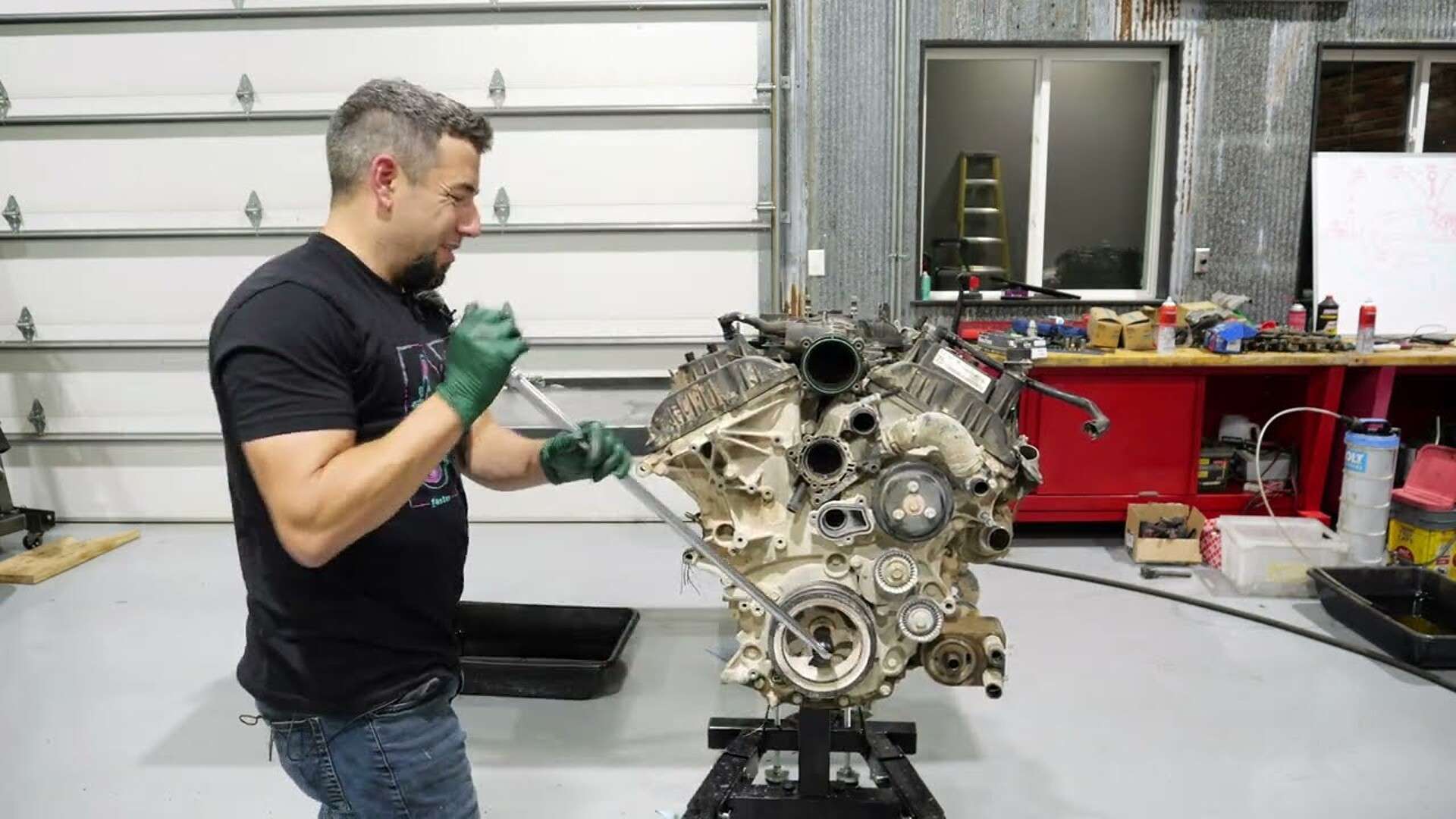
A 2022 Ford F-150 Lariat that rolled out of the factory in May 2022 had 180,000 miles on it about four years later, and its twin-turbo 3.5-liter EcoBoost V6 ended up on an engine stand in Missouri. The host of the YouTube channel I Do Cars, whose videos send parts buyers to Importapart, a used-parts seller in Hazelwood, took it apart on camera in a teardown posted in late September. Thirty minutes in, he pushed out a piston with a hole burned through the top of it and past the rings.
The truck is still working. Someone pulled this engine, put another one in, and sent the F-150 back out, which is how a four-year-old engine ended up in a parts recycler’s shop. Whoever owns that truck paid for the swap. Ford’s warranty ran out on this engine long before the piston did, and what the teardown shows about how the truck was run and repaired is the kind of evidence that decides who pays when an engine like this fails earlier.
@kieran25251325 2022 Ford F-150 3.5L Ecoboost Fails At 180K In FOUR YEARS! Is the 3rd Gen The Best One Yet #fordf150
Video: Region HP (@kieran25251325)/TikTok, excerpted from the original I Do Cars teardown on YouTube
What came out of the 3.5-liter EcoBoost
The engine arrived missing its right-side turbocharger, one ignition coil, and its oil filter, and caked in the kind of dirt he said looked like years of gravel roads. He was told it came out of a commercial vehicle and might still run. It turned over by hand, but with a steady resistance he didn’t like.
The first clue was under the passenger-side valve cover. The variable cam timing solenoids on that bank were new, genuine Ford parts, and not fully bolted down. The solenoids on the other bank were the originals, and their screens were coated in metal debris. His read was that someone had replaced a pair of solenoids to chase trouble codes without asking where the metal was coming from.
From there the wear stacked up. The cam caps were scored, which he tied to dirty oil or oil starvation. The oil pump housing and outer plate showed more wear than the vanes. The pistons wore a heavy layer of carbon, and the bores on one bank had the deepest wear in the engine. Then the rods came out. One piston had burned through from the crown down; in his words, it “torched right through the rings.” The aluminum it shed went into the oil and chewed up the rod and main bearings. The crankshaft survived with a polish, but the aluminum smeared into the cylinder walls means the block needs machine work, and he said that damage wipes out most of its value as a rebuild core.
Four ways to burn a piston, and one spotty oil change record
He didn’t claim to know the cause, and nothing in the video settles it. He didn’t know whether the truck was tuned, what fuel it ran, or what it was doing when the piston let go. He named the usual suspects: a tune, bad gas, a wastegate stuck closed and overboosting the engine, a failing direct or port injector, or an engine burning oil. The last one works through octane. Oil that gets into the combustion chamber lowers the fuel’s effective octane, so the mixture is more likely to detonate, and detonation hammers the piston crown, which sits directly in the fire. All of them come down to fuel or spark at the wrong time, or too much air for the fuel.
The maintenance history he pulled from Carfax doesn’t settle it either, but it doesn’t help the truck. He said some oil changes came every 5,000 to 6,000 miles, and some gaps stretched to 12,000 or 13,000 miles. He also pointed out that a missing record only means no one reported the service, not that it was skipped.
Ford sets a hard ceiling. The 2022 F-150 owner’s manual lets the Intelligent Oil-Life Monitor stretch intervals up to one year or 10,000 miles, then says: “Never exceed one year or 10,000 mi (16,000 km) between oil change intervals.” The same page lists driving in any dusty conditions, idling in traffic, and hauling heavy loads or towing as severe duty, which moves the truck onto the shorter severe-service schedule. A work truck coated in road dust fits that description. At Ford’s ceiling, 180,000 miles takes at least 18 oil changes. At the 5,000 to 6,000 miles the I Do Cars host said he’d use on this engine, it’s 30 to 36. With synthetic oil changes getting more expensive, fleet managers have a reason to stretch them, and this teardown shows what stretched intervals can leave behind.
Ford’s warranty stopped paying around month 16
The 2022 Ford Warranty Guide covers the powertrain for five years or 60,000 miles, whichever comes first. The list includes every internal lubricated part, the block, the cylinder heads, and the turbochargers, so a burned piston and the bearings it took with it would be covered on a truck inside the limits.
This truck averaged about 45,000 miles a year. At that pace it crossed 60,000 miles roughly 16 months after it was built, which left more than three years on the calendar clock and no coverage. That is the normal fate of a fleet truck, and it’s why companies that run high-mileage pickups buy extended service plans or budget for engines.
For an owner still inside 60,000 miles, the same teardown evidence would decide the claim. Ford’s warranty guide says skipping the maintenance in the owner’s manual voids coverage on the parts that lack of maintenance affected, and it excludes damage from performance chips, performance software, and non-Ford software. Ford also recommends keeping every maintenance record and receipt for its review. Federal law limits how far that goes. Under the Magnuson-Moss Warranty Act, the Federal Trade Commission says a dealer can’t deny coverage because an independent shop did the routine maintenance, and a manufacturer has to prove an aftermarket part caused the damage before it refuses to pay. The FTC also tells owners to keep records of oil changes and other service, because those records are what show a vehicle was maintained when a claim is disputed. On a truck whose history showed 12,000- and 13,000-mile gaps, the owner would be arguing against Ford’s own manual.
Federal records show one engine, not a pattern
I went through the National Highway Traffic Safety Administration’s files for the 2022 F-150. The agency has logged 594 owner complaints on the truck, the most recent filed Sept. 23, 2026. By my count, 41 involve the engine, and none describes a burned or holed piston. The engine recalls don’t point at the 3.5 either. Recall 24V635000 covers intake valves that can break in 2.7- and 3.0-liter EcoBoost engines, 90,736 vehicles across six models. Recall 25V455000 covers low-pressure fuel pumps that can fail and stall the engine.
That’s a different picture from the F-150’s 5.0-liter V8, where a judge let an oil consumption lawsuit proceed. The I Do Cars host said this was the first third-generation 3.5 EcoBoost he had ever torn down, so he had nothing to compare it to, and a single engine with an unknown tune status and an uneven oil record can’t indict the design. What the teardown does support is narrower. A 2022 truck driven 45,000 miles a year on a stretched oil schedule came apart in the ways dirty oil and heat take engines apart, and one cylinder failed badly enough to end the engine.
What happens to the truck and the engine now
The engine is being sold off in pieces; he said he hopes the good parts recover some of what it cost him. The truck is still on the road with a different engine, and if it’s ever sold, the buyer will be looking at 180,000-plus miles, an engine swap, and a vehicle history showing oil change gaps past Ford’s 10,000-mile limit, the same facts a warranty claims reviewer would weigh.
If this F-150 showed up on a used lot with a newer engine and those oil change gaps on its history report, would the fresh engine make it worth buying, or would the maintenance record send you to the next truck?
Top photo: Image: I Do Cars/YouTube.