
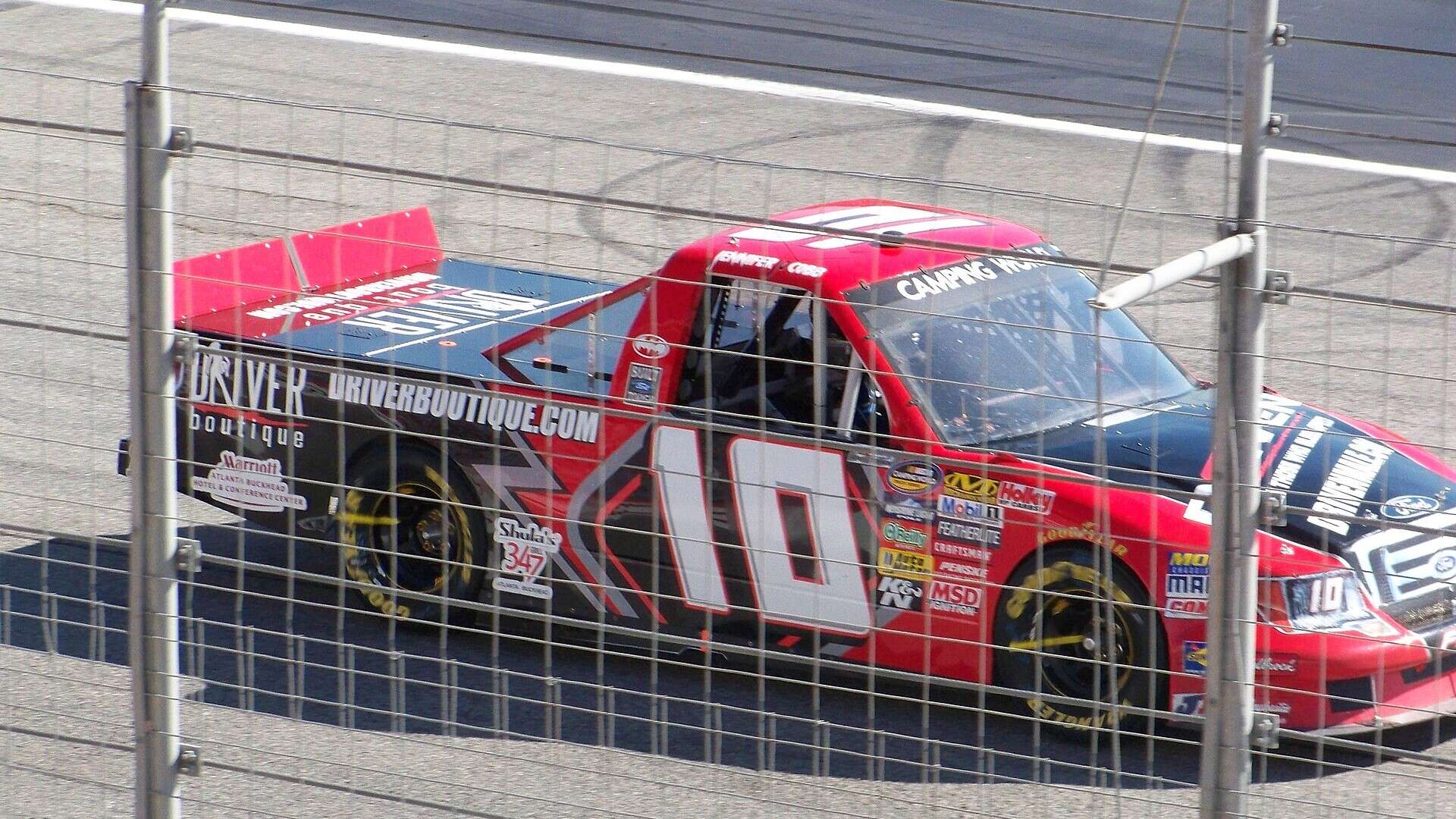
Jennifer Jo Cobb spent most of two decades doing one of the hardest jobs in NASCAR: keeping an underfunded team on track mostly through stubbornness. A Davidson County jury has now handed her a bill roughly six times what her trucks earned in posted winnings in 2013.
On Sept. 24, after a three-day trial in Lexington, N.C., jurors found the former Truck Series owner-driver liable to Tracey Hughes on two claims most of the country dropped generations ago: alienation of affection and criminal conversation. They awarded $50,000 on the first, $800,000 on the second, and $1 in punitive damages on each, for a total of $850,002.
Hughes’s ex-husband, Clayton Hughes, was Cobb’s longtime spotter. The suit, filed Jan. 5, 2024, alleged that Cobb pursued a relationship with him in the months before the couple separated in January 2021, after about 17 years of marriage, including during race travel. Cobb denied the allegations. She has said publicly that the fight continues because no judgment has been entered.
Why the spotter detail matters
A spotter isn’t a pit-road extra. He stands on the grandstand roof with a radio and serves as the driver’s eyes for every lap, calling traffic high, low, and clear. On a small team, the spotter is often one of only a handful of people who travel every weekend. That closeness is what the complaint relied on, with allegations about contact tied to racing trips in several states.
The résumé versus the bill
Cobb’s career record shows a Kansas City native born in 1973 who spent most of her national-series career fielding her own trucks. Her ownership ledger tells the money story. In 2013, 16 starts produced $138,239 in posted winnings. That is gross purse money, before engines, tires, fuel, travel, and payroll. Her last national-series starts were two races in 2024. Set those numbers next to $850,002 and it’s not hard to see why she’s still fighting.
Why this happens in North Carolina and almost nowhere else
North Carolina still recognizes these “heart-balm” suits, and G.S. 52-13 sets the rules. Conduct after spouses physically separate with intent to stay apart doesn’t count. Suits must be filed within three years of the defendant’s last act. A January 2021 separation and a Jan. 5, 2024 filing put Hughes inside that window with very little room to spare.
The two claims work differently. Alienation of affection requires proof of a genuine marriage, proof that the affection was destroyed or diminished, and proof that the defendant’s wrongful conduct caused that loss. Criminal conversation is blunter: sex with a married person during the marriage. That difference is why the split in the award stands out. The jury put 16 times more money on the simpler claim than on the emotional collapse. Expect that ratio to show up in any post-trial motion arguing the damages are excessive.
Related Articles
- Newsom Signed Four California DUI Laws. One Doesn’t Kick In Until 2031.
- Illinois Motorcycle Pursuit Started Next to a Gas Station and Ended About a Minute Later on an Empty Tank
Cobb argued early on that the law itself is unconstitutional, and the court denied her motion to dismiss in December 2024. That argument was always a long shot. In 2017, the Court of Appeals rejected a challenge claiming both torts were facially invalid under the First and Fourteenth Amendments. The court was openly skeptical of the torts’ origins, though, and left room for challenges based on different facts.
There’s a repeal bill. It won’t help her. Senate Bill 836, filed April 27, 2026, would repeal G.S. 52-13 and abolish both claims outright. The bill also says it doesn’t affect cases pending when it becomes law. Even if it passed tomorrow, it would not help Cobb.
What $850,002 actually means
- Insurance probably won’t cover it. Personal liability coverage on homeowners and umbrella policies is generally written around accidental bodily injury and property damage. Intentional conduct is a standard exclusion.
- Bankruptcy isn’t automatic relief. Federal law blocks discharge of debts for “willful and malicious injury.” The Supreme Court’s reading in Geiger requires intent to cause injury, not just an intentional act. Whether a heart-balm verdict meets that bar would have to be fought out in bankruptcy court.
- The $1 punitive awards send a signal. The jury found the conduct crossed the punitive line, then chose not to pile on.
The paddock takeaway
Racing runs on long weekends, shared hotels, and people who spend more time with each other than with their families. North Carolina is the sport’s industrial heartland, and there that lifestyle carries legal exposure that doesn’t exist in most states. Cobb can still file post-trial motions and appeal. Until a judge enters judgment, $850,002 is a verdict, not a payment.
Images Via: Wikipedia
The jury valued the affair at 16 times the heartbreak. Should a court be pricing either one?
Top photo: Jennifer Jo Cobb’s No. 10 truck at Atlanta Motor Speedway in 2010. Photo: WSU93 via Wikimedia Commons (CC BY-SA 3.0).
