
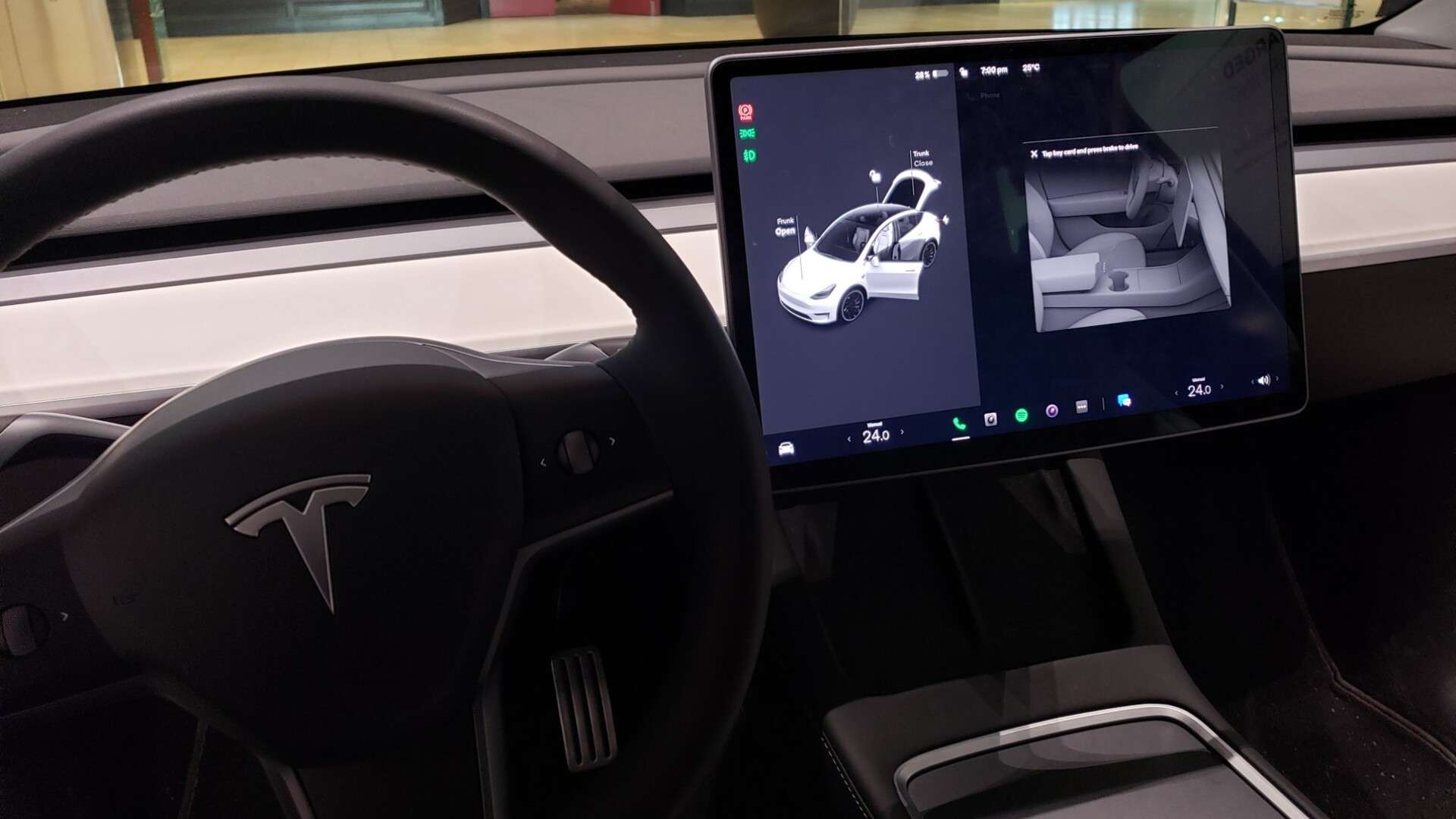
After a head-on crash, a Tesla Model 3 owner says his car lost power and caught fire, the electric door handles died, and he never found the mechanical release. He climbed out a rear window. That’s the account in a notice the National Highway Traffic Safety Administration filed July 23 and published the next day in the Federal Register, denying his request for a defect investigation.
The notice, signed by Associate Administrator for Enforcement Eileen Sullivan, rests on three points. As of March 13, NHTSA’s databases held one complaint alleging a concealed, unlabeled release among 179,031 subject vehicles, and that complaint came from the petitioner’s own VIN. (The agency’s opening resume in December listed 179,071.) Second, NHTSA wrote that the federal door-lock standard has no requirements on the labeling or location of a mechanical door release. Third, a separate petition it received November 4, 2025, asking for a new standard, was granted, and NHTSA said it will start a rulemaking on what it called a “robust and obvious door egress system in all motor vehicles.” The notice gives no timeline for that proceeding.

One complaint decided the file
A defect petition asks NHTSA’s Office of Defects Investigation to open a case. Under 49 CFR Part 552 the agency has to grant or deny it, and a denial gets published with reasons. Here the reason was that the data did not point to a likely safety-related defect, and the data was one complaint.
That count measures people who tried the release, failed, and then filed a report with NHTSA. A mechanical door release is used once, if ever, at the worst possible moment, so a complaint search says little about how many of the 179,031 owners could find the lever in the dark. I read that as a mismatch between the tool and the question; NHTSA’s notice does not say it, and it did not say the release is safe either. It said the issue is better handled by rule.
The standard it pointed to, FMVSS No. 206, covers door locks and door retention components. With nothing in it about labeling or placing the release, there was no requirement for the Model 3 to fail, which left only a general-defect argument resting on a single report.
A new rule does not reach cars already built
Federal safety standards apply to vehicles manufactured after a rule takes effect (49 U.S.C. § 30112). A rulemaking that starts now can, at the earliest, set requirements for future cars. The 2022 Model 3s already on the road would change only if NHTSA found a defect and a recall followed, which is the step the agency just declined to take.
The other Tesla door file moved on nine complaints
NHTSA does open door cases when complaints stack up. On Sept. 15, 2025, it opened preliminary evaluation PE25010 into 174,290 2021 Model Ys whose door handles stop working when the 12-volt battery runs low. The resume cites nine owner questionnaires, four of them describing a broken window to get back into the car, and records no crashes, fires or injuries. NHTSA opened that investigation on nine owner questionnaires and denied this petition on one complaint. The two problems differ, since one concerns getting into a parked car and the other getting out of a crashed one, and NHTSA’s stated reason for the denial was rulemaking, not severity. Different defects, but the count did a lot of the steering. The Auto Wire has also covered a lawsuit alleging Tesla’s electronic door handles trapped a couple in a fatal Washington crash and Tesla’s recall over door handles in China.
Where Tesla’s manual puts the release
NHTSA’s notice says the 2022 owner’s manual describes a front-door release in front of the window switches and that the lever in its illustration carries no label. Tesla’s current Model 3 manual page, “Opening Doors with No Power,” tells owners of newer cars to pull up a lever in front of the window switches. For the rear doors it describes a mechanical release behind a cover in the door pocket, reached through a slot at the bottom, with a cable pulled forward. The page says not to use the manual release while the car is moving, and to use the button at the top of the interior handle when the car has power. It describes the current car; the 2022 manual is the one NHTSA reviewed. Tesla’s response to the petition is not in the Federal Register notice.
What happens next
The rulemaking has no published date. Until a proposal appears, the only federal text on the subject is a standard that, in NHTSA’s own reading, is silent on whether a release has to be marked or where it has to be. Automakers and the public can file comments once a proposal is published.
Without looking: could you find the manual door release in your own car, in the dark, with the power out? Where is it?