
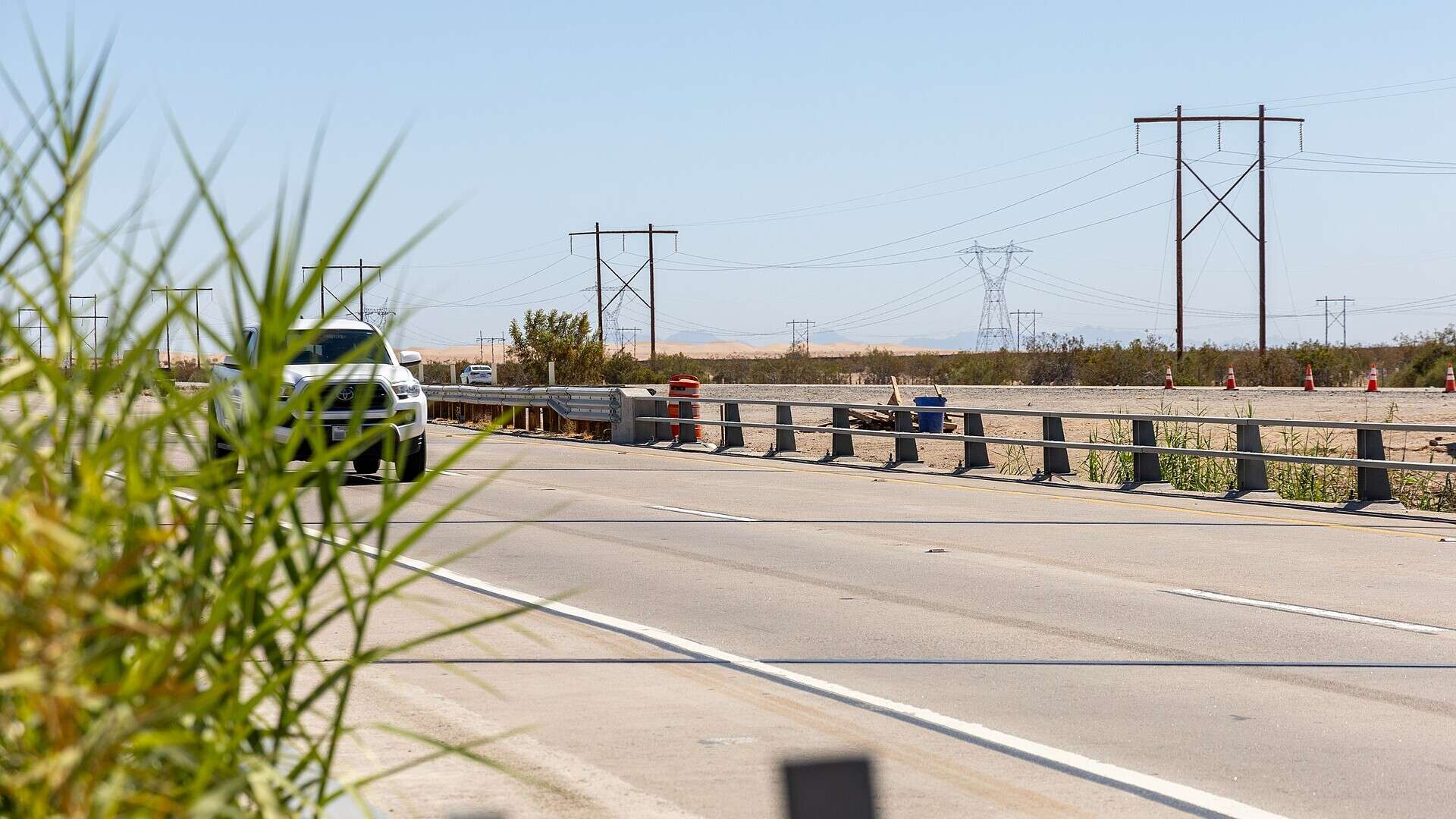
A Bexar County sheriff’s deputy held Alek Schott, an oilfield equipment salesman from the Houston area, on the shoulder of Interstate 35 for 76 minutes in March 2022 after a camera flagged his truck. A federal jury in San Antonio has now found the county liable for it. The jury’s verdict, dated Sept. 28 on the court docket, awarded Schott $76, a dollar for every minute of the stop, which is the amount Texas Public Radio reported he sued for.
A stop that started with cameras
According to the Institute for Justice, the law firm that represented Schott, he drove from his home near Houston to a well pad outside Carrizo Springs on March 15, 2022, spent the night at a hotel, and headed home in his Ford F-250. Cameras operated by the federal government flagged the truck. The tip reached the Bexar County Sheriff’s Office through a WhatsApp group chat called the “Northwest Highway Group,” and Deputy Joel Babb testified that it came from a man he knew only as “Kiki,” whom Babb believed worked at a federal fusion center in Laredo.
Babb waited on the shoulder, followed the truck, and stopped it. He told Schott the reason was that the truck had drifted across the fog line. IJ says the evidence shown at trial showed it never did. Schott was questioned in the front seat of a patrol car, and a drug dog alerted on his truck. IJ says deputies found nothing. Schott said in IJ’s release that he filed a complaint with the Sheriff’s Office afterward and that the department reviewed it, found no violation, and told him to sue if he had a problem. The Sheriff’s Office told Texas Public Radio it does not comment on active lawsuits and referred questions to the Bexar County District Attorney’s Office, which had not responded by publication time.
Why one stop was enough to hold a county liable
A county does not pay for a deputy’s bad stop just because the deputy made it. Schott sued under the federal civil rights statute, 42 U.S.C. § 1983, and under the Supreme Court’s 1978 decision in Monell v. Department of Social Services he had to show that the county had a policy or custom behind what happened to him. IJ’s release spells out the elements: a practice of stopping and searching drivers this way, a sheriff who knew or should have known about it, and a link between the practice and Schott’s stop. The jury, according to IJ, agreed on all of it and found the practice violated Schott’s Fourth Amendment rights.
IJ describes the practice as a five-step pipeline: cameras log plates, analysts or tipsters flag ordinary travel such as driving toward the border and back, deputies invent a traffic violation, drivers are questioned and asked to consent to a search, and a dog alert supplies probable cause when they refuse. IJ says it ran for four years and reached thousands of drivers. The county has not responded publicly to that description.
The fog line carries the whole stop
Pretext stops are legal. In Whren v. United States, a unanimous 1996 decision written by Justice Antonin Scalia, the Court held that a stop supported by probable cause of a traffic violation is reasonable even if the officer had another motive, because “Subjective intentions play no role in ordinary, probable-cause Fourth Amendment analysis.” An officer can be after something else entirely, as long as the lane violation, the missing turn signal, or the burned-out bulb actually happened.
That makes the claimed violation what the stop stands on, and it explains why Schott’s case turned on whether he crossed the line. The ACLU says dashcam footage contradicted Babb’s claim and that the deputy later admitted it was bogus. The second limit comes from Rodriguez v. United States, a 2015 decision: a stop can be held no longer than the traffic mission requires, and a dog sniff is not part of that mission. Extending it needs reasonable suspicion of something else, and a drive to the border and back is the only suspicion this record describes.
Where the ACLU’s new report fits
Schott’s stop predates the products the ACLU’s Jay Stanley wrote about on Oct. 26. In that post, Stanley says Flock Safety began advertising in July 2025 that it could alert police to drivers with “suspicious” travel patterns and track which vehicles are frequently seen together, and that Wired later obtained files describing a next-generation system open to wide-ranging queries of plate data. Neither IJ’s release nor the ACLU names a camera vendor in Schott’s stop; IJ describes the cameras as federal. Stanley cites the verdict as an example of where the approach leads, along with a driver he identifies as Grace Knowles, who said an officer pulled her over in September 2025 for being in the left lane too long and then told her, as she recalled it, that a plate scan had shown “suspicious travel patterns.” Flock’s response is not included in the ACLU post.
The plate data behind all of this has its own rules about how long it is kept and whether a warrant is needed to search it, and those fights are being settled one state at a time.
What happens next in San Antonio
The $76 is the smaller part of the case. IJ says it will ask U.S. District Judge Orlando Garcia to enjoin Bexar County from using baseless traffic stops as a route to warrantless searches, and that it is prepared to sue on behalf of other drivers treated the same way. A county appeal has not been reported. Until the judge rules on the injunction, the verdict covers one stop and the county practice behind it.
Driving toward the border and back for work was enough to get Schott flagged. What does your own commute look like to a camera network, and how would you ever find out?