
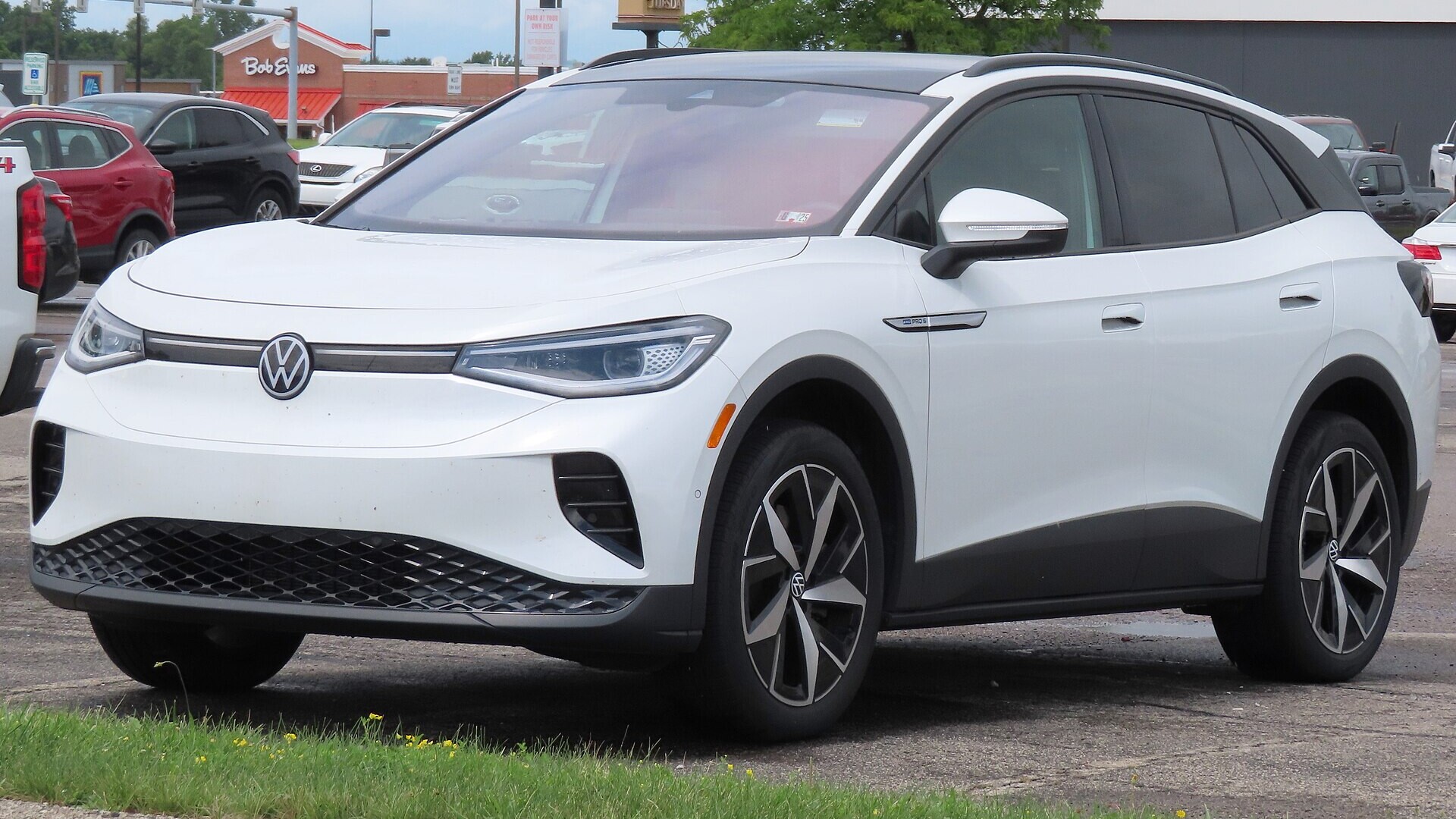
Researchers at PCA Cyber Security took over a Volkswagen ID.4 through its Bluetooth connection in their lab in Budapest, Hungary, the same model Volkswagen told 22,524 U.S. owners this fall to stop charging past 80% over a fire risk. Once in, they followed the car’s location, recorded a conversation inside it, read messages and contacts from the paired phone, and switched the heater, wipers and sunroof on and off, according to The Times of London, whose reporters watched the demonstration.
Volkswagen is now rolling out a fix for older ID. models. PCA’s disclosure record says the firm told Volkswagen’s incident response team on June 19, 2024, that the flaw worked on an ID.4. That is nearly two and a half years before the fix began reaching those cars this month.
What PCA did to the ID.4 in Budapest
The attack uses four bugs PCA calls PerfektBlue, all in BlueSDK, the Bluetooth software OpenSynergy licenses to infotainment suppliers. PCA’s public advisory lists them as CVE-2024-45431 through CVE-2024-45434. The worst, CVE-2024-45434, is a use-after-free bug in the service that handles audio remote-control commands, rated 8.0 on the CVSS 3.1 scale. Chained together, the four let an attacker run code on the head unit with the permissions of its Bluetooth process, and from there, the advisory says, escalate privileges and move to other components.
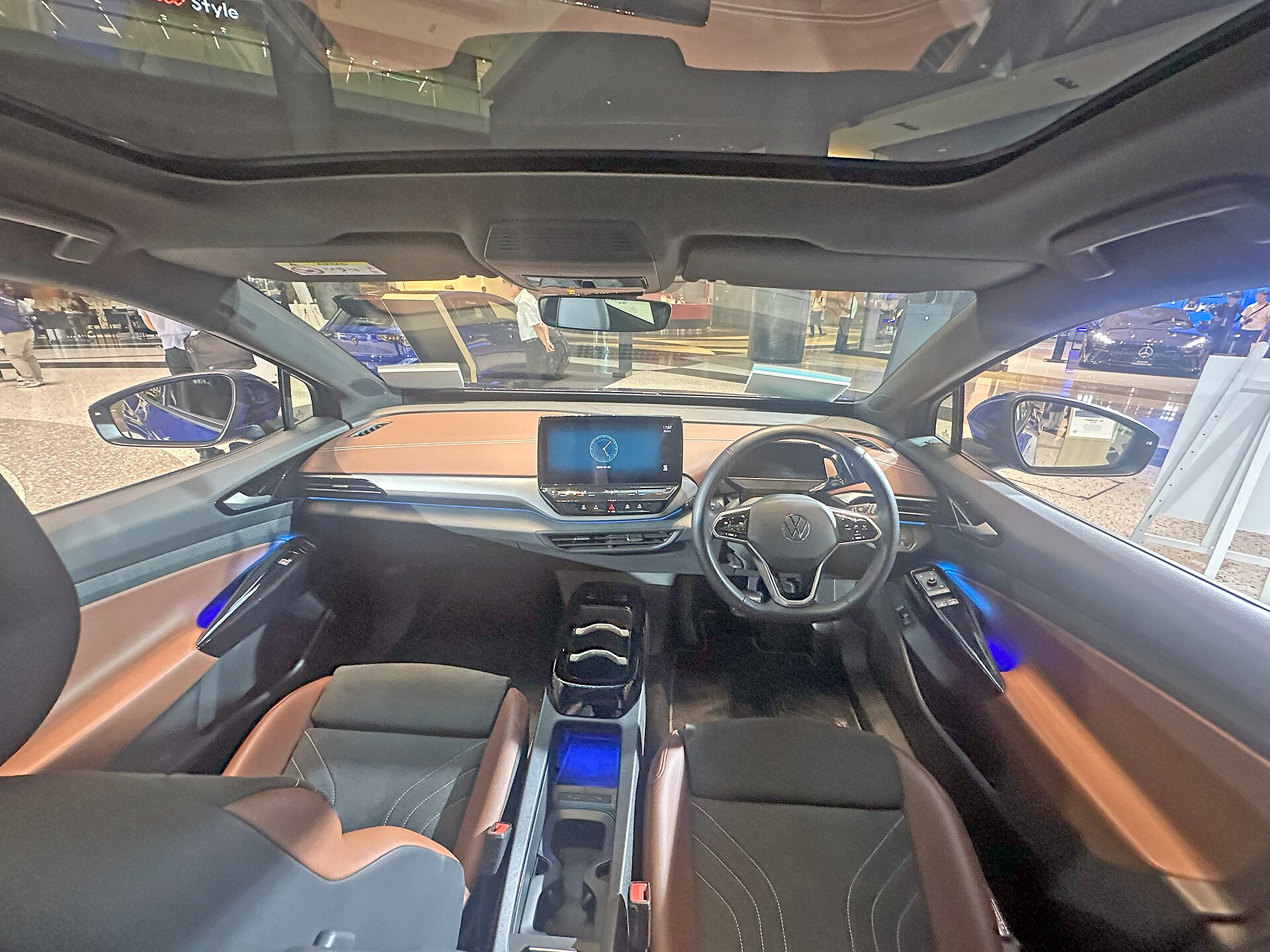
The target was the ICAS3, the computer behind the center screen in Volkswagen’s MEB-platform ID. models. PCA lists two ICAS3 software builds it broke into: part number 10A035816E running firmware 0792, which it labels ID. software 2.1, and part number 10A035816J running firmware 0561, labeled ID. software 3.2.12 and dated December 2023.
On the units PCA tested, the bugs were reachable only after pairing, and the advisory calls the exploit a “1-click” attack without saying what the click is. Germany’s heise online, which got Volkswagen’s response, reported that the driver has to accept a Bluetooth pairing request first. Decline it and the infotainment system stays out of reach. PCA’s advisory adds that some devices built on BlueSDK may be exposed before pairing, depending on the security mode the developer chose.
Once paired, the reach goes past the radio. According to heise’s account of The Times report, the researchers tapped the car’s hands-free microphone to record what was said inside. Earlier this month, at the Nullcon security conference in Berlin, PCA researchers Radu Motspan and Abdellah Benotsmane presented a longer chain against the ID.4 under the title “Hypervisor? IDS? A silent Head Unit takeover with physical impact on modern EVs.” PCA promoted the talk as combining Bluetooth and Apple CarPlay flaws to take over the head unit and get past the car’s internal security boundaries.
Volkswagen’s account, and the dates that don’t match it
Volkswagen told heise that its customers’ and vehicles’ safety was never at risk, and that an attacker could not reach the steering, brakes or accelerator. It said the bugs affect an older generation of infotainment software, that it fixed them quickly on ID. models running software newer than version 5.0, and that the older software needed additional changes and security checks before an update could ship. heise reported that Volkswagen is fixing the cars without a recall.
PCA’s disclosure log gives this timeline:
- May 17, 2024: PCA first contacts OpenSynergy.
- June 19, 2024: PCA confirms the chain on an ID.4’s ICAS3 unit and informs Volkswagen’s incident response team.
- September 2024: OpenSynergy says it shipped patches to its customers.
- Oct. 31, 2024: PCA confirms the bugs in a Skoda Superb’s MIB3 unit and informs Volkswagen again.
- July 7, 2025: PCA publishes the advisory.
- November 2026: Volkswagen begins rolling out ID. software 3.9.1 for older cars.
Counted from public disclosure, owners of older ID. models waited about 16 months, which is the figure heise used. Counted from the day Volkswagen’s own security team heard about it, they waited about 29 months. The advisory records no Volkswagen reply after the October 2024 notice.
The supplier wasn’t the slow link. OpenSynergy had a patch out within about four months of PCA’s first contact. PCA says that by June 2025 not every carmaker had received it, which it blames on long supply chains, and BMW, another BlueSDK customer, told PCA it had never received a vulnerability notice or patch through its suppliers. Volkswagen did know. What took time was getting a fix into software it was no longer developing.
Volkswagen’s own release notes for 3.9.1 lead with battery preconditioning for faster DC charging, better battery temperature management and a door-handle fix. The security work appears as one line about important security updates, with no mention of Bluetooth, eavesdropping or location tracking. An owner reading those notes would have no idea the update closes a hole that let someone listen to the cabin.
Which ID. owners need the update, by software version
Volkswagen’s guidance, as reported by heise, depends on the software generation:
- Below version 4.0: version 3.9.1 fixes the flaw and installs over the air while the car is parked, over cellular or Wi-Fi.
- Version 4.0 and above but below 5.6: the update has to be installed at a dealer.
- Version 5.6 or later: not affected, according to Volkswagen.
Those version numbers come from Volkswagen’s European statements. American ID.4s are a separate case. A Volkswagen technical service bulletin filed with NHTSA in February 2025, 91-25-02, confirms that 2021 through 2023 model-year U.S. ID.4s carry the ICAS3 head unit. In April 2024, Volkswagen of America ran service action 97H1 to bring 2021 ID.4s up to software level 3.2.12. That is the version PCA lists for one of the two ICAS3 units it compromised.
Since then, Volkswagen of America has sent U.S. ID.4s an over-the-air update to version 3.8.11, released in waves starting in the fall of 2025 according to a Sept. 30, 2025, dealer notice. The owner email filed with NHTSA says 3.8.11 provides enhanced IT security. The notices filed with NHTSA that I found don’t name Bluetooth or PerfektBlue, and I found no public statement from Volkswagen on whether 3.8.11 closes these bugs or whether U.S. cars will get 3.9.1. That remains unconfirmed.
Even an over-the-air fix has strings attached. Volkswagen’s U.S. software update page says OTA updates require the myVW app and acceptance of the myVW and Car-Net terms of service. An owner who never signed up for the connected services, perhaps to keep the car from sharing data, won’t get the update over the air.
Why U.S. law doesn’t force a recall or a notice
Volkswagen’s line that safety was never at risk carries legal weight. Under the federal vehicle safety law, a carmaker must recall a vehicle and notify owners when it has a defect related to motor vehicle safety. A flaw that exposes your location and your conversations, but not your brakes, is a privacy failure, and nothing in that law requires a carmaker to send owners a letter about a privacy failure.
There is a precedent for when a hack crosses that line. On July 23, 2015, Fiat Chrysler filed recall 15V-461 covering about 1.4 million 2013–2015 vehicles with Uconnect radios, after researchers showed the radios’ software vulnerabilities could let outsiders reach some networked vehicle control systems, as NHTSA’s file describes it. PCA’s Nullcon talk title promises “physical impact,” but nothing published so far shows the ID.4 attack reaching steering, braking or acceleration, and Volkswagen says it can’t.
Below the recall threshold, U.S. rules are voluntary. NHTSA’s 2022 Cybersecurity Best Practices for the Safety of Modern Vehicles tells carmakers to track and fix known vulnerabilities, but the agency’s own Federal Register notice says the guidance does not have the force and effect of law. Europe goes further. UN Regulation 155, mandatory for all newly produced vehicles in the EU since July 2024 according to Britain’s Vehicle Certification Agency, requires carmakers to run a certified cybersecurity management system. Congress’s recent connected-car fights have centered on Chinese software and hardware, not on how fast any carmaker patches the cars already on the road.
Volkswagen isn’t the only exposed brand. PCA’s advisory confirms the bugs on a Mercedes-Benz NTG6 head unit and a Skoda Superb’s MIB3 unit, and found an information leak on two BMW models. PCA’s log shows it informed Mercedes on Nov. 5, 2024. The researchers estimate several hundred thousand Volkswagens are affected, according to The Times. Volkswagen has not published a number.
What ID.4 owners can check now
The attack depends on a paired device, so the cheapest protection is the one Volkswagen recommends: don’t accept a Bluetooth pairing request you didn’t start, and don’t connect devices you don’t know. Check the software version in the myVW app or in the vehicle’s update menu. If it’s below 4.0 and no update is waiting, ask Volkswagen whether one is coming for your car. If it’s 4.0 or higher but below 5.6, plan on a dealer visit. Shopping for a used ID.4? Ask for the installed software version before you buy, because an unpatched car stays unpatched until someone installs the update.
The next move belongs to Volkswagen of America. It has the version history for every U.S. ID.4, and it hasn’t said whether 3.8.11 closed PerfektBlue or whether 3.9.1 is coming to American cars. Car apps already leak more about owners than most realize, and an ad tracker can’t hear what you said at the last red light.
ID.4 owners: what software version is your car on right now? And did anyone at Volkswagen ever tell you why that number matters?