
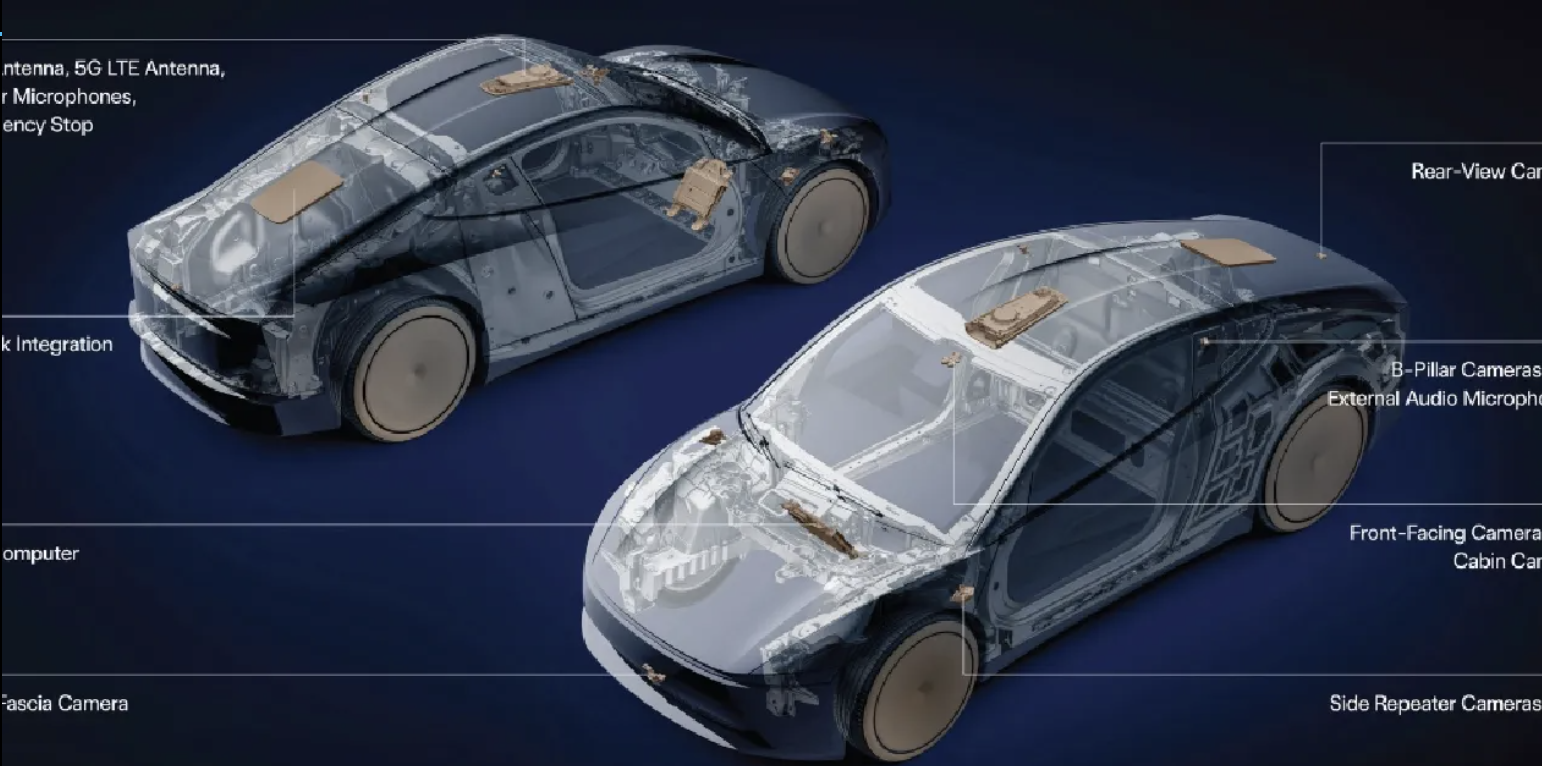
Tesla dropped a hardware reveal that reads like a solution in search of a problem: its purpose-built robotaxi, the Cybercab, will ship with a Starlink dish baked into it. The company posted a cutaway on July 20 with the caption “Starlink V5 directly integrated in Cybercab,” slotting the satellite terminal in among the eight cameras, dual GPS antennas, 5G LTE modem, cabin microphones, emergency-stop button, and Full Self-Driving computer. SpaceX’s Starlink account ran the same diagram with the tagline “High-speed internet from space for the future of autonomous vehicles.” Sounds momentous. Then you start asking what the dish is actually for, and the story gets more interesting than the marketing.
Here’s the mechanical reality that the “internet from space” framing quietly skips over: a Cybercab does not need any connection to drive. Tesla’s autonomy stack is vision-only and runs inference locally on the car’s AI4 computer. Cameras in, path-planning and control out, all on silicon bolted to the vehicle. Cut every antenna on the roof and the car still perceives, plans, and drives. That’s not my interpretation — it’s Tesla’s whole architectural bet, and the company’s own AI VP, Ashok Elluswamy, said as much when the questions started rolling in. The satellite link, he wrote plainly, “is still not required for safe operation of the vehicle. Connectivity is primarily meant for navigation, customer service and, in general, fleet management.” So the headline feature isn’t a safety system and isn’t a driving system. It’s plumbing for the fleet operator and, per Elon Musk’s own follow-up posts, a way to feed riders 4K video on the ride.
Related Articles
- California Rewrote Its EV Rebate Just for Rivian. Rivian’s Sales There Cratered Anyway.
- Georgia’s Gas Prices Are Rising Faster Than the Rest of the Country. Blame the Pipeline, Not the Persian Gulf.
Fine — connectivity does real work. Remote support for a car that gets itself wedged, dispatch and routing, over-the-air updates, telemetry upload, and passenger streaming are all legitimate. None of that keeps the car on the road, but a driverless taxi that loses its uplink in a genuine dead zone is a stranded asset, and a satellite fallback is a reasonable hedge against that. The trouble is geography.
Satellite’s entire advantage is filling gaps where cellular thins out — rural highways, canyons, the empty middle of the map. Look at where Cybercabs would actually pick you up, though. Tesla just switched on Orlando and Tampa, adding to Austin, Dallas, Houston, and Miami, with the Bay Area still running supervised. Those are dense metros with some of the best 5G coverage in the country. In every place this robotaxi operates today, the satellite link is answering a coverage problem the car doesn’t have. Tesla is nowhere near the remote territory where a Starlink terminal earns its keep, and the fleet isn’t exactly straining at the leash to get there — independent tracking via Robotaxi Tracker pegs the unsupervised count at roughly 17 cars in Austin, down from a peak near 29, four in Dallas, and Houston hovering at zero. The map keeps growing. The garage doesn’t.
There’s a hardware wrinkle worth flagging, too. The V5 that SpaceX unveiled in mid-July is a residential kit — a “home internet” terminal built to sit still on a roof, rated around 375+ Mbps and drawing 35 to 50 watts. It’s smaller and far more power-efficient than the V4, which is exactly why it’s plausible in a car, but it wasn’t designed for a vehicle threading between overpasses and tree cover at 45 mph, where a low-earth-orbit dish has to constantly reacquire satellites through a shifting sky. That also implies an engineering constraint most people won’t notice: a metal or glass roof would block the signal, so a satellite-integrated Cybercab needs a radio-transparent panel over the antenna. This isn’t a bolt-on; it shapes the roof.
Related Articles
- Jeep and Ram Just Got New CEOs Who’ve Never Built a Car. That’s the Whole Point.
- Cadillac’s All-Electric Future Is Dead. Long Live the XT6 Nobody Asked to See Again.
So why announce it now, for a car that isn’t carrying paying passengers yet and doesn’t need the dish to drive? Follow the corporate plumbing. Tesla put about $2 billion into xAI in January, per its own filings. Weeks later SpaceX absorbed xAI in an all-stock deal that ranks as the largest private merger ever, valuing the combined company north of a trillion dollars — and Tesla’s xAI stake converted into SpaceX stock in the process. Musk’s companies are financially braided together. Against that backdrop, standardizing a Starlink terminal into every future Cybercab isn’t just a feature; it’s a recurring subscription line, paid by Tesla’s fleet, flowing to SpaceX. When the vehicle that’s supposed to become Tesla’s highest-volume product carries a mandatory satellite radio from a sister company, that’s a revenue pipe with a lot of throughput.
The practical takeaway for anyone watching this space: don’t read the Starlink dish as a leap in autonomy, because it isn’t one, by Tesla’s own admission. Read it as fleet infrastructure and a passenger amenity — and as one more data point on how tightly Musk’s ventures now underwrite each other. The announcement landed the day before Tesla’s Q2 earnings call, which is its own kind of tell. New city names and a shiny satellite render give the call something to point at that isn’t the fleet size.
Images Via: Starlink