
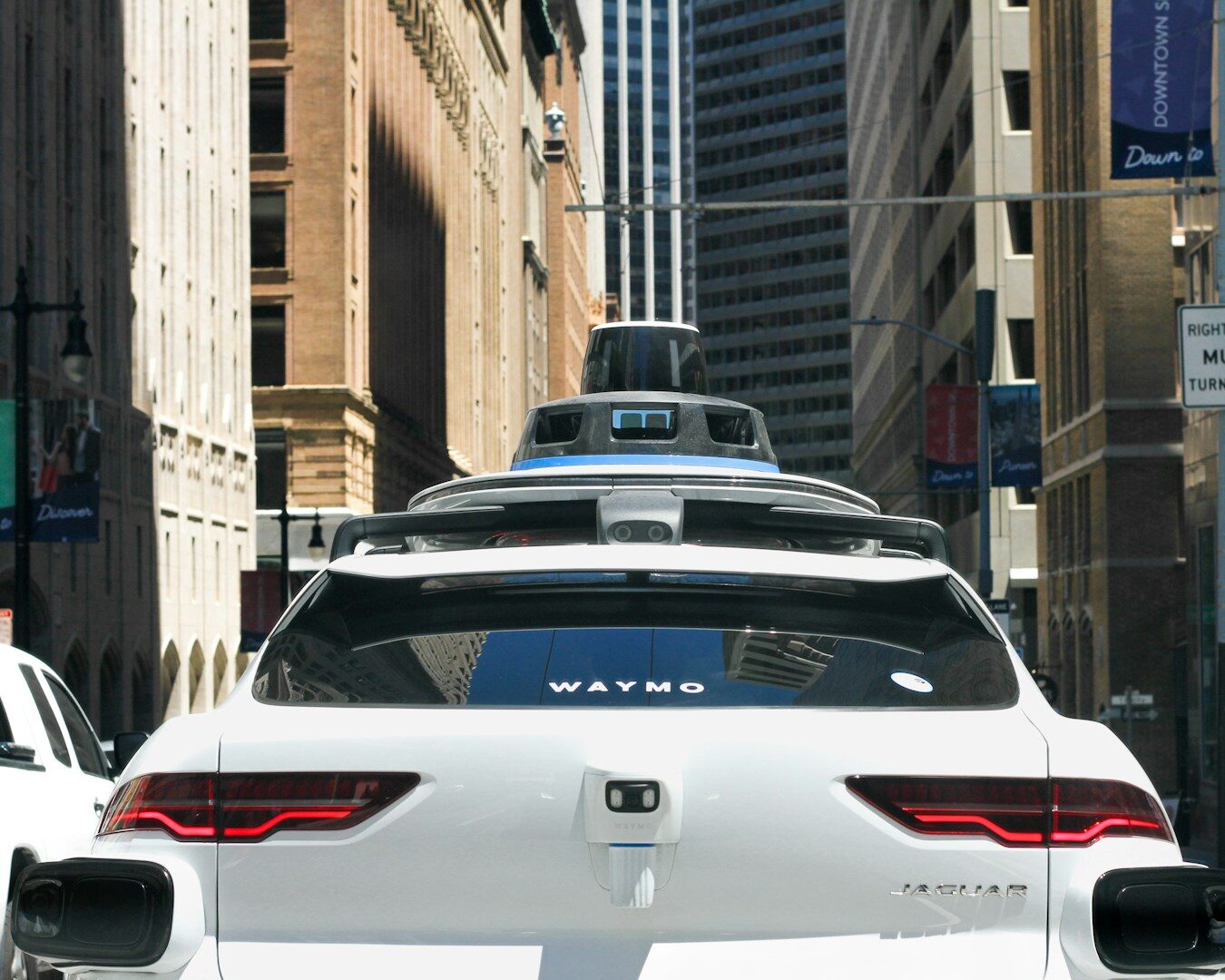
Sunday night on the 1700 block of Cheshire Bridge Road NE, a driverless Jaguar I-Pace sat waiting to turn left onto Manchester Street. According to Waymo, another vehicle — identified at the scene by Atlanta Fire Rescue as a Jeep — hit it in the rear at roughly 33 mph. Within a minute there was a serious fire involving both cars. Atlanta Fire Rescue knocked it down, evaluated two people from the Jeep, and turned the scene over to police. One occupant had burns, the other complained of a shoulder injury, and both declined transport. Nobody was riding in the Waymo.
That’s the whole incident, and it’s less interesting than what it exposes about how these vehicles are built and who has to deal with them at 10 p.m. on a Sunday.
The “rear of the Waymo” detail is doing a lot of work
Waymo’s account is that the striking vehicle caught fire and the flames spread into the back of the I-Pace. Atlanta Fire’s read was that the impact itself started a rapidly growing fire at the rear of the autonomous car. Those aren’t the same claim, and the difference matters for anyone trying to guess whether this was a lithium-ion event or a gasoline one.
Related Articles
- Car Dealers Keep Falling Into The Same PPP Trap, And One Whistleblower Won’t Stop Collecting
- Ford’s Empty Spanish Factory Found a Savior: The Chinese Company It Sold Volvo To in 2010
Here’s the part most people get wrong: the I-Pace’s traction pack is not in the trunk. Per Waymo’s own first-responder response guide, the high-voltage battery runs along the bottom of the vehicle between the axles, inside a sealed metal enclosure. What is in the back of a Waymo I-Pace is hardware Jaguar never installed: the added autonomy computer and a second, isolated 12-volt battery that exists solely to power the self-driving stack. There are also power electronics and orange HV cabling routed through the car to feed it.
So a rear-end hit at 33 mph into a stationary vehicle lands squarely on top of aftermarket compute hardware and a dedicated 12V supply, in a crush zone Jaguar validated for a stock cargo area. That’s not an accusation — it’s just where the parts are. A 12V lead-acid or AGM battery that gets deformed and shorted will absolutely start a fire, and it will do it fast, without any thermal runaway in the traction pack at all.
The other candidate is boring and probably more likely: a modern gasoline crossover striking a fixed obstacle hard enough to compromise a fuel line or the tank, with the Waymo simply being the thing parked in front of the flames.
Why the I-Pace’s history complicates the read
The I-Pace has one of the ugliest battery-fire records of any mainstream EV, which is why “Waymo caught fire” headlines land the way they do. Jaguar Land Rover is currently running recall 26V067, covering 2,278 model year 2020–2021 I-Paces whose high-voltage batteries may overheat. The interim fix is a software cap limiting state of charge to 90 percent; NHTSA’s acknowledgment letter states the final remedy is still under development, and owners are told to park outside and away from structures in the meantime. That’s the fourth or fifth bite at this apple — an earlier Part 573 report filed on 2019 cars describes post-remedy fires showing as smoke or flame from the underside of the vehicle, traced to folded anode tabs in LG-supplied cells.
Note the phrase “from the underside.” That’s the signature of a pack-level event on this platform. It is not what witnesses described here. Absent a fire investigator’s origin-and-cause finding, treating this as another I-Pace battery incident is a guess, and a lazy one.
What Atlanta Fire was actually dealing with
Waymo’s guide tells responders that if the HV system is exposed to fire or high heat, treat it as unsafe, use very large volumes of water, and expect toxic vapor including sulfuric acid, oxides of carbon, nickel, lithium, copper, and cobalt. It also tells them battery fires can take up to 24 hours to extinguish and that letting it burn while protecting exposures is a legitimate tactic.
Then there are the wrinkles specific to a robotaxi. The liftgate latch is electric and won’t open in autonomous mode or with 12V power removed, so crews can’t just pop the hatch to look at the burning thing. Killing the HV system means lifting the rear seat base to reach the manual service disconnect — inside a car that may be on fire. Opening any door prevents the vehicle from driving itself off, and if the doors are locked, the guidance is to break a window rather than wait. The right C-pillar carries washer fluid lines to the roof sensor pod, which is a surprise nobody wants mid-extrication. Waymo says it has trained more than 35,000 first responders across 150-plus agencies, and Atlanta Fire has already been through it — the department has said it wants more.
Also worth knowing: the car calls its own emergency. The guide states the vehicle detects a collision, brakes to a stop, notifies Waymo’s Fleet Response team, and disables the propulsion system if an airbag deploys. There’s a 24-hour hotline at 1-877-503-0840 for police and fire.
The paperwork nobody sees
Under NHTSA’s Standing General Order, Waymo has to report this. The third amendment, effective June 2025, requires a one-day filing when a reportable crash involves a fatality, hospital-treated injury, tow-away, airbag deployment, or a struck vulnerable road user. Both injured occupants refused transport, but a burned-out car is unambiguously a tow-away, so this should surface in the public SGO data. Everything less serious gets rolled into a monthly filing due by the 15th of the following month.
Separately, NHTSA’s FMVSS 305a rule now requires manufacturers to compile risk-mitigation documentation and submit standardized emergency response information for EVs, with the emergency-response documentation compliance date having passed in December 2025. The Waymo guide above is essentially what that regime is trying to make universal.
If you hit one, here’s your problem
Georgia legalized driverless operation years before anyone here saw a robotaxi. Georgia law allows a fully autonomous vehicle to operate with no human aboard provided it can achieve a minimal risk condition, carries commercial liability coverage at the limits set for for-hire carriers, and is registered as a fully autonomous vehicle. It also requires the vehicle to remain at the scene and the operator to supply information to law enforcement. Waymo’s I-Paces carry two sets of registration and insurance documents clipped to the sun visors, which is the closest thing you’ll get to exchanging paperwork with a driver.
Related Articles
- 10 Best Tire Inflator Accessory Deals on Amazon Right Now
- Rivian Just Posted a ‘Profit.’ The Cars Themselves Are Still Losing Money.
What you won’t get easily is the evidence. Waymo’s guide states plainly that vehicle data goes to law enforcement in response to proper legal process — a subpoena or search warrant, routed through a dedicated legal address. A car with lidar, radar, and a camera ring recorded your crash in exhaustive detail, and your adjuster cannot simply ask for it. If you’re the striking party in a rear-end hit, Georgia’s following-too-closely presumption is already against you, and the other side owns the sensor log. Budget for counsel accordingly.
Then there’s the repair math. A totaled I-Pace is a $70,000-ish used EV; a totaled Waymo I-Pace carries a roof pod, fender sensors, redundant steering and braking, and a purpose-built compute stack on top of that. Subrogation on that claim is not a fender-bender number, and Waymo carries commercial coverage precisely because of it.
The context Waymo would like you to have
The company’s June safety update reports more than 5.4 million fully autonomous miles in Atlanta, with 94 percent fewer airbag-deployment crashes and 86 percent fewer injury-involving crashes than the human benchmark over the same roads. Service here launched in June 2025 exclusively through Uber, covering roughly 65 square miles of the city with the I-Pace fleet.
That record is real, and it’s also not a defense against this particular scenario, because in this one the robot did nothing wrong. It was stopped, waiting to turn, doing exactly what it should. It just happens to be a stationary EV with a computer in the trunk, and stationary objects get hit.
The practical takeaway for regular EV owners is the same one Atlanta Fire is living: after any significant impact, a damaged battery or damaged 12V system can light off later, not just at the scene. Don’t park a wrecked EV in the garage. Don’t let a body shop park it against a building. And if you’re ever the person standing next to one that’s smoking, the correct distance is much farther away than instinct suggests.