
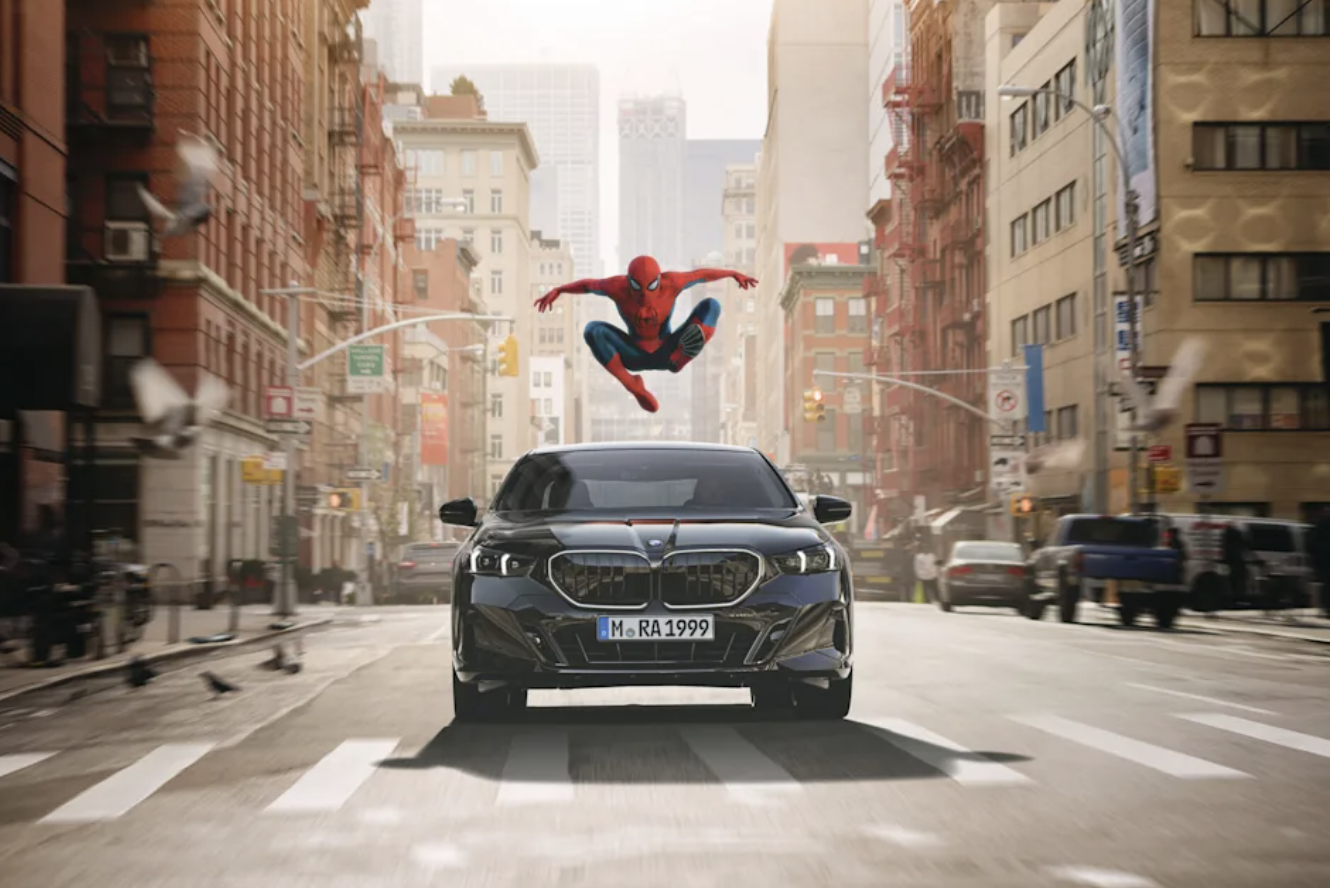
BMW picked a strange hill to build its first billboard on.
If you own a BMW built after July 2020 and you started it any time in the past week, you may have been greeted by a banner promoting a Sony Pictures release. Tap it and the center screen hands itself over to a full-screen Spider-Man animation with a soundtrack and a coordinated ambient lighting sequence. BMW’s own press release calls it “a special surprise for its drivers.” It runs July 27 through August 10, in more than 70 countries, on cars running Operating System 7, 8, 8.5, 9 or Operating System X.
That build-date cutoff is the interesting part, and almost nobody has stopped to ask why it’s July 2020 specifically.
The paper trail nobody read
July 2020 is when BMW pushed what it then billed as its most comprehensive software upgrade to date. Buried in the middle of that 2020 press kit, under a section about digital personalization and functions on demand, is a sentence that reads very differently in 2026 than it did six years ago: “In-car communication is becoming increasingly important as a channel.”
A channel. That’s advertising vocabulary, written down and published by BMW, three and a half years before an executive told reporters the screen was off limits.
The executive in question was Stephan Durach, BMW Group’s senior vice president for connected company development. At a December 2023 media roundtable reported by MediaPost, Durach described the cabin as the last private space a person has and dismissed the idea of “selling the screen to play a commercial.” He wasn’t lying, exactly. He was describing a business BMW hadn’t built yet, using a definition of “commercial” narrow enough to exclude whatever you’d call a co-branded animation delivered as part of a global entertainment tie-up.
How it actually gets in there
This is not an over-the-air firmware flash, and the distinction matters more than the outrage does.
Related Articles
- Wichita’s License-Plate Cameras Misidentify Cars Up To 20% Of The Time. Now A Local Is Suing To Rip Out All 200
- Ford Recalls 86,543 Mustang Mach-Es Because Its Factory Got Faster Than the Glue Could Handle
Your BMW is not connected to the open internet. Per BMW’s own technical description, the car talks to the ConnectedDrive backend over a secure VPN tunnel — that architecture is precisely why a third party can’t reach into your CAN bus from a coffee shop. But it’s also why BMW can. The same pipe that delivers real-time traffic data, map tiles, and remote services is a general-purpose content channel, and content is content.
BMW has been open about how deep that access goes. In an October 2022 release covering OTA upgrades to roughly 3.8 million cars, the company noted it has been able to modify every line of programming code in vehicle software remotely since 2019, installing across every control unit in the onboard network in about 20 minutes.
Practically, a startup banner doesn’t require anything that heavy. It’s a payload — artwork, audio, a lighting script, a trigger condition — dropped into an existing widget framework. Which is the real story here. BMW didn’t build new capability to run this campaign. The capability shipped with your car. This is the first time it’s been pointed at something you didn’t ask for.
Nobody is regulating this
If you’re waiting for a federal agency to step in, understand what actually exists.
NHTSA published driver distraction guidelines for factory-installed electronic devices back in 2013. They identify a category of “per se lock outs” — tasks so inherently distracting that manufacturers are advised to make them inaccessible while the vehicle is in motion. Displaying video, and displaying graphical or photographic images unrelated to driving, are both on that list.
An animated superhero sequence with backing music sits squarely inside that description. But read the notice’s own summary line: the guidelines are nonbinding and voluntary. There is no federal motor vehicle safety standard governing what an automaker may render on a center display. State distracted-driving statutes are worse than useless here — they regulate what a driver does with a device, not what a manufacturer transmits into one.
So the only enforcement mechanism available to owners is the one currently being applied: complaining loudly enough that it stops being worth the media value.
What owners can actually do
Not much, but not nothing.
That same 2020 press kit describes a data protection menu covering more than 30 individual digital services, with the option to switch off all services and the data transmission that goes with them. Kill the connected services and you kill the delivery mechanism. You also kill live traffic routing, remote services, the app, and cloud navigation. eCall stays on regardless, because it’s legally mandated. It’s a blunt instrument, and for most owners the cure is worse than a two-week Spider-Man banner.
Used-car buyers should think about this differently. When you buy a five-year-old F-series or G-series BMW, you’re not just inheriting the hardware — you’re inheriting a live account relationship with a backend that can change what the dashboard does after the sale. The car you inspect on a test drive is a snapshot, not a spec. Check the software version and the connected-services settings during a pre-purchase inspection the same way you’d check for a coded-out DPF or an aftermarket tune.
Related Articles
- Waymo Puts Robotaxis Back On Freeways — Here’s What Actually Broke
- Ford Buried a Timing Belt in Motor Oil to Save Gas — Now the Feds Say 135,000 Cars Are a Safety Risk
Anyone treating this as a BMW-specific character flaw is missing the industry math. Ford has a published US patent application, US20240289844A1, titled “In-vehicle advertisement presentation systems and methods.” It describes selecting how many ads to present during a trip using vehicle speed, drive mode, location, traffic conditions, route and destination prediction — and inferring user preferences partly from audio signals inside the cabin. A patent application isn’t a product. It is, however, a written record of where an engineering department’s thinking went.
BMW’s earlier misstep with seat-heating subscriptions taught the industry a lesson, but not the one owners think. The lesson wasn’t “stop monetizing the car after the sale.” It was “don’t put the paywall in front of something the customer can physically see they already bought.” Attention has no such tell. Nobody opens a door and points at the screen and says the ad-free version was included.
A two-week movie promo isn’t the damage. The precedent is. BMW has now demonstrated, publicly and at scale, that a Hollywood studio can rent the first thing you look at when you start your car. The capability was always there. The rate card is what’s new.
Images Via: BMW Group