
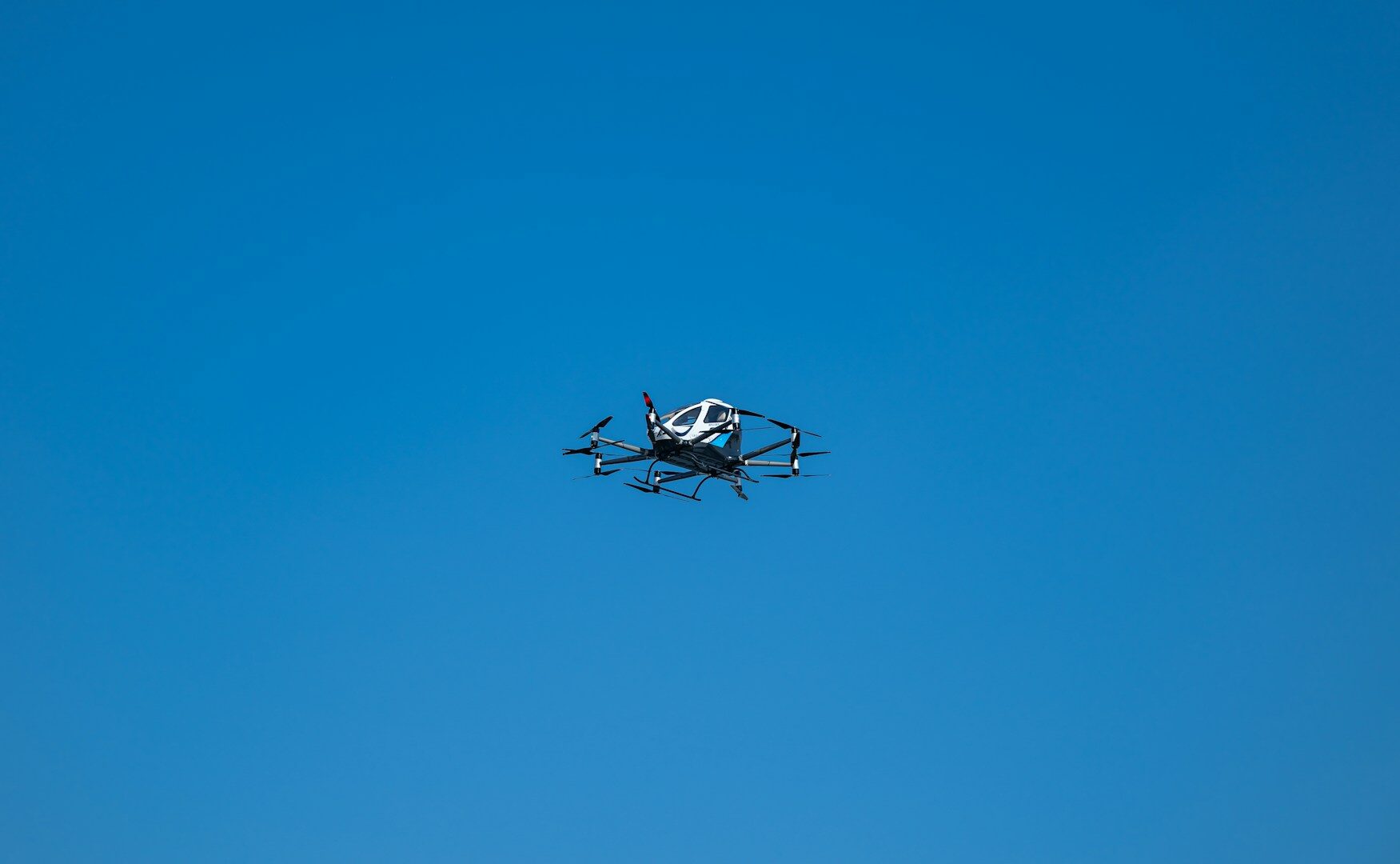
Florida’s governor stood in front of a hangar in Auburndale this week and talked about flying cars. That’s the part of this story everyone will remember. It’s also not the part that matters.
Buried in the same announcement, almost as a footnote, was the actual news: Waymo is already carrying paying passengers on Florida’s interstates with nobody behind the wheel, and by this fall it plans to do the same thing in Tampa. One of these technologies doesn’t have a certification path yet. The other one already has a customer base.
The occasion was Governor Ron DeSantis touring SunTrax, a 775-acre research campus the Florida Department of Transportation built along Interstate 4 in Polk County. SunTrax has spent the better part of a decade quietly building the only highway-speed autonomous vehicle test track in the Southeast, a 2.25-mile oval where companies can throw a self-driving car into simulated rain, roundabouts, and pedestrian crossings before it ever touches a public road. This week’s news is that FDOT is bolting a second campus onto it: SunTrax Air, a 212-acre aviation annex built for testing electric vertical takeoff and landing aircraft, known to headline writers everywhere as flying cars. Florida expects test flights there by the end of the year, paired with a new workforce deal between FDOT, Embry-Riddle Aeronautical University, and Polk State College to train pilots, mechanics, and engineers for the industry. DeSantis framed the whole effort as a bid to make Florida “the premier location for emerging transportation technology.”
Here’s the part the press release glosses over: no state government can certify an aircraft to carry passengers. That authority belongs entirely to the FAA, and it doesn’t move at the speed of a governor’s press conference. Powered-lift aircraft, the category the FAA created to cover eVTOLs, is a brand-new corner of aviation law, and the agency has been slow and deliberate about finishing the pilot licensing and operating rules that would let one of these things sell a ticket. A test flight at SunTrax proves an aircraft can fly in controlled airspace with FAA cooperation. It says nothing about when that same aircraft gets to carry a paying stranger. Florida can build all the vertiports and charging pads it wants. It cannot shorten the federal runway.
Compare that to what’s happening on the ground side of the same campus. Waymo’s Florida service already includes autonomous highway driving in South Florida, at speeds and merging scenarios that were, for years, considered one of the hardest unsolved problems in the entire self-driving industry. City-street robotaxi driving is hard. Merging into 70-mph interstate traffic with no one able to take the wheel is a different order of difficulty, and it’s already commercial, not experimental. The Tampa expansion follows a pattern Waymo has used in other markets: map the roads, run rider-only test loops, train local fire and police departments on how to handle a crash with a car that has no driver to ask for identification, then switch on paid service. That’s not a five-year plan. That’s a fall launch.
There’s a second story hiding in the language FDOT used to describe SunTrax Air. The announcement doesn’t just mention test flights. It mentions tenant hangars for research, light manufacturing, and final assembly. That is not test-track language. That is economic-development language. Southern states have run this exact play before, offering cheap land and friendly regulation to convince automakers to build assembly plants instead of just shipping cars in. Florida is making the same pitch to an industry that doesn’t have a single mass-produced passenger aircraft yet, betting that whoever hosts the testing also gets first claim on hosting the factory.
The winners in this story are easy to name: Florida’s construction and tourism-adjacent economy, Embry-Riddle and Polk State’s enrollment numbers, and Waymo, which gets to expand into new metro areas while the regulatory rulebook is still being written state by state instead of nationally. The losers are quieter but just as real. eVTOL manufacturers now have to decide whether to keep spending money certifying aircraft for a passenger market that’s still years from commercial viability, and Florida taxpayers are funding a facility whose aviation side has so far produced test flights and press conferences rather than revenue.
The ground-vehicle side of this story has its own regulatory subplot. As robotaxi fleets expand across more states, insurers and regulators are still working out who carries liability when there’s no driver to blame, a question already playing out in the federal exemption that let Amazon’s Zoox start charging for driverless rides without a steering wheel. Florida’s approach so far has been to let Waymo carry its own commercial insurance and coordinate directly with FDOT and local first responders, a lighter touch than some states have taken, and one that’s about to be tested at a much larger scale.
Waymo, for what it’s worth, isn’t just renting track time and calling it a day. The company is already building its own purpose-made robotaxi in an Arizona factory, which says something about where the ground-vehicle half of this industry actually stands: past the test track and into vehicle production. The aviation half is still figuring out what its test track should even look like.
Florida’s weather is also going to matter here more than the press release lets on. SunTrax’s ground track already simulates heavy rain, for exactly the reason anyone who has driven I-4 in July would guess. Waymo has already had to recall its entire fleet once after a car drove into floodwaters, a reminder that sensor suites and software still have to contend with a state where a sunny afternoon can turn into a flash flood faster than a human driver would think to slow down. Hurricane season is not a footnote for a state betting on autonomous highway driving and low-altitude aircraft. It is the whole exam.
Strip away the ribbon-cutting language and what Florida actually announced this week is two projects moving at two very different speeds, sharing one press release. The aircraft is still asking the FAA for permission. The car already has the keys. Remember that the next time a state government says it’s testing flying cars. Ask what’s already driving right past the cameras.