
Paint plants don’t usually get much attention from enthusiasts, which is a shame, because the coating on your car is one of the few things on it that was engineered to last twenty years without any maintenance and usually does.
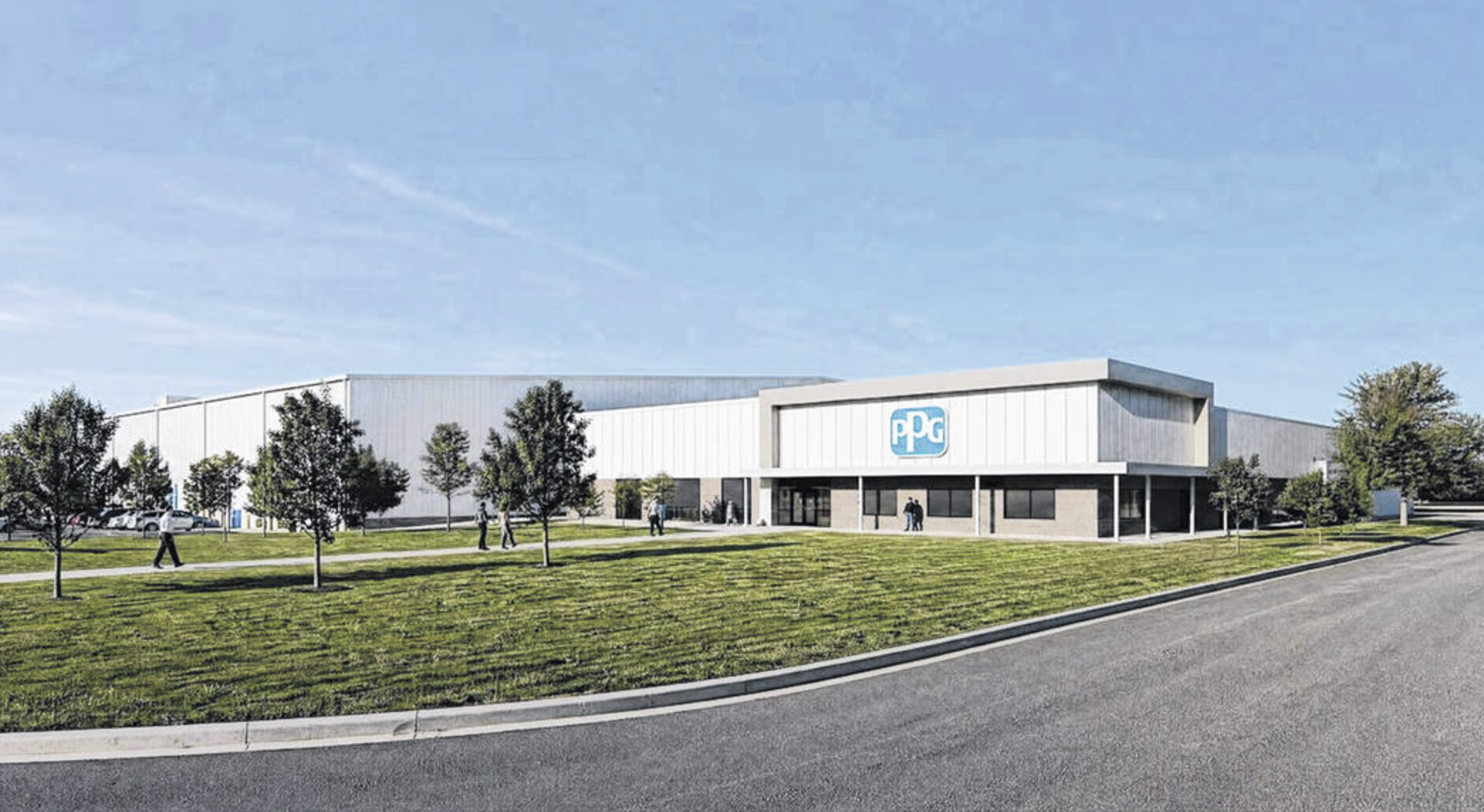
PPG put shovels in the ground August 6 on a 100,000-square-foot addition to its Delaware, Ohio site, part of a project the company pegged at more than $280 million, dedicated to automotive OEM coatings production, adding 100 full-time jobs to a site that already employs roughly 450 people, with operations projected for 2028. The state chipped in. Ohio Tax Credit Authority meeting minutes from March 2 record the approval of a 1.483 percent, eight-year job creation tax credit for PPG Industries Ohio, Inc., against a commitment to create 100 full-time-equivalent jobs generating $7,993,116 in new annual payroll and retain $37,264,715 by the end of 2029. The credit runs 2027 through 2034; the vote was 3-0 with one member abstaining. Columbus Region
That’s the paperwork. Here’s why it matters to anyone who cares about how a car is built or repaired.
The stack you’re actually looking at
Factory paint is four systems doing four different jobs. First comes electrocoat — a waterborne primer applied by dunking the entire body-in-white in a tank and running current through it so the coating plates onto every surface the electrolyte can reach, including the insides of box sections and pinch welds. Then a primer-surfacer for chip resistance and smoothness, then basecoat for color and effect pigments, then clearcoat for gloss and UV protection.
Related Articles
- Stellantis’s CEO Used To Run Quality Control. Ram Just Recalled 1.27 Million Trucks On His Watch.
- Toyota And Hyundai Got Caught Tracking Drivers. GM Already Put A Price On It: $25 Billion.
E-coat is the one that actually keeps your rocker panels from turning into lace. It’s also the layer nobody can replicate outside an assembly plant, which is the practical fact hiding inside this announcement.
The EV problem is a thermal problem
Conventional cathodic e-coat wants heat. The chemistry has historically leaned on organotin catalysis and cure temperatures above 160°C, which is fine when you’re baking a stamped-steel unibody and awkward when you’re baking a battery-electric body with giant aluminum castings, a structural pack tray and wildly uneven gauge. Thick sections soak up heat; thin ones overbake while you wait. Bodies that need more oven time slow the line, and the paint shop is already the energy hog of the plant — PPG has put the figure at 50 to 70 percent of energy use in automotive assembly. American Chemistry Council
PPG’s answer is an expanded bake window. Its launch announcement for the Enviro-Prime EPIC family described e-coats that cure at lower temperatures than competing technologies, aimed at lower energy use and reduced CO2 at the plant. On the EPIC 300 product, PPG has claimed a 20°C reduction in required bake temperature and 11 to 13 percent lower energy input on heavy EV assemblies. The chemistry went tin-free along the way, which matters more than it sounds — organotin catalysts are under regulatory pressure globally, and reformulating away from them without giving up corrosion performance is genuinely hard. PPG’s technology has since collected industry awards on the strength of it. Ppg American Chemistry Council
A wider bake window also means a plant can run mixed EV and combustion bodies down one line without retuning ovens. That flexibility is worth more to an automaker right now than any single sustainability metric.
Why waterborne, and why Ohio
The Delaware plant opened in 1965, in the solventborne era, and the regulatory clock has been running ever since. The federal NESHAP for automotive assembly coating — Subpart IIII, promulgated in the 2004 rule — sets hazardous air pollutant standards for facilities coating new automobile and light-duty truck bodies and body parts. Stack that on top of decades of state VOC rules and the industry’s migration to waterborne basecoat stops looking like a marketing choice and starts looking like arithmetic. eCFR
There’s a second reason this is an Ohio story and not a greenfield story: what already comes out of that plant. PPG said in 2021 that the Delaware site produces resins and coatings for packaging, industrial and automotive OEM markets as well as the automotive refinish and collision market. Refinish. That’s your body shop’s supply, out of the same site. Business Wire
What your body shop can’t do
Now the part worth filing away. Your collision repairer cannot bake at e-coat temperatures. Glass, plastic trim, wiring, adhesives and — on an EV — a lithium pack all cap the booth at roughly 60°C. Refinish clears are engineered around that limit, which is why they’re chemically different products from anything sprayed on a bare body-in-white.
Related Articles
- Toyota’s Third Blank-Speedometer Recall in a Year Comes With a Two-Tier Fix — Guess Who Loses
- Russia’s Record Car-Import Month Has Two Real Stars: A Country That Builds No Cars, and a Corolla That Won’t Die
The consequence: when a shop cuts out a quarter panel and welds in a new one, the factory e-coat is destroyed in the heat-affected zone at every weld, and nothing sprayed afterward reaches inside the seams and box sections the way an immersion tank did. That’s the mechanism behind corrosion blooming along repaired seams five or six years later while the untouched side of the car looks new.
So, practical takeaways:
Buying used. Bubbling along a seam or door edge on one side only is a repair history clue before you ever pull a Carfax. Check pinch welds and the bottom of door skins.
Getting repaired. Ask whether the estimate includes weld-through primer at the mating surfaces and cavity wax injected into closed sections afterward. Both are standard OEM procedure and both are frequently skipped. It’s a small line item against the cost of a rusted quarter.
Insurance. Paint and materials is a negotiated allowance on your estimate, not a fixed cost, and tri-coat pearls and matte finishes legitimately carry more of it. If your car wears one, make sure it’s coded correctly. Coating supply reliability also feeds cycle time — a shop waiting on materials is a rental car burning your coverage days.
Nobody buys a car because of what’s in the e-coat tank. But it’s the reason a fifteen-year-old car from a good paint shop still has floors, and the reason a badly repaired three-year-old one might not. A $280 million bet on that tank is a bet that OEMs still care about the difference.
Images Via: PPG