
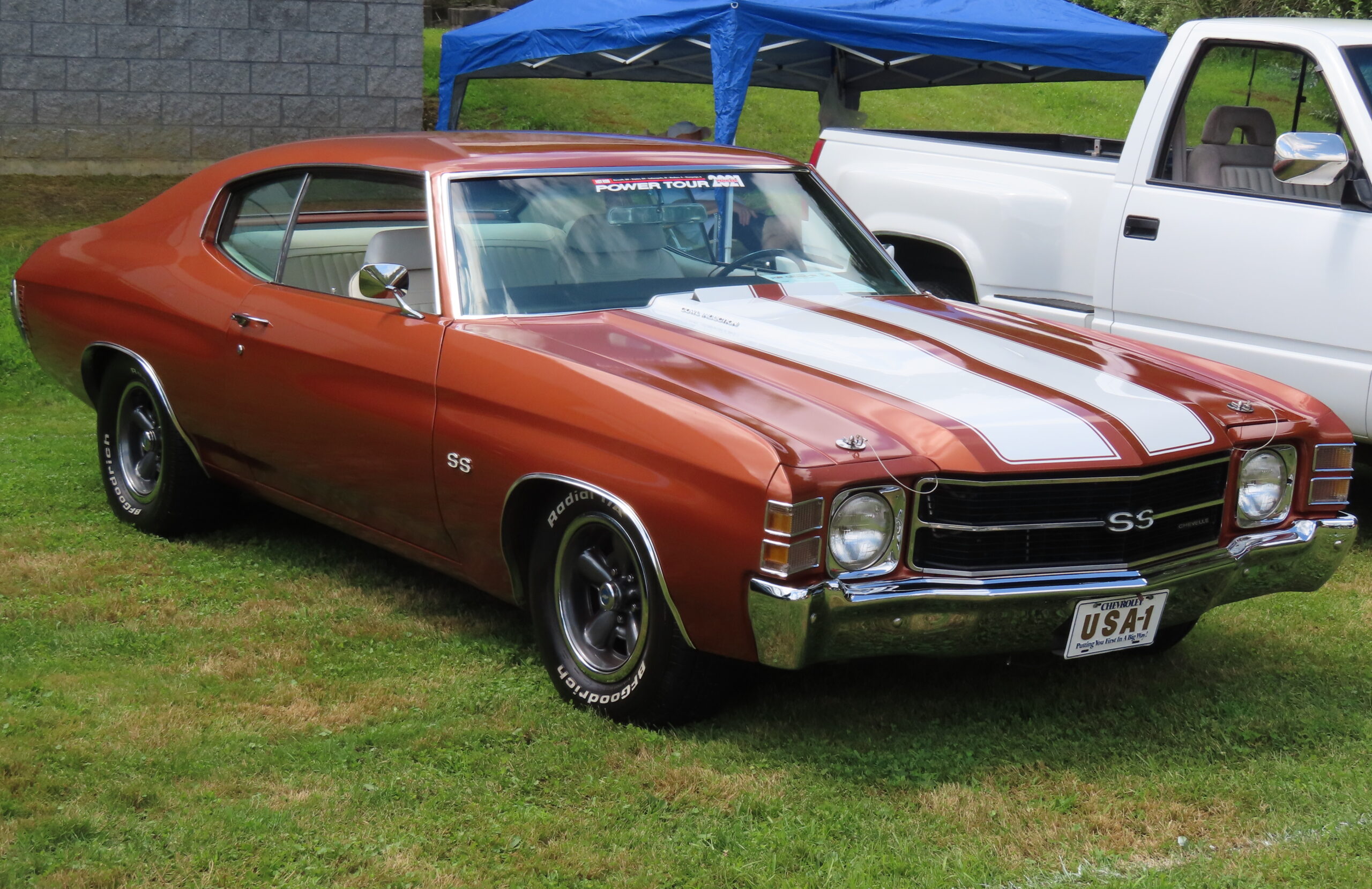
Somewhere in Northern California there is a man holding the keys to a car he legally owns, cannot legally drive, and almost certainly could not afford to buy today.
His 1971 Chevrolet Chevelle disappeared in San Mateo County in 1993. On August 13, the California Highway Patrol’s Auburn Area office posted a photograph of it back on its wheels in the Sierra foothills — black, SS badging in the grille, looking like very little had happened in the intervening three decades. CHP says officers spotted something that did not add up during a VIN inspection, worked the discrepancy with the San Mateo Police Department, and, in the agency’s own words, got to “reunite the Chevelle with its original owner.” The owner is not being named, which is the right call.
Everyone is going to run that photo. Almost nobody is going to mention that for the man in it, the reunion is the beginning of the work, not the end.
A theft report has no expiration date. The rest of the file does.
Start with the mechanism that actually worked, because it is not the one most enthusiasts assume. Nothing high-tech surfaced this car. It came out of hiding because a human being was legally required to physically look at it before the state would move a piece of paper.
Stolen-vehicle entries do not age out. They sit in the system until an agency clears them, which is why a report taken during the first Clinton administration was still live enough in 2026 to stop a routine inspection cold. That cuts both ways, and it is worth acting on: if a vehicle of yours is on an old report, call the agency that took it and confirm two things — that the entry is still active, and that the VIN in it is right, character for character. Long-shot recoveries die on transposed digits far more often than they die on bad police work. They also die on assumptions about geography. The 1971 Chevy pickup that spent eight months “missing” while parked in a garage is a useful reminder that gone and far away are different conditions.
What did not survive with the same stubbornness is the registration file. A California car that stopped being registered in 1993 and never came back has, for practical purposes, fallen out of the state’s records entirely.
Getting it legal again is its own project
California has a procedure for this and it is nobody’s idea of a victory lap. Under Vehicle Code section 5911, a vehicle whose DMV record is no longer available gets processed as an original registration. You are not renewing anything. You are introducing the car to the state as though it had never been here. DMV’s registration procedures manual wants an original California title, or an original, not-photocopied, expired registration card, to do it.
Original. The one in the shoebox. Thirty-three years later.
That is the most useful thing any owner can pull out of this case, and acting on it costs nothing. Your old title and your dead registration cards are not sentimental clutter. They are the instrument that converts “they found my car” into “my car is registered.” Scan them, sure. Then keep the paper somewhere that is not the glovebox of the vehicle you are worried about losing.
After that it is a REG 31 Verification of Vehicle — the same physical inspection that caught the Chevelle in the first place — plus whatever the state decides it is owed. A 1971 model at least lands on the friendly side of the smog line, since California exempts gasoline vehicles from the 1975 model year and older. Fees, penalties and use tax on any transfer of ownership are all live questions the moment the file reopens. And the rules around old cars keep moving: Maryland just froze historic plate eligibility at 1999 instead of letting it roll forward, which is the kind of change owners tend to discover at the counter.
The asset changed species while it was gone
Here is what makes a long-fuse recovery genuinely strange. In 1993, this was a 22-year-old used car. The collector market that turned 1970–72 Chevelles into six-figure property was still years out, and a big-block A-body was something you bought because you wanted one, not because a price guide told you to.
Today the CLASSIC.COM market benchmark for a second-generation Chevelle SS sits around $87,000, with 1971 cars currently listed anywhere from roughly $40,000 to about $135,000 depending on engine, documentation and how much of the car is still the original car. Hagerty’s condition-based numbers land in the same neighborhood. That does not mean the segment is white hot right now — Barrett-Jackson’s Columbus sale showed where the real money is chasing at the moment — but the direction of travel since 1993 is not in dispute.
Stretch that spread across three decades and you understand why everybody else in this story suddenly has an interest in it.
The insurance question with a 33-year fuse
If a comprehensive claim was paid on this Chevelle in 1993, the carrier — not the man in the photograph — most likely acquired the owner’s rights in the car the day that check cleared. Time does not soften that. Decades-later recoveries usually end one of two ways: the original owner buys his own car back from an insurance company, or the carrier releases its interest because chasing a file that old costs more than the file is worth. CHP says the Chevelle went home to its original owner, so however that conversation went, it got settled.
The practical version, for everyone else: if a vehicle of yours resurfaces after a paid total-loss claim, establish who owns it before you authorize anyone to move it anywhere. Tow and storage charges start accruing immediately, and they attach to a car whose ownership may not be yours to assert. And for anything you would be sick to lose, an agreed-value collector policy is the difference between being made whole and being handed 1993 money for a 2026 asset. That is exactly the arithmetic facing owners in cases like the 1970 Chevelle SS recovered after an anonymous tip and the Chevelle and Camaro taken from a Washington collector.
Somebody down the chain just lost every dollar they paid
No one who bought this car after 1993 ever owned it. A thief has nothing to hand over, so nothing transfers — not to the first buyer, not to the fifth, and good faith does not repair it. A registration document proves a state’s filing cabinet is tidy. It says nothing about who owns the vehicle, which is precisely the gap that re-VIN operations and insiders with police database access are built to exploit. Whoever is left holding this Chevelle can only chase the person who sold it to them, and after this many hands that trail tends to end at a phone number nobody answers.
Criminal exposure is thinner than people expect. California’s general felony limitations period is three years, so a 1993 taking is long past it. Knowingly possessing a stolen vehicle is a separate offense, but knowledge is the hard element, and it is harder still when the paperwork looked clean to everyone who touched it. Contrast that with a theft recent enough for the system to function as designed: three people were charged over a 1972 Chevelle and that car still has not turned up.
Why the SS badge is the least informative thing in the photo
Since the grille emblem is doing a lot of work in that CHP picture, it is worth knowing what it does not prove. For 1971, Super Sport was not a model line. It was an option code, RPO Z15, layered onto a Malibu, and a 1971 Chevelle’s VIN does not record whether it was ordered. Emblems bolt on. Only documentation settles what a car actually is — which is the same thing at issue in the $140,000 Chevelle restoration lawsuit now working through the courts, where the paper trail is the entire fight.
The model year matters too. 1971 is when GM cut compression across its whole engine lineup to 8.5:1 ahead of the industry’s move to low-lead fuel, and the SS 454’s LS5 came out the other side rated at 365 gross horsepower. Still a serious car. Not a 1970, which is why the market has always priced the two years differently and why anyone valuing this Chevelle will care a great deal about what is stamped on the block.
If a car of yours is sitting on a decades-old report
- Confirm with the reporting agency that the entry is still active, and read the VIN back one character at a time.
- Locate your original title and expired registration cards now, not the week you get the phone call. Under VC 5911 they are what put the car back on the books.
- If a claim was ever paid, call the insurer before you call a tow truck.
- Photograph every identifier on the cars you still have — dash plate, firewall tag, driveline stampings. Re-identification is a comparison exercise, and it only works if there is something to compare against.
The Chevelle came home because a physical inspection outlasted three decades of paperwork drift. Now its owner gets to spend the next several weeks proving to the State of California that a car sitting in his driveway is real.
Related Articles
- Motorcyclist Arrested After Wearing Helmet Inside Walmart Store
- Rare Chevy SS Sedan Stolen From Washington Dealership
- Father’s Day Ruined As Thieves Take Impala And Motorcycle
- Collector Car Market Softens Further in August 2025 as Values Continue Declining