
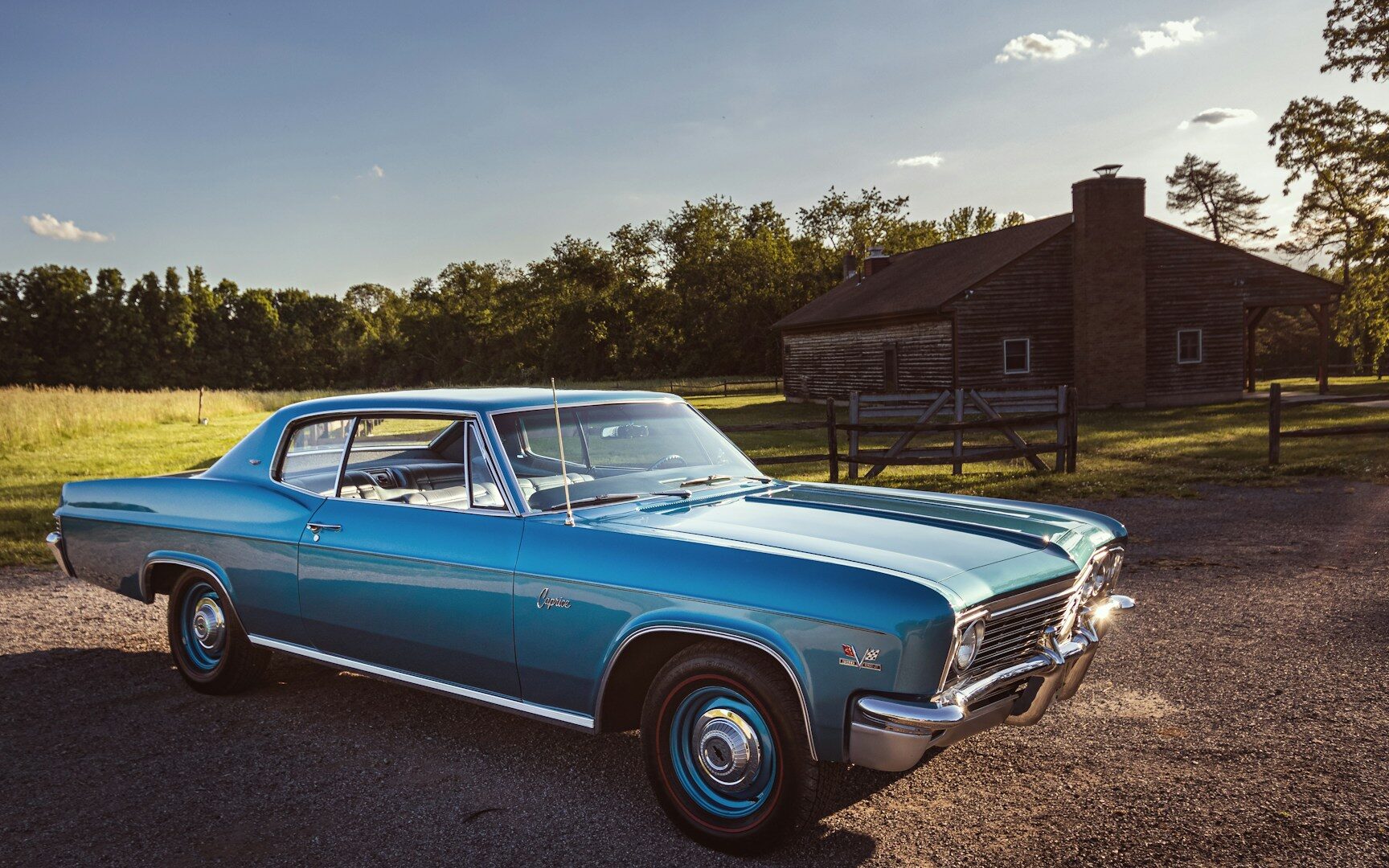
Somebody wanted this 1965 Chevrolet Impala badly enough to case a body shop, cut a lock, and roll an $80,000 car down the street without ever starting the engine. That’s the detail worth sitting with. The getaway wasn’t a burnout. It was a tow dolly.
The theft happened August 12 at R&E Collision Center in La Puente, California, where the freshly restored Impala had been undergoing repairs for close to a year following a crash. Surveillance video shows a masked crew arriving in an early-2000s Chevrolet Avalanche, breaking the shop’s gate lock, and wheeling the Impala out on a two-wheel dolly before disappearing down the street. Owner Giovanni Robles told ABC7 the car had gotten a fresh coat of paint three days earlier and was parked outside, behind the locked gate, while the finish cured. He estimates its value between $60,000 and $80,000. Ten days later, it’s still gone.
This isn’t really a story about a stolen car.
It’s a story about why a fifty-nine-year-old sedan can be easier to disappear than a brand-new one, and why the shop repairing it can end up holding a bill nobody agreed to pay.
Start with the dolly. Professional theft crews increasingly avoid ever starting a stolen vehicle’s engine, and it isn’t because they can’t hot-wire a car. It’s because the ignition is where most of a modern vehicle’s defenses live: chip-keyed immobilizers, OnStar-style telematics that phone home the moment the engine turns over, aftermarket GPS units wired into the starter circuit. A car that never runs never trips any of it. Roll it onto a dolly, tow it behind a pickup, and the only thing that can catch you is a person watching a camera in real time. Robles suspects that’s exactly what happened here: “I believe they were patrolling the area for quite some time.”
Here’s the part most owners don’t know until it’s too late. The federally standardized, 17-character VIN that every car buyer takes for granted didn’t exist until the 1981 model year, when NHTSA’s final rule on vehicle identification numbers took effect. Before that, there was no fixed format at all. Manufacturers stamped whatever length and layout they wanted onto a metal tag, usually riveted to a door jamb or cowl, with no national system cross-checking it against anything. A 1965 Impala’s identification is closer to a suggestion than a fingerprint. Swap the tag, forge a title to match, and a stolen classic becomes a legitimately papered one with far less friction than doing the same to a 2024 Silverado, whose VIN is stamped, laser-etched, and cross-referenced across federal and insurance databases the moment it’s built.
The Auto Wire has already documented how far that gap can be pushed. Earlier this year we reported on a California police officer accused of running a stolen-car ring on the side, allegedly using her own agency’s database access to help clean up titles on vehicles carrying cloned VINs. The Impala case doesn’t need a corrupt officer to work the same trick. The vulnerability is baked into the car.
Then there’s the economics. Collector Impalas, Chevelles, and Camaros have appreciated hard enough over the past decade that a driver-quality restoration routinely clears six figures, money that didn’t used to sit behind a chain-link gate in a commercial parking lot. Robles says his shop also houses other high-end classics, which makes it look less like a repair facility and more like an unguarded warehouse of appreciating assets. It’s not even the first Impala to disappear this way. A custom 1960 model vanished from an Imperial Beach driveway in 2025, and the $10,000 reward its owner posted still hasn’t brought it home.
Organized crews have caught on to where the money sits. The Auto Wire previously reported on a Missouri City chop shop bust that unraveled from a routine traffic stop into a much larger operation moving stolen trucks through a parts pipeline, and on stolen Jeep Wranglers lifted from a Washington, D.C. street that turned up weeks later at the Port of Baltimore, crated for a container ship bound for West Africa. Parting a car out and exporting it whole are two branches of the same tree. Both need a vehicle nobody is actively tracking, and both do better when several of them are parked in the same lot.
The part almost nobody thinks about is what happens to the money if the car is never found. A classic sitting at a body shop for a year is typically covered under the shop’s garagekeepers or bailee coverage, a commercial policy meant to protect vehicles in a business’s care, custody, and control. That kind of policy usually pays actual cash value, not the agreed or appraised value a specialty insurer would write directly for the owner. It’s exactly why collector-focused insurers sell a separate restoration-shop policy in the first place: ordinary garage coverage was never priced for a car mid-build, wearing three-day-old paint, worth close to $80,000. If a shop’s coverage doesn’t match a car’s real value, an owner can end up compensated for a fraction of what the Impala was actually worth, stolen once by the thieves and effectively a second time by a coverage gap nobody negotiated.
None of this requires a dishonest shop, either. The Auto Wire has covered cases where a dealership’s own paperwork became the fraud vector, including a Salt Lake City used car dealer accused of forging a deceased woman’s signature to resell hail-wrecked cars as clean. That case and this one share the same lesson: ownership records for older and collector vehicles are only as trustworthy as the last person who touched them, and a fifty-nine-year-old Impala has had a lot of hands on its paperwork.
Robles is doing the obvious things now: more cameras, a security guard, tighter control over who gets near the lot. Those fixes matter, but they treat the symptom.
The real vulnerability rode off the assembly line with the Impala in 1965, decades before anyone in Detroit or Washington decided a car’s identity needed to be tamper-resistant.
If you own a classic and you’re about to drop it off for bodywork, ask two questions before you sign anything: what does the shop’s policy actually pay out if the car disappears, and does that number match what the car is worth today? The lock on the gate is the easy problem to fix. The one stamped into the car sixty years ago is not.