
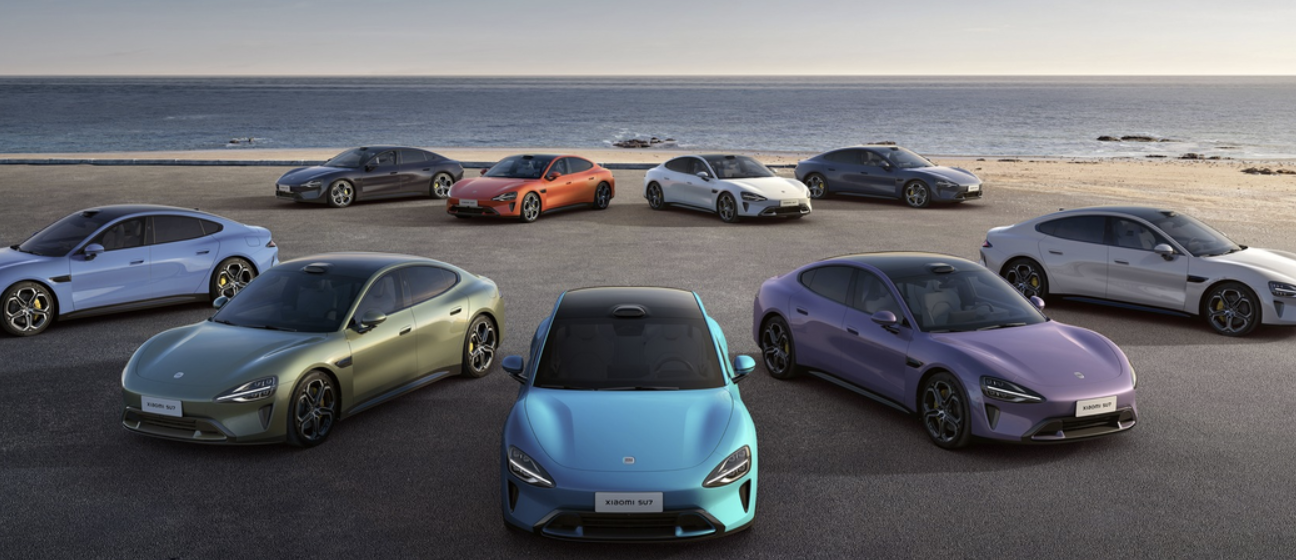
Chinese brands have been announcing European arrivals for about five years now, and the announcements have roughly the same information content as a horoscope. Xiaomi’s version, live since 26 August at xiaomiauto.com, is at least a different genre. Under the hero image sits a section headed Dealer and Distribution Inquiries, with a single line of copy — this is the official channel for dealership and distribution partnership inquiries — and an address: Autopartners@xiaomi.com.
Not a portal. Not a franchise application with financial disclosure fields. An inbox. That tells you exactly which stage of the process this is: Xiaomi wants to know who’s interested before it decides what shape the network takes.
Which is still more than most brands do before showing up.
What the site commits to, and what it carefully doesn’t
The banner reads “Xiaomi Auto Officially Coming to Europe in 2027.” That’s it for hard commitments. There’s no configurator, no pricing, no country sequence, and no statement of which models make the boat. The gallery shows the SU7, SU7 Ultra, the Ultra Prototype and the Vision Gran Turismo concept, but a gallery is not a lineup.
Related Articles
- A Murder Case Alert Was Never Deleted — So Cops Pulled Guns On Innocent People Weeks Later
- Hands-Free Laws Were Never About Safety. New Crash Data Proves They Were About Loopholes
The R&D section is where the intent leaks. Xiaomi describes a Europe R&D and Design Center whose stated mission includes “EU Market Entry Readiness Enablement,” and the page closes the pitch with a line that reads as a direct swipe at every rebadged Chinese import already on European forecourts: “Not just an import, but a vehicle made for Europe.” It also claims more than 2,000 granted global patents as of 16 July 2026, and hiring is running through auto-talent@xiaomi.com and a LinkedIn posting.
Now read the small print at the bottom
Here’s the detail nobody’s picked up, and it’s the most informative thing on the whole site. Click through to the imprint and the operator is listed as Xiaomi Technologies Limited, Suite 603, Laws Commercial Plaza, Cheung Sha Wan Road, Kowloon, Hong Kong, business registration number 80301470.
Hong Kong. Not Munich, not Amsterdam, not Frankfurt.
That matters because of how European vehicle approval actually works. Under Article 13(4) of Regulation (EU) 2018/858, a manufacturer established outside the Union must appoint a single representative established within the Union to act before the approval authority, plus a representative for market surveillance. Article 23 adds that a given vehicle type gets exactly one application, in one member state, to one approval authority — pick KBA in Germany or RDW in the Netherlands and you’ve picked for the whole bloc, with no do-overs if it’s refused.
None of that scaffolding is visible on Xiaomi’s own site yet. It doesn’t mean it doesn’t exist behind the scenes. It does mean the public-facing company is still, legally, a Hong Kong entity running a brochure.
The homologation bill is bigger than the tariff bill
Everyone fixates on duties. The harder work is Regulation (EU) 2019/2144 — the second General Safety Regulation — which since July 2024 has applied its full requirement set to every newly registered vehicle in the EU. Intelligent speed assistance, driver drowsiness detection, emergency lane keeping, event data recorders, tyre pressure monitoring, the lot.
Buried in that framework are UN Regulations 155 and 156, which require a certified Cyber Security Management System and a certified Software Update Management System before a type approval is issued. And this is the genuinely interesting bit: Xiaomi’s entire value proposition is a phone company’s software cadence applied to a car. HyperOS, frequent OTA drops, ecosystem integration. R156 is the regime that governs precisely that — every over-the-air update to a type-approved function needs documented traceability back to the approval. The thing Xiaomi is best at is the thing that will face the fussiest audit.
Chinese domestic type approval runs on GB standards and does not include R155. So this is new institutional muscle, not a paperwork exercise.
The tariff arithmetic, and the clock on it
The EU’s countervailing duties on Chinese-built BEVs, in force since 30 October 2024, run at 17.0% for BYD, 18.8% for Geely, 35.3% for SAIC, 7.8% for Tesla Shanghai, 20.7% for other cooperating companies and 35.3% for everyone else — all stacked on top of the standard 10% car import duty.
Two things worth noticing. First, that schedule came out of an anti-subsidy investigation the Commission formally initiated in October 2023, which is before Xiaomi had delivered a single customer car. Which rate a newcomer lands on is not a detail — the gap between 20.7% and 35.3% on a €50,000 car is roughly €7,300 of landed cost.
Second, the measures run five years, expiring around October 2029. Xiaomi would arrive with roughly two years of duty exposure before an expiry review. Meanwhile the Commission published guidance in January 2026 for exporters seeking price-undertaking alternatives, so the minimum-price route is still live. Any brand planning a 2027 launch is planning against a moving pricing floor.
Can they afford it?
Xiaomi’s own Q2 2026 results show 104,199 vehicles delivered, up 28.2% year on year, with the Smart EV, AI and Other New Initiatives segment posting RMB 24.9 billion of revenue at a 19.2% gross margin. That’s a real business, not a science project. It’s also a segment still consuming capital, and a European launch — homologation, a parts network, a warranty reserve, marketing from zero brand recognition in cars — is a nine-figure euro commitment before the first delivery.
What actually decides this
Not the showroom. The aftersales.
Note that Xiaomi’s inbox asks for “dealership and distribution” partners — two very different animals. A distributor is a national importer that takes title, holds stock and carries the warranty exposure; a dealer under an agency model is a delivery and service point with the manufacturer keeping the margin and the risk. Which model Xiaomi picks determines whether there’s parts depth in Europe or a container ship’s worth of lead time on a rear subframe.
Related Articles
- Tariffs Aren’t Why Your Car Parts Are Stuck At The Border. Here’s What Actually Is.
- Lucid Just Recalled More Cars Than It Sold All Last Year — Because the Tail Lights Might Start a Fire
That question gets sharper because of how the cars are built. Xiaomi’s own technology announcement describes the SU7’s body structure coming from its T9100 die-casting cluster — a single enormous aluminium casting rather than a stamped-and-welded assembly. Gigacast structures are brilliant for factory throughput and miserable for collision repair: sectioning is limited, approved repair methods are narrow, and a moderate rear impact can flip a car into total-loss territory. European insurers price that, and they price it into your premium.
If you’re tracking this seriously between now and 2027, ignore the Instagram account. Watch for four things: a named EU legal entity in the imprint, a whole-vehicle type approval issued by a named authority, a Euro NCAP result, and a published parts and body-shop network. Until those exist, “coming to Europe in 2027” is a banner image with an email address underneath it — which, to be fair, is one email address more than the competition has managed.
Images Via: Xiaomi