

The second person killed in Sunday morning’s McLaren crash in Irvine has been identified as Alexis Kramer, a 22-year-old from Florida.
Family members identified her to KTLA, a day after James Wehr’s own family identified him within hours of the wreck. Kramer was a bartender who appeared in the 2026 Hooters calendar, according to relatives quoted by several outlets. The Orange County Coroner’s Office has still not officially released either name — both bodies were burned badly enough that officials said confirmation could take days.
Irvine police have not said which of them was driving. Officer Ziggy Azarcon told KTLA that investigators believe “speed was a factor,” and witnesses at the scene described the car traveling at more than 100 mph before it left the road. The department’s Major Accident Investigation Team still has the burned car at an impound lot and is canvassing nearby homes and businesses for surveillance video.
Buyer’s guide: Best Dash Cams for Every Budget (2026 Buyer’s Guide)
So two people are dead, and more than 48 hours later nobody has said who had the wheel. What is already knowable is the physics both of them were sitting inside, and it is worse than almost any driver assumes.
Two numbers explain what happened on Culver Drive better than any amount of wreckage photography.
The first is 7.8 seconds. That is how long McLaren says a 720S needs to get from a standstill to 124 mph. Not a magazine’s stopwatch — the company’s own published specification, sitting on its website today next to a 2.9-second 0–62 time and a 10.3-second quarter mile.
The second is 50 mph. That is the highest impact speed in any federal crash test that applies to that car, and it is a rear-end test using a deformable barrier — the gentlest kind of collision partner engineering knows how to build.
Everything that killed Wehr and Kramer early Sunday morning happened in the space between those two numbers. That space is not regulated by anybody. It is not tested by anybody. And it is roughly seven seconds wide.
What Irvine police actually described
The Irvine Police Department’s account of the crash is worth reading closely, because one detail in it reframes the whole thing.
According to the department’s public statement, officers were called at 12:18 a.m. on Sunday, September 13 to Culver Drive at Deerfield Avenue for a vehicle fire. Orange County Fire Authority crews put the fire out and found two people dead inside. The preliminary investigation determined that a 2019 McLaren had stopped northbound on Culver at Deerfield. When the light turned green, the car accelerated north at a high rate of speed, the driver lost control, the car traveled to the right, struck a curb and a tree, split in two and caught fire.
Read that again. The car was stopped at a red light.
This was not a canyon run or a freeway pull. Whatever speed the car reached — and Irvine’s Major Accident Investigation Team has not determined it yet — it reached from zero, at a suburban intersection, inside the length of one city block. That is the part of this story that should bother anyone who drives a modern performance car, and it is the part that has almost nothing to do with the two people involved.
Wehr, 27, helped build South OC Cars & Coffee into one of the largest weekly car gatherings anywhere; we covered that identification and the community’s reaction here. Kramer’s name came from her family a day later. Police have not officially released either one, and investigators have offered nothing about the two victims’ relationship or about who was driving. Detective David Juarez is asking witnesses to call 949-724-7047.
Nothing in the rulebook goes above 50
Here is the first thing most drivers do not know about the car in their garage.
Federal Motor Vehicle Safety Standard 301, the rule written specifically to keep cars from burning after a crash, is built around three tests. The regulation specifies a frontal barrier impact at speeds up to 48 km/h, about 30 mph. A lateral moving barrier at 53 km/h, about 33 mph. And a rear moving deformable barrier at 80 km/h, about 50 mph. Pass those, hold fuel spillage under 142 grams in the five minutes after the car stops moving, and the car is compliant.
NHTSA’s consumer-facing crash program is no more ambitious. The New Car Assessment Program runs its frontal test into a fixed barrier at 35 mph, its side barrier test at 38.5 mph, and its side pole test at 20 mph.
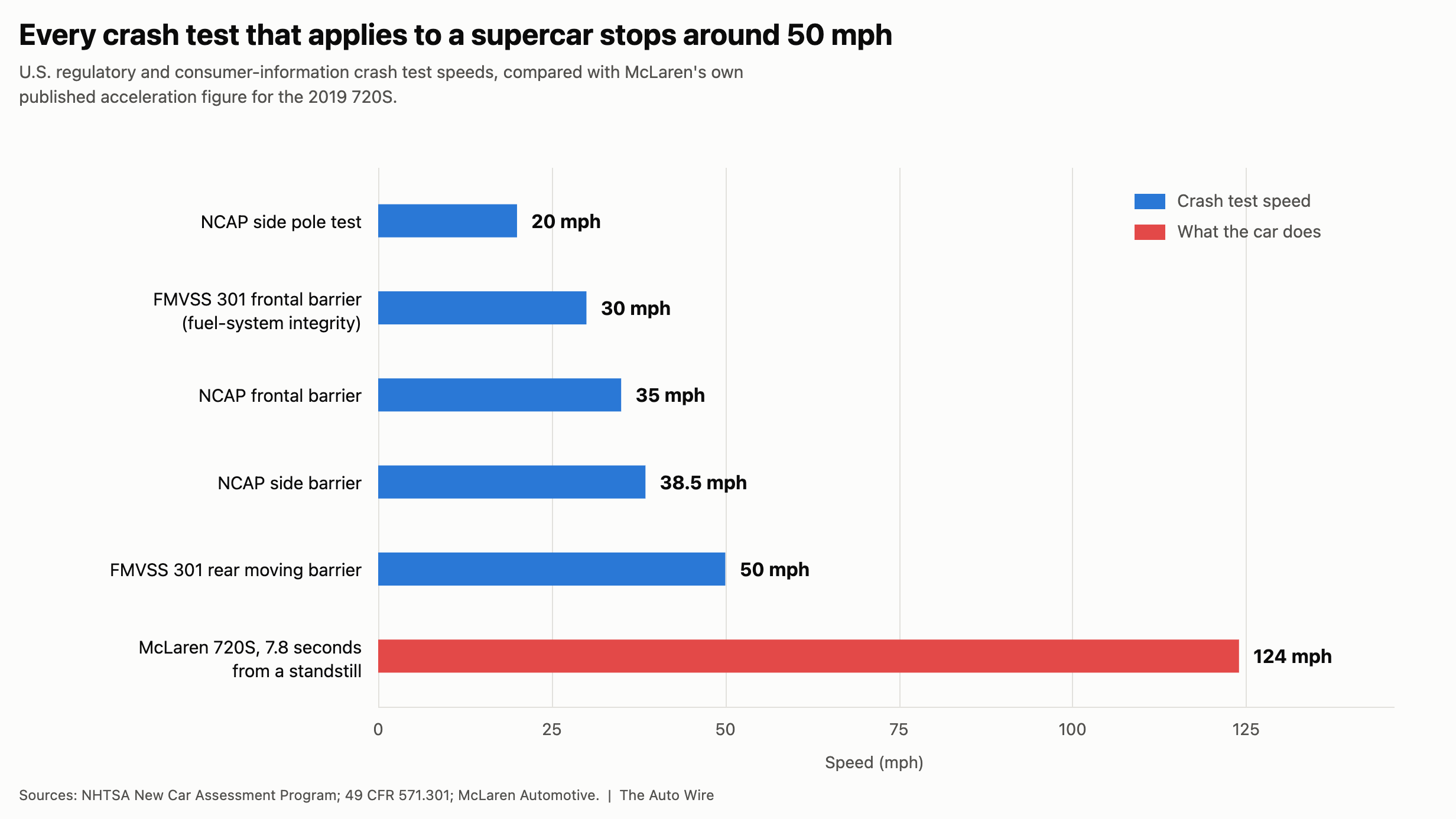
Crash energy scales with the square of speed, which is the single most useful piece of physics a driver can carry around. A 70-mph impact is not twice as violent as the 35-mph NCAP test. It is four times as violent. At 105 mph it is nine times. The structural engineering that earns a car a good frontal rating does not get proportionally better as the speed climbs; it simply ends up operating in a regime nobody ever asked it about.
And in this case, nobody asked at all. Query NHTSA’s own safety ratings database for the 2019 model year and the make McLaren and it returns a count of zero. No frontal rating, no side rating, no rollover rating, for any of the eight 2019 McLaren models listed in the federal vehicle database: the 540C, 570S, 570GT, 600LT, 720S, GT, Senna and Senna GTR. That is not a scandal and it is not an accusation. NHTSA selects a slate of mostly high-volume vehicles for testing each year, and as the agency itself points out, every car sold here is certified by its own manufacturer as meeting the federal standards. Low-volume exotics self-certify and are essentially never chosen for the crash-test program.
So the honest summary is this: the most powerful street cars sold in America are the ones about which the public crash data is thinnest.
Why the car came apart, and why that is the least interesting detail
“Split in two” is the phrase everyone has fixated on, and it is the phrase that carries the least information.

McLaren builds its road cars around a carbon fibre tub. The 720S structure is called Monocage II; the Sports Series cars of the same era use the MonoCell family. The tub is the survival cell. Around it hang separate structures carrying the powertrain, the suspension and the crash cans. McLaren’s own engineers treat that as the architecture rather than a compromise: in the company’s account of developing the W1’s Aerocell monocoque, its head of body structures describes bolting front suspension directly into the carbon cell as “another first for McLaren Automotive.” Cars built before that first — which is every 2019 McLaren — route those loads through intermediate structures.
A car that separates along the boundary between a survival cell and a bolt-on frame is not automatically a car that failed. It may be a car that ran out of energy-absorbing capacity long before the structure ran out of impact.
More to the point, the phenomenon is not a carbon fibre phenomenon at all. We reported on a McLaren torn in half in Dallas in 2024 after it struck another car and a tree, killing both occupants. We reported on a BMW split in half in Chicago — steel unibody, no exotic materials involved. And we reported on a 720S driver near Munich who walked away after submarining his car under a guardrail, because that impact, violent as it looked, stayed inside what the tub could handle.
The variable is not the material. The variable is what the car hit.
A tree is the worst thing on the road, and we already know it
Here is the second thing most drivers do not know.
Every crash structure in every car you have ever driven is designed around spreading force out. A barrier test loads the whole front of the vehicle at once, so rails, crush cans and subframes all go to work together. A tree does the opposite. It concentrates the entire kinetic energy of the car into a contact patch perhaps a foot wide, and it does not deform, does not slide and does not absorb. It intrudes.
Regulators understand this perfectly. It is exactly why NHTSA’s pole test exists — a 25-centimetre pole, struck at a 75-degree angle — and it is why that test is run at 20 mph, the slowest speed anywhere in the program. The narrow fixed object is the hardest thing in the world to crash into, so it gets tested at the lowest speed of anything.
Trees are also, statistically, among the most dangerous objects in American life. Federal Highway Administration research found trees involved in 10,697 roadway departure fatalities between 2016 and 2018, an average of roughly 3,566 deaths a year. Trees are the most harmful event in about 10 percent of all U.S. traffic fatalities, and 19 percent of roadway departure deaths.
Roughly one in ten people who die on an American road dies against a tree. That number belongs on a billboard.
The road has a design speed too, and nobody told the car
Roadside engineering has its own answer to the tree problem, and it is called the clear zone: an unobstructed, traversable area beside the travel lanes where a driver who leaves the road can recover or stop without striking anything. Its width is a risk calculation built from traffic volume, vehicle speeds and roadside slope.
The FHWA’s reference figures show the scale of that thinking. On a 60-mph highway carrying 6,000 vehicles a day across flat terrain, the recommended clear zone runs about 30 to 32 feet. On low-speed, low-volume roads it can be as little as 7 to 10 feet. Those are the numbers a landscaped suburban arterial gets designed against — a street built for commuters, delivery vans and school runs.
Now consider where the speed driving that calculation comes from. Under California’s manual for setting speed limits, a posted limit generally comes out of an Engineering and Traffic Survey, and that survey is anchored to the 85th percentile speed — the speed at or below which 85 percent of free-flowing traffic is already traveling. The state’s method, by design, calibrates the road to the behavior of ordinary drivers in ordinary cars.
There is no line in that process for the outlier. There is no box on the form asking what happens if one vehicle sitting at that light can be doing triple the posted limit before it reaches the next driveway.
The gap nobody owns
Put the two halves together and the picture gets uncomfortable.
The car was legal. It met every federal standard its manufacturer certified it against, and those standards stop at 50 mph. The road was legal. It was designed, signed and landscaped to standards derived from how normal traffic actually behaves, and those stop somewhere near the posted limit. Both halves of the system did precisely what they were asked to do.
Nobody was ever asked about the space in between. And that space opens up in under eight seconds from a standstill, at any traffic light in America, in a car anyone with the money can buy used.
This is not an argument for banning supercars, and it is not a verdict on anyone who was in that McLaren. Irvine’s investigators will establish the speed, the driver and the sequence, and that work deserves to finish before anybody draws conclusions about the people involved. But there is a structural point sitting underneath this crash that will still be true long after the case file closes.
For most of the last century, the ceiling on how fast a car could be going when things went wrong was set largely by how much road you had. Acceleration was the limiting factor, and the limiting factor was generous. It gave drivers time — time to notice, time to lift, time for the road to talk them out of it.
That buffer is gone. A modern supercar converts a green light into triple-digit speed faster than a driver can reconsider, and everything outside the car — the curb radius, the clear zone, the tree in the parkway, the crash standards printed in the Code of Federal Regulations — was engineered for the world where that buffer still existed.
The cars have been redesigned four or five times since. The street has not been redesigned once.
So where does the fix actually belong? If a street car can reach 124 mph in under eight seconds from a dead stop, is that a problem for the manufacturers, for the agencies that design and post our roads, or for the person holding the key? Share your take in the comments.
Related: This Fatal McLaren Crash Isn’t Really About Speed. It’s About Who’s Buying Supercars Now.
Top photo: Scott Rodgerson on Unsplash.