
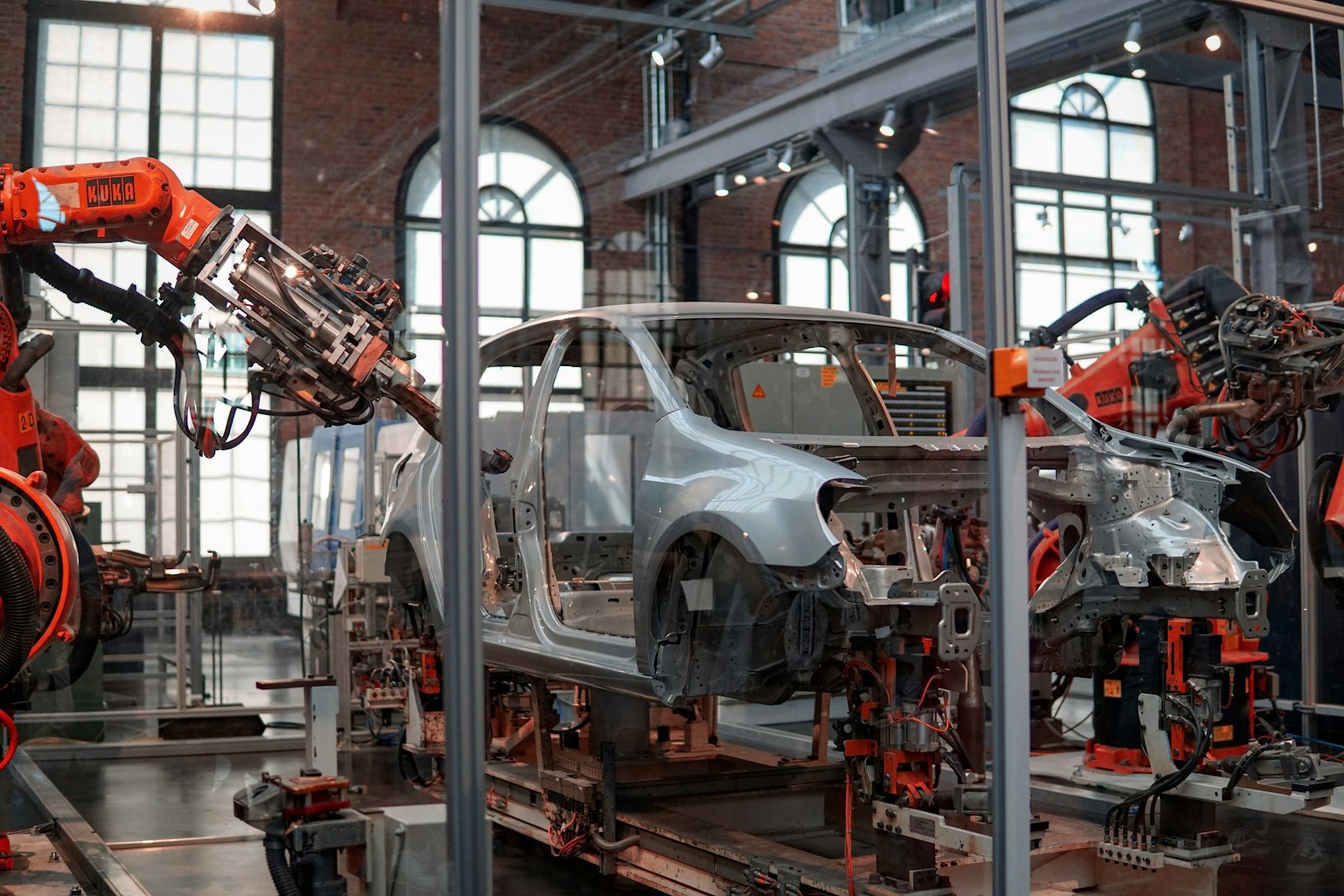
Hyundai told investors last month that the first IONIQ 5 robotaxis for Waymo will be delivered in the fourth quarter, assembled in Georgia using a local supply chain.
That reads like an American manufacturing story, and Hyundai is happy for you to read it that way.
It is really a deadline story. There is a model year on the horizon after which a robotaxi built on a Chinese platform cannot legally be sold or operated in the United States, and the fourth quarter of 2026 is when a compliant supply line has to already be running.
What Hyundai has actually committed to
The partnership was announced on 4 October 2024: Waymo’s sixth-generation driver integrated into the IONIQ 5, the vehicles “assembled at the new Hyundai Motor Group Metaplant America (HMGMA) EV manufacturing facility in Georgia and then integrated with Waymo’s autonomous technology.”
It was the first agreement under Hyundai’s new autonomous vehicle foundry business — part of a wider pivot we examined in why Tesla and Hyundai are building robot armies — selling Level 4-capable vehicles to autonomous driving companies as a product line.
The volume has never been disclosed. Hyundai said “significant volume over multiple years” in 2024 and has not improved on it since. Treat any unit number you see as unsourced.
What has firmed up is the timing. Waymo said in July 2026 that it had “begun autonomously driving, with an autonomous specialist present, our growing fleet of Hyundai IONIQ 5 vehicles” — supervised, not driverless. Then Hyundai’s investor day in August: first deliveries in the fourth quarter, Georgia assembly, local supply chain, and vehicles that “will enable an international expansion of robotaxi services as early as 2027.”
The rule that makes Georgia the answer
Now the legal machinery, because almost none of the coverage of this partnership mentions it.
In January 2025 the Commerce Department’s Bureau of Industry and Security published its connected vehicles rule, effective 17 March 2025 and codified at 15 CFR Part 791, Subpart D.
Check whether a robotaxi is covered, using the rule’s own definitions. A connected vehicle is one that integrates onboard networked hardware with automotive software to communicate wirelessly with any other network or device. An automated driving system is hardware and software collectively capable of performing the entire dynamic driving task. Covered software is software that directly enables the function of vehicle connectivity systems or automated driving systems.
A robotaxi is the most covered vehicle imaginable. It is a connected vehicle, running an automated driving system, on covered software.
The prohibitions then bite at a model year, not a calendar date. The exemption for completed vehicles incorporating covered software runs out at model year 2027. Connectivity hardware follows at model year 2030. And the rule defines model year as decoupled from the calendar: “irrespective of the calendar year in which the vehicle was actually produced.”
That is why a fourth-quarter 2026 delivery is the relevant date. Not because anything happens in December, but because the vehicles being built now are the first of a generation that has to be clean.
The clause about services, which is the one for robotaxis
Most of the rule is about importing and selling vehicles. One section is about something else entirely, and it has barely been written about.
Section 791.304 provides that connected vehicle manufacturers owned by, controlled by, or subject to the jurisdiction of China or Russia may not knowingly sell completed connected vehicles in the United States — and then adds: “These connected vehicle manufacturers are also prohibited from offering commercial services in the United States that utilize completed connected vehicles that incorporate ADS.”
Not selling the car. Running the service. It is a direct prohibition on a Chinese-controlled company operating an American robotaxi business, with no model-year runway attached to that sentence.
Waymo is not a customer here. It is a regulated manufacturer.
And here is the detail that reframes the entire Hyundai relationship.
The rule defines a connected vehicle manufacturer to include a US person who “integrates ADS software on a completed connected vehicle for sale in the United States.”
That is a precise description of what Waymo does. It buys vehicles and installs its driver on them.
So Waymo is not a company shopping for a supplier and happening to prefer an American one. It is itself a regulated entity under this rule, responsible for the provenance of the software and hardware in the vehicles it puts on the road. Choosing a platform is a compliance decision it has to be able to defend, not a procurement preference.
The tariff got the attention. The rule did the work.
There is a useful contrast here for anyone trying to understand which trade instruments actually change corporate behaviour.
In September 2024, the US Trade Representative raised the Section 301 tariff on Chinese electric vehicles to 100 percent. That got enormous coverage.
A tariff is a price. A very large price, but a number a company can model, absorb, pass on or design around.
The connected vehicle rule is not a price. It is a prohibition. You cannot pay your way past it, and it reaches not just the sale but the operation of the service.
The tariff dominated the 2024 conversation. The rule, effective March 2025, is the thing that actually determined where Waymo’s next platform would be assembled.
A name that quietly left the conversation
One observation, offered as an observation rather than a conclusion.
In May 2025 Waymo wrote that it would integrate its sixth-generation driver onto new platforms “beginning this year with the Zeekr RT.”
From February 2026 onward, Waymo’s public writing describes its new vehicle only as the Ojai, manufactured at its own facility in Metro Phoenix with Magna. Zeekr is not named in the dedicated vehicle launch post in May 2026, nor in the August 2026 piece detailing its custom compute and naming seven silicon partners, nor in the September 2026 Las Vegas launch describing a “majority Ojai fleet.”
We reported on the platform it appears to be replacing in why Waymo has been stockpiling Chinese-built robotaxis in Arizona. We are not going to assert that the Ojai is a rebadged Zeekr RT; Waymo has not said so and we could not confirm it. What is verifiable is that a vehicle name Waymo used publicly in 2025 has stopped appearing, on the same timeline as a rule that makes Chinese-platform robotaxis unsellable from model year 2027.
Waymo has, for the record, made no public comment on the connected vehicle rule or on tariffs.
Georgia, and the subsidy that is already gone
The plant at the centre of this is real and large. Hyundai’s Metaplant in Ellabell, Bryan County, opened in March 2025 as part of a $12.6 billion Georgia investment, with capacity for up to 500,000 electrified vehicles a year and 8,500 jobs targeted by 2031. The first vehicle off the line, in October 2024, was an IONIQ 5 — one day before the Waymo partnership was announced.
Hyundai is now raising its local parts sourcing target from 60 to 80 percent by 2030.
And the economics have to work without help. The commercial clean vehicle credit under section 45W — up to $7,500 for a business vehicle under 14,000 pounds — terminated for vehicles acquired after 30 September 2025. Robotaxis delivered in the fourth quarter of 2026 fall entirely outside it.
That is worth sitting with. Two companies are building a domestic robotaxi supply chain with the subsidy removed and only the prohibition remaining. The carrot expired; the stick is what is left.
Why the IONIQ 5 specifically
The platform choice is not arbitrary either, and Waymo named the reason in its own announcement: the 800-volt architecture, which “enables rapid charging with minimal service downtime.”
For a personal car, charging speed is a convenience. For a fleet vehicle, charging time is inventory sitting idle — a car that is plugged in is a car not earning. Hyundai quotes roughly 10 to 80 percent in about 20 minutes on a 350 kW charger. Halving downtime on a fleet is the same as adding vehicles without buying any.
Waymo also cited autonomous-ready modifications, redundant hardware and power doors. The IONIQ 5 has also moved to a native NACS charging port, which matters for a fleet operating across American infrastructure.
What to remember
Forget the delivery date. Remember which kind of rule moved the factory.
Everyone spent 2024 arguing about a 100 percent tariff on Chinese electric vehicles, because tariffs are loud and easy to write about. Meanwhile a Commerce Department rule quietly made it illegal, from a model year now within sight, to sell a robotaxi running Chinese-origin driving software in the United States, or to operate a service with one.
Hyundai’s Georgia plant is the answer to the second thing, not the first. “Built in America” is doing duty here as a legal category rather than a slogan — and the date it has to be true by is measured in model years.
Does it matter to you whether a car being built here is patriotism or just paperwork? Share your thoughts in the comments.