
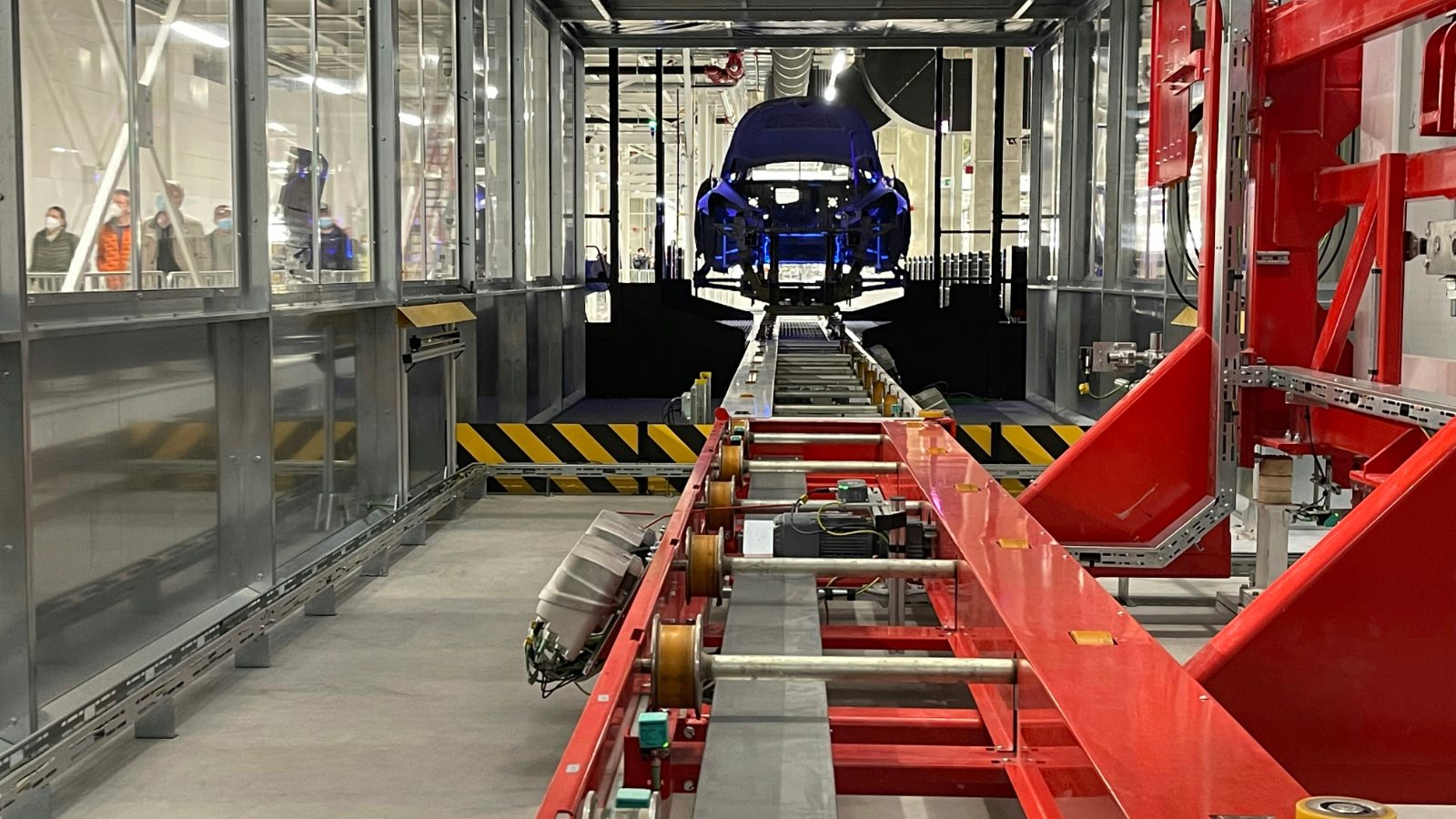
For four decades, there has been one dependable answer to an American trade fight with a foreign automaker: build it here. Honda did it. Toyota, BMW, Mercedes-Benz, Hyundai and Volkswagen followed. Hire American workers, buy American steel, put a plant in somebody’s congressional district, and the political problem quietly converts itself into a ribbon-cutting.
That arrangement is not available to Chinese automakers. The reason has almost nothing to do with tariffs, politics or who holds the scissors at the ribbon. It has to do with who owns the company that writes the software in the dashboard.
Speaking with Laura Ingraham on Fox News’s “The Ingraham Angle,” President Trump said he would not object to Chinese automakers opening American factories. “If China wanted to come in and open a plant to build their cars here, I’d be OK with it,” he said, holding up the Japanese transplants as the model: “The big thing is they hire our people.”
The instinct is grounded in real history. It also runs straight into a federal rule that has been in force since March 2025 — a rule that never asks where a vehicle is assembled. It asks who controls the company assembling it.
The rule that does not care about your ZIP code
The Commerce Department’s connected-vehicle rule, published in the Federal Register in January 2025 and now sitting in the code at 15 CFR Part 791, Subpart D, contains three prohibitions. Two are the ones everybody talks about: no importing Chinese or Russian vehicle-connectivity hardware, and no importing or selling vehicles that carry Chinese or Russian connectivity and automated-driving software.
The third prohibition is the one that matters here, and it is written very differently. It bars connected-vehicle manufacturers “owned by, controlled by, or subject to the jurisdiction or direction of” China or Russia from selling completed connected vehicles in the United States at all — including, in the rule’s own words, when the hardware and software inside them have no connection to either country.
Read that again. A Chinese-owned automaker could build a vehicle in Ohio, with an American-designed modem, American-written infotainment code and American workers on the line, and still be prohibited from selling it. The prohibition attaches to the manufacturer, not to the merchandise. There is no assembly plant anywhere on earth that cures it.
The clock is close, too. The manufacturer prohibition and the software prohibition both bite at model year 2027. The hardware prohibition follows at model year 2030. Model year 2027 vehicles are being built right now.
The rule reaches past sales, as well. A Chinese- or Russian-controlled manufacturer also cannot operate commercial services in the United States using its own vehicles equipped with automated driving systems. That closes the robotaxi door in the same paragraph that closes the showroom door — which is why the economics of Chinese-built autonomous fleets look the way they do. And as we have covered, the rule stops at 10,000 pounds, which leaves buses and heavy trucks outside it entirely.
A Chinese-controlled automaker already builds cars in South Carolina
Here is the part that gets lost in the argument about whether to “let them in.” The premise that no Chinese-owned company builds passenger cars in the United States is already false.
Volvo Car AB is 78.65 percent owned by Geely Sweden Holdings AB, according to Volvo’s own corporate governance report. Volvo’s plant in Ridgeville, South Carolina, builds the electric EX90 and the Polestar 3, and the company says it has put $1.3 billion into the site over the past decade. Late this year, the XC60 joins the line — Volvo’s global best-seller — in what chief executive Håkan Samuelsson described as an ambition to “build where we sell.”
Whether Washington treats a Swedish-headquartered carmaker with a Chinese majority owner as “owned by, controlled by, or subject to the jurisdiction or direction of” China is not a question the rule settles in a sentence. It is a determination, supported by declarations of conformity, general authorizations, and case-by-case specific authorizations that the Bureau of Industry and Security must decide within 90 days. Geely’s reach into Western manufacturing is not hypothetical, either; the same group is taking over a Ford plant in Valencia.
That ambiguity is the story. The bright line most people assume exists — Chinese cars out, American cars in — is in practice a compliance filing.
BYD, meanwhile, has been assembling vehicles on American soil for more than a decade. Its first U.S. manufacturing site, announced for Lancaster, California in a converted recreational-vehicle plant, builds electric buses. Buses sit above the connected-vehicle rule’s weight ceiling.
So the honest version of the president’s comment is not “should we allow this.” It is: we already have, in pieces, and nobody has agreed on where the line falls.

The tariff code is blind to ownership. The security rule is not.
Everyone reaches for tariffs first, and the numbers are genuinely large. Chinese electric vehicles have faced a 100 percent Section 301 duty since September 27, 2024, with 25 percent on lithium-ion EV batteries, stacked on top of the Section 232 duties applied to imported vehicles generally. We have written plenty about where those rates may go next.
But a tariff is a border measure, and a border measure is precisely the thing local assembly defeats. That is the entire lesson of the 1980s.
Now the part that should stop you. A Chinese-owned automaker assembling vehicles in the United States would qualify for the same import adjustment offset that Ford and General Motors receive. The April 2025 proclamation set that offset at 3.75 percent of a vehicle’s suggested retail price in its first year and 2.5 percent in its second. Eligibility turns on domestic assembly and domestic content. It does not ask who owns the company. A plant is a plant.
So the United States now runs two systems that point in opposite directions. The trade architecture rewards the factory. The security architecture punishes the owner. They were written by different agencies to solve different problems, and a Chinese automaker with an American plant would sit exactly in the seam between them.
Why the Japanese playbook does not transfer
The president’s comparison to Japan is fair on the labor question and wrong on the legal one.
Honda announced its Ohio car plant in January 1980, broke ground that December, and built the first Marysville Accord on November 1, 1982. By Honda’s own telling, the company moved before trade friction became a public fight, on Kiyoshi Kawashima’s judgment that “one-way exports would not last indefinitely.”
It worked because the barrier stood at the water’s edge. Quotas and duties apply to things arriving in containers. Move final assembly inside the border and the barrier simply stops applying to you.
The connected-vehicle rule has no water’s edge. Its subject is data flow and remote access, and neither of those stops at a port. A telematics control unit in Ohio phones home the same way one in Shenzhen does.
The old trade border was a coastline. The new one runs through the telematics unit in your dashboard, and no one can build a factory on the far side of it.
Congress wants to replace judgment with a number
Legislators are not waiting for Commerce to make case-by-case calls. The Connected Vehicle Security Act of 2026, introduced in April by Sens. Bernie Moreno and Elissa Slotkin, would bar the import, manufacture, sale, resale and introduction into interstate commerce of connected vehicles tied to China, Russia, North Korea or Iran. The Senate Commerce Committee advanced it on July 22.
The bill’s test is arithmetic. More than 15 percent of the equity interest, voting interest, board representation or other indicia of control in a vehicle’s manufacturer triggers the ban; the threshold rises to 25 percent for covered software and hardware. Vehicles and software are covered from January 1, 2027, hardware from January 1, 2030. We have already picked through the suppliers that language quietly sweeps in.
A hard number is easier to comply with. It is also easier to engineer around. Commerce’s standard — owned by, controlled by, or subject to the jurisdiction or direction of — is deliberately elastic, because control in corporate structures is frequently exercised through something other than a share count. A 15 percent line, by contrast, is a target. Restructure to 14.9 and you are outside the statute while remaining, in substance, the same company with the same parent and the same code repository. Committee chairman Ted Cruz acknowledged the balancing act at the markup, saying the national-security risks are real but so are “the dangers of writing an indiscriminate measure.”
The industry is pushing for the widest version. In a September 3 letter to House and Senate leadership, Alliance for Automotive Innovation chief executive John Bozzella asked Congress for a permanent ban on Chinese connected vehicles, hardware and software, arguing that American manufacturers are not competing with companies so much as with “the entire country of China.” Back in April, responding to the Moreno-Slotkin bill, he was more direct: “The U.S. will not throw open the doors to Chinese automakers to manufacture or sell here.”
Note the verb. Detroit’s trade group is not principally worried about imports. It is worried about plants. Which tells you the industry understood the stakes of a factory-based strategy long before anyone asked the president about it on television.
What this means if you are just trying to buy a car
Nobody should expect a $20,000 Chinese electric car in an American showroom because of a cable-news answer. The more useful takeaway is the reverse: you should not expect one even if a Chinese company breaks ground in Texas tomorrow, because the plant was never the obstacle.
There is a second-order effect worth thinking about, and it applies to every modern car regardless of where it was screwed together. Software is not a one-time transaction. It is a standing dependency on a manufacturer’s continued ability to reach your vehicle. Volvo pushed Apple Music into two million cars overnight; that pipeline runs in both directions. And when a supplier relationship collapses, owners find out what was actually promised — as EX90 buyers learned when a hardware feature quietly became a subscription.
Any regime with the power to revoke a manufacturer’s authorization to sell also has the power, in effect, to strand the cars it already sold. That is a new category of ownership risk, and it is not written on any window sticker.
The idea worth keeping
Forget the percentages and the model years for a moment. The durable point is this: “domestic” has stopped describing a place.
For most of the industry’s history, a car’s nationality was settled by geography and payroll. Build it in Marysville with Ohio workers and it counted as American, whatever the logo said. That definition held because the things governments feared — lost jobs, trade imbalances, hollowed-out factory towns — were all things a factory could fix. The thing Washington fears now is a data path, and a factory cannot fix a data path. So the definition has migrated from the parking lot to the software bill of materials, and the ownership structure on a corporate filing now matters more to a car’s legal status than the state printed on its Monroney label. Stellantis has already said out loud that it expects the car world to split into two incompatible halves. This is what that split looks like in regulation.
The president can offer a Chinese automaker a factory. Only Congress and the Commerce Department can offer it a customer.
So here is the question worth arguing about: if a Chinese-owned company built a car in Ohio, with American workers, American steel and American-written software, would you call it an American car — and would you put one in your driveway?
Do you think building factories here should be enough to lift the ban? Let us know in the comments.