
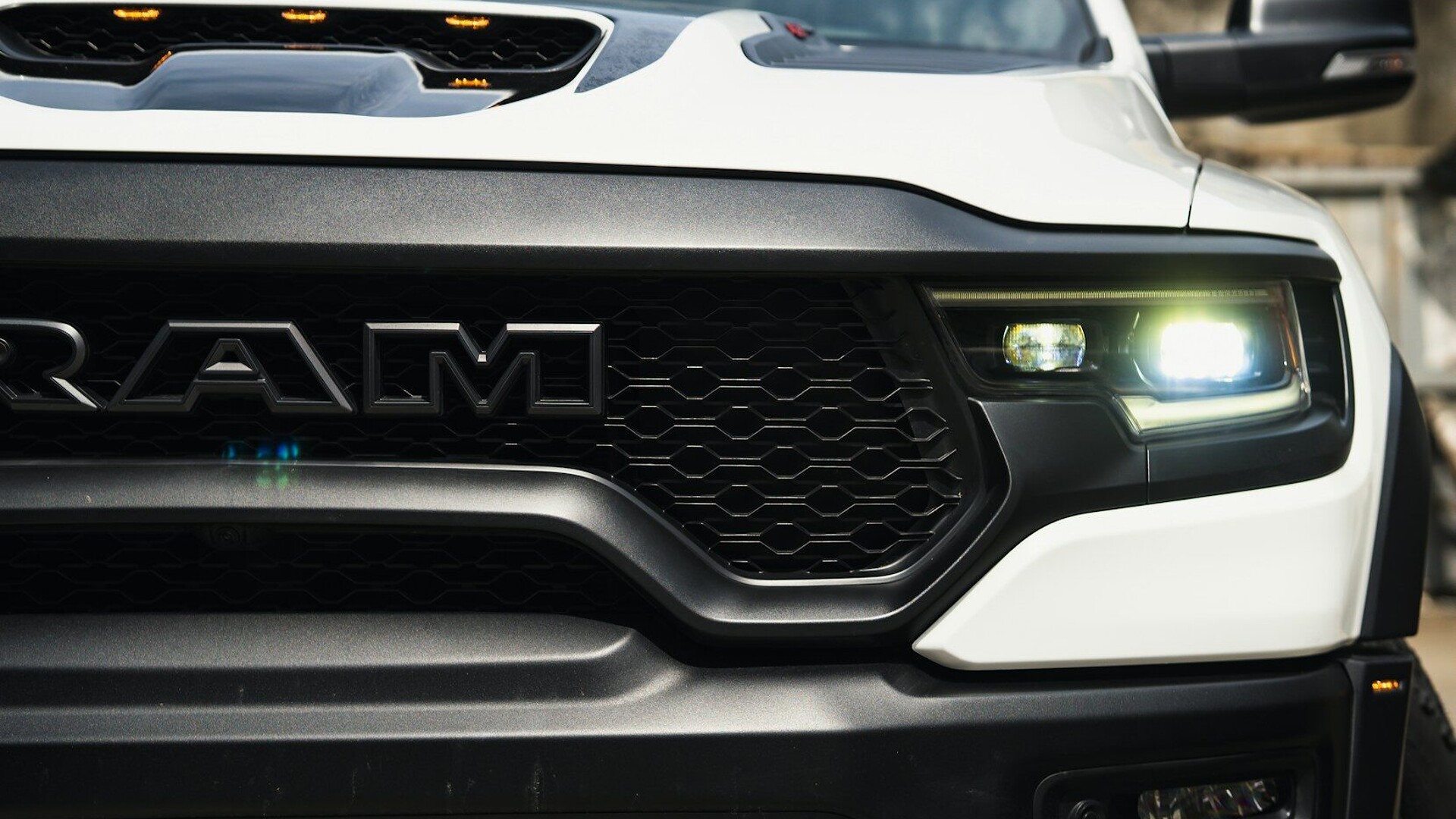
The 2025 Ram 1500 has been recalled eight times. Six of those recalls are software faults: the instrument cluster, the trailer tow module, the rearview camera, the tire pressure display, the stability control, the headlights.
Stellantis, in other words, has no difficulty filing a federal defect report when bad code is the problem. It has done it six times on this one truck.
The engine is not on the list. It is the one thing being fixed quietly.
What the federal file actually contains
Start with what is verifiable, because on this story a lot is not. Reports of a class action alleging defective engine and powertrain control modules in 2025 Ram 1500s have circulated, but The Auto Wire could not locate the filing in public federal court records. We are not going to print a case number we cannot see. What follows is the regulatory record, which is public, extensive, and more interesting anyway.
NHTSA’s file for the 2025 Ram 1500 shows 337 owner complaints, 8 recalls, 579 manufacturer communications and, notably, zero open defect investigations.
Of those 337 complaints, 108 involve the engine, powertrain, fuel system or speed control. The 2024 truck, by comparison, has 70 complaints total. The 2025 model is running at roughly five times the complaint volume of the truck it replaced.
Break out the themes and one signal dominates. Reports mentioning misfire, shudder or rough running: 19 on the 2025 truck, one on the 2024. Reports of stalling or shutting off: 51 versus 16.
The complaints that matter are the low-mileage ones
Owner complaints are unverified by definition, and we treat them the way we did with Ford’s EcoBoost petition — as a pattern to test against the manufacturer’s own bulletins. They are also filed under penalty of law and they are the only public window into a failure pattern before a regulator acts. These are verbatim.
ODI 11621276, filed at 280 miles: “Started the vehicle at 280 miles and the check engine light started flashing and engine running rough, sounding rough and stalling out. After restart check engine light was solid and I drove to nearest dealership. I was told it’s Multiple Cylinder Misfire codes and that it’s a known issue with these engines/models.”
ODI 11626729, at 200 miles: “Ram has acknowledged the issue but doesn’t have a fix almost 6 months later. I call the dealer monthly and they always say there is no fix.”
ODI 11669498, four days after purchase: “At the time of purchase the vehicle had just 25 miles on it. The drive home from the dealership was about 87 miles. A few miles from home, the truck began to shake violently when the gas pedal was pressed.”
And ODI 11653107, which is the one that stays with you: “Suddenly every warning light came on and all systems failed. Engine had stopped and computer had shifted vehicle into neutral. Power steering and power brakes had failed as well… The vehicle was still coasting at highway speed!!!”
GMET6: Stellantis names the problem in its own service literature
Now the documents Stellantis wrote itself, which are the strongest evidence in this story.
Technical service bulletin 18-072-26, issued 22 July 2026, is titled for an internal engine code: GMET6. That stands for Global Medium Engine Turbo, six cylinders. It is the Hurricane.
The bulletin lists the trouble codes: P0300 multiple cylinder misfire, then P0301 through P0306. Cylinder one, two, three, four, five, six. Every cylinder in the engine. The customer symptom is “engine missing or running rough.” The remedy is a software reflash.
Bulletin 18-077-26, from 19 August 2026, is blunter still: “Flash: Powertrain Control Module (PCM) Updates… This bulletin involves reprogramming the PCM with the latest available software.”
Then look at the cadence. Powertrain control module flashes: September 2024, revised October, revised November, December 2024, June 2025, July 2025, revised September, revised again September, revised October, revised November, March 2026, July 2026, August 2026. Ignition system control module flashes run a parallel track from September 2024 through March 2025, with their own A and B revisions.
Twenty-two control-module reflashes in two years, many of them revisions of revisions. A bulletin that reaches REV. C is not a fix. It is a company still looking for one.
Why a software fault is legally a defect, and why that matters here
There is a common assumption that a recall is for broken parts and a software update is just housekeeping. The statute does not say that.
Federal law at 49 U.S.C. 30102 defines a defect as “any defect in performance, construction, a component, or material.” Performance comes first. Code that makes an engine behave wrongly is a defect in performance even though nothing is physically broken.
The international functional-safety standard, ISO 26262, frames it the same way: it addresses hazards caused by “malfunctioning behaviour” of electrical and electronic systems. Behaviour, not breakage.
And under 49 CFR Part 573, a manufacturer must file a defect report within five working days of determining a defect is safety-related. That clock is the whole ballgame, because it only starts when the manufacturer decides. Stellantis has decided six times on this truck for other software. It has not decided on the engine.
Whether that is a judgment call or an avoidance is exactly the question a defect investigation would answer. There isn’t one.
The award arrived sixteen days before the first misfire bulletin
Some timelines are too neat to leave out.
On 5 September 2024, Stellantis announced that the 3.0-litre Hurricane High Output had been named to Wards 10 Best Engines, winning “in its first year of availability.”
On 21 September 2024, it issued the first ignition system control module flash for multiple-cylinder misfires.
Sixteen days.
The engine existed for a carbon target that no longer applies
The Hurricane was not built because customers asked for it. Stellantis said so plainly when it launched the engine in March 2022. Propulsion chief Micky Bly tied it directly to “a 50% reduction in carbon emissions by 2030” and the Dare Forward 2030 plan, promising V8-rivalling output while being “up to 15% more efficient than larger engines.”
The 2025 Ram 1500 duly launched with no V8 at all: Hurricane standard output at 420 horsepower, high output at 540, and a Pentastar V6.
Fourteen months later Stellantis reversed it. From the June 2025 release bringing back the 5.7-litre HEMI, Ram CEO Tim Kuniskis: “Ram screwed up when we dropped the HEMI — we own it and we fixed it.” And: “At the end of each month, we count sales to customers, not to statisticians or ideologues. Data be damned — we raise our flag and let the HEMI ring free again!”
The trucks get a “Symbol of Protest” fender badge, and Stellantis has since leaned further into the reversal with a turbo-lag fix that reads as much like penance as engineering. The Hurricane, meanwhile, was on its eighth powertrain control module reflash.
The sentence Stellantis put in a federal filing
For scale, go to the money, because Stellantis has already said the quiet part in a document signed for the SEC.
Its 2025 Form 20-F reports a net loss of €22.3 billion and discloses a change in estimate for contractual warranty provisions of €4,130 million in the operating-income reconciliation, with the notes describing €5.4 billion in additional provisions recognised within cost of revenues.
The stated reason: “recent increases in cost inflation and a deterioration in quality, as a result of operational choices, which did not deliver the expected quality performance.”
The same filing adds: “In 2025, we decided to recall approximately 13.4 million vehicles.”
“Operational choices” is doing an enormous amount of work in that sentence. None of it is broken out by model or engine, and nothing in the filing points at the Hurricane specifically. But a company does not add €5.4 billion to its warranty reserve because of one truck, and it does not describe its own quality problem as a consequence of choices unless someone chose.
What to remember
Forget the bulletin numbers. Remember the shape of the thing.
When the instrument cluster in this truck goes blank, Stellantis files a federal defect report and mails 72,509 letters. When the engine misfires on all six cylinders, Stellantis writes a bulletin, reflashes the module, and revises it four months later.
The difference is not the severity of the failure. An engine that stalls in traffic is not a lesser problem than a dark gauge cluster. The difference is that the recall system is triggered by a manufacturer deciding it has a safety defect, and a software update is what a manufacturer can do instead of deciding.
Twenty-two reflashes into the Hurricane, that decision still has not been made.
Should a truck with 22 reflashes and ongoing misfires get an actual recall? Sound off in the comments.