

The number worth circling in Honda’s newest aircraft announcement is not 2,625 nautical miles, and it is not 450 knots. It is 2031.
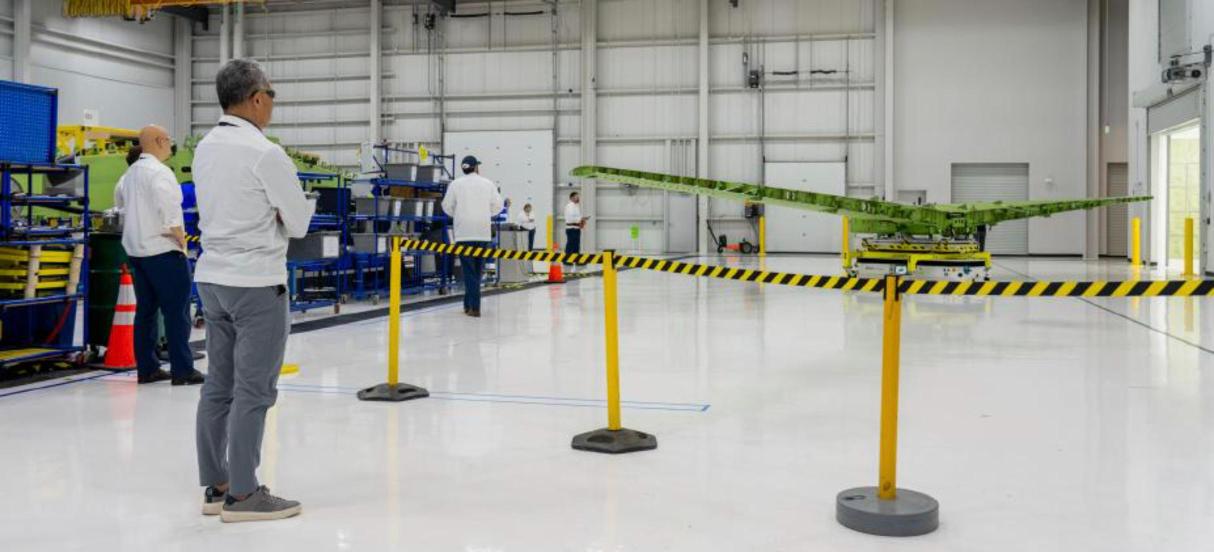
That is the year Honda Aircraft Company now expects to hand the first HondaJet Echelon to a paying customer. When Honda named the airplane and published its schedule in October 2023, first flight was set for 2026 and type certification for 2028. On Tuesday, announcing that it had completed the first wing structure for the test aircraft, the company quietly reset that calendar: first flight in 2028, type certification and first delivery in 2031.
Honda’s explanation for a three-year slip runs to one clause. The revised timeline, the company said, “reflects tier-one supplier-related schedule adjustments.”
That clause is the story. The wing is not.
A wing that took nineteen months
Honda said in February 2025 that wing structure assembly had begun on the first test unit, with the assembly tooling installed at the end of 2024. The announcement that the first wing structure is complete arrived roughly nineteen months later.
That sounds worse than it is, because nobody builds a first article to produce a wing. You build it to find out whether your tooling produces a wing. The first structure is where a manufacturer learns whether its jigs hold true, whether its drill templates land where the drawings say, and whether the tolerance stack-up of a few thousand incoming parts still closes when they are all bolted and bonded together at once. The first one is an experiment. The fifth one is a factory.
Honda says five wing structures are now in various stages of final assembly and that mainline final assembly should begin in early 2027. Fine. But read the manufacturing status line in the release again: more than 70 percent of the parts required for first assembly are on hand.
Not all of them. Nineteen months into building the structure of the single most consequential airplane in the company’s future, Honda is still waiting on something close to a third of the parts for it.
That is what “tier-one supplier-related” looks like from the shop floor.
Honda builds jet engines in North Carolina. The Echelon will not use them.
Here is a fact that reframes the entire program. Honda designs, certifies and manufactures turbofan engines. The HF120 was developed with General Electric, is sold through the GE Honda Aero Engines joint venture formed in 2004, is built by Honda Aero, and produces 2,095 pounds of thrust.
The Echelon will fly behind a pair of Williams International FJ44-4C engines.
There is nothing scandalous in that. The HF120 was sized for a very light jet carrying four to six people. An eleven-occupant airplane crossing the country nonstop needs considerably more thrust, and developing a clean-sheet engine in that class is a program unto itself: years of work, its own certification campaign, its own supply base. Buying a proven engine is the rational decision, and Honda made it at the very start of the project.
Notice what the rational decision costs, though. Honda’s entire aviation identity was built on refusing to outsource the hard part. The company began aircraft research in 1986 and started designing its own airplane in 1988. Its MH02 experimental flew in 1993. The HondaJet that first flew in December 2003 did so on Honda’s own HF118 engines. Honda Aircraft Company was formally established in 2006, and provisional FAA type certification came in March 2015.
The Echelon is the first HondaJet on which the most complex single component does not belong to Honda. It is also the first HondaJet to be delayed by a supplier. Those two sentences are not a coincidence.
The reason it can seat eleven is a thirty-year-old argument about shock waves
The HondaJet’s signature feature is the engine pylon standing on top of the wing, and it exists because Honda refused to accept the received wisdom about it. Conventional thinking held that an over-wing nacelle was an aerodynamic penalty, because at high subsonic speed the nacelle and the wing upper surface would throw interfering shock waves at each other and drag would climb.
Honda’s finding was that the penalty depends entirely on placement. Put the nacelle in the right spot and its pressure field can be made to work against the wing’s shock rather than reinforce it. Honda’s own account of the work says the over-the-wing arrangement ended up outperforming the conventional rear-fuselage mounting it was supposed to lose to.
The aerodynamics were the headline. The structure was the point.
A business jet with engines hung off the rear fuselage needs heavy internal structure to carry those loads across the airframe, and that structure lives inside the cabin, eating the back of the airplane. Move the engines out onto the wing and the requirement goes away. The fuselage becomes usable from the nose to the tail cone.
Which is why an eleven-occupant Echelon can still call itself a light jet. A layout decision made to solve a drag problem in the 1990s is the reason the cabin scales in the 2030s. That is what good engineering looks like when it compounds.
What “more than 530 letters of intent” actually tells you
Honda says customer enthusiasm “remains exceptionally strong,” and cites more than 530 signed letters of intent.
In February 2025, the same executive said the program had “almost 500 letters of intent signed to date, and numbers increasing every month.”
Roughly thirty in nineteen months is not monthly growth.
It is also worth being precise about what a letter of intent is, because the aviation industry and the car industry have the same bad habit here. An LOI is a non-binding expression of interest that reserves a position in a delivery queue. It is not a purchase agreement, it obligates nobody to take the airplane, and it does not become order backlog. Anyone who watched refundable electric-vehicle reservation totals get quoted as demand a few years ago has seen this movie.
None of which means the interest is imaginary. It means the softest number in the release is the one Honda chose to lead with, at the exact moment the delivery date moved three years to the right. A queue position you signed up for in 2024 expecting a 2028 airplane is a long thing to hold onto.
The product is not the range. It is the permission.
The Echelon’s central claim is that it will be the world’s first single-pilot certified light jet with U.S. transcontinental range. Read that again, because the differentiator is not a performance number. It is a certificate.
Under 14 CFR 91.531, a turbojet-powered multiengine airplane has to be flown with a second in command unless that airplane is type certificated for operation with one pilot. Honda is not really selling 2,625 nautical miles of target range. Plenty of airplanes will fly that far. Honda is selling 2,625 nautical miles flown while the owner pays one flight-crew salary instead of two.
That is why the feature list reads the way it does. Emergency Autoland, Auto Throttle, Autobrake, a runway overrun awareness and alerting system, advanced steering augmentation: those are not comfort items. They are the evidence Honda intends to put in front of the FAA to argue that one human can safely operate this airplane on a coast-to-coast leg. Every one of them is a brick in a regulatory case.
Anyone following driver assistance in cars should recognize the shape of this immediately. The capability arrives years before the permission, and the permission is the slow part. Honda’s aviation arm is running the same experiment its automotive arm is running with hands-off driving, except in aviation the regulator makes you write the argument down and prove it before anyone is allowed to use it.
Why a company writing off billions still funds an airplane
The backdrop matters. In March, Honda cancelled the Honda 0 SUV, the Honda 0 Saloon and the Acura RSX for North America, warned of as much as 2.5 trillion yen in losses across the current and future fiscal years, and swung its operating forecast from a 550 billion yen profit to a loss. Ten months before that it had already cut planned electrification spending from 10 trillion yen to 7 trillion yen through fiscal 2031. We have written about how that retreat is reshaping what Honda builds in Alabama and how Honda develops vehicles at all.
Against that, Honda Aircraft is a rounding error. Global HondaJet deliveries passed 250 in 2024. That is cumulative, across the entire life of the program. No version of that business moves Honda’s earnings.
So the jet is not there for the money. It is there as proof. It is the clearest surviving statement that Honda is an engineering company that solves problems nobody asked it to solve, which is the same instinct behind restoring and selling its old race cars and the same reputation that its balance sheet has been leaning on through a rough two years.
Which is exactly why the supplier line in this week’s release stings. The proof-of-engineering program just got held up by somebody else’s delivery schedule.
What to remember
Honda spent four decades learning to build an airplane without anyone’s help. Then it designed one that needs everybody’s.
That is not an indictment of the Echelon, which looks like a genuinely clever airplane and is being built with more discipline than most clean-sheet aircraft programs manage. It is a description of a trade. Buy the engine, buy the systems, concentrate your own people on the airframe and the cabin, and you get a better product to market faster and cheaper. It is the same trade the automobile industry made decades ago, for the same sound reasons, and it arrives with the same invoice: you no longer own your own calendar. Honda’s car business has spent this year pressing its suppliers on cost and losing weeks of Civic production to a single plant it does not control. Its aircraft business just learned the same lesson in a cleaner room.
So when a manufacturer tells you a delay is “tier-one supplier-related,” it is not making an excuse. It is showing you an org chart.
Remember that the next time a car company tells you a launch has moved.
Here is the argument worth having: when a company that made its name building its own engines starts buying somebody else’s, is that a sign of maturity, or the first step toward becoming just another assembler? Where do you land?
Would a three-year delay change whether you’d still buy in? Tell us in the comments.