
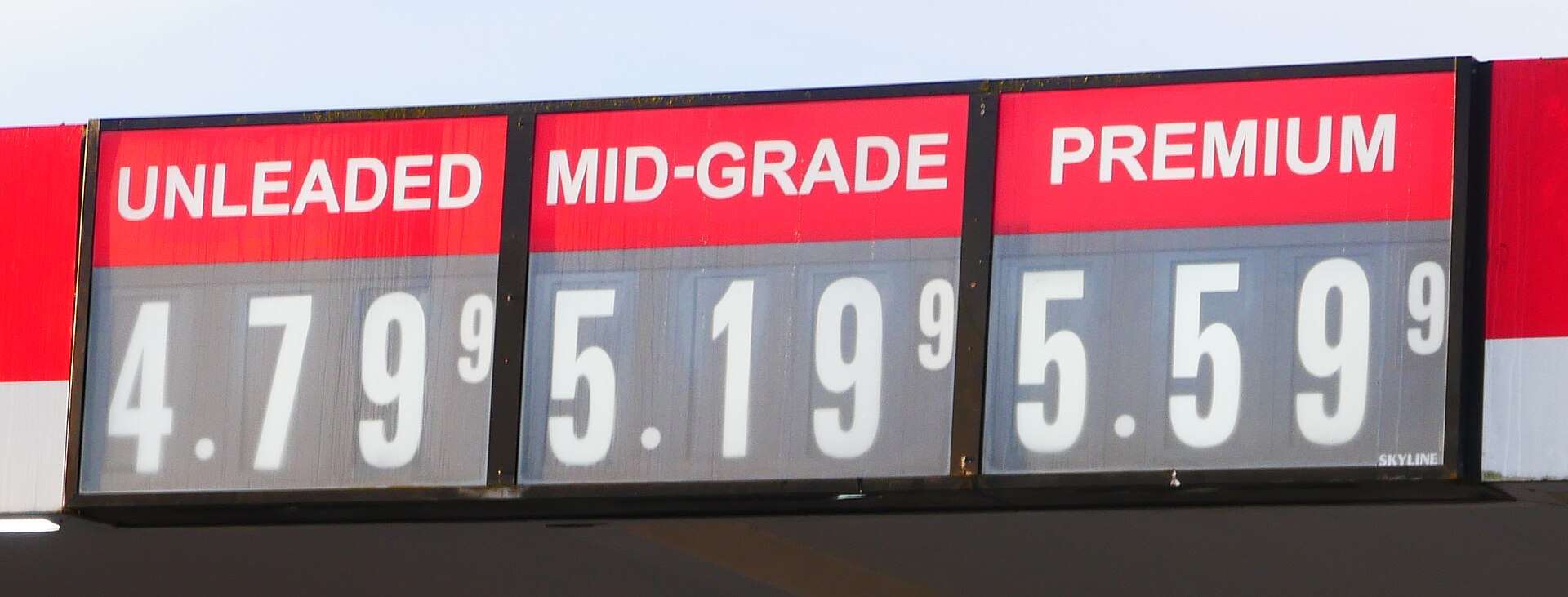
The most useful number inside this week’s record diesel prices is not $6.29. It is $1.97 — the gap between a gallon of on-highway diesel and a gallon of regular gasoline. Sit with that one, because it is the whole story.
Diesel holds roughly 14% more energy per gallon than gasoline — 137,381 Btu against 120,166 Btu, using the Energy Information Administration’s own 2026 conversion figures. It currently costs 45.5% more to buy. Every argument ever made for paying extra for a compression-ignition engine was built on the first number. The pump is being priced off the second.
Record diesel prices are not, whatever your instinct says, a story about a crude oil shortage. The United States is on track to produce more crude this year than in any year in its history. American refiners are making more diesel than they have since 2019. The fuel set a nominal record anyway. Understanding why means looking past the barrel and at the machinery that cuts it apart.
The number that broke the record
The EIA’s weekly survey put the national average on-highway diesel price at $6.285 per gallon on Monday, September 14. The agency says that is the highest figure in nominal terms since the series began in 1994, and the highest in inflation-adjusted terms since 2022. We flagged the moment diesel first pushed past $6 earlier this month.
The velocity is the part that should worry people. Diesel climbed 31.8 cents in a single week. In the Lower Atlantic it jumped 49.1 cents in seven days. Year over year, diesel is up roughly 68%. Regular gasoline over the same twelve months is up roughly 36%. West Coast diesel averages $7.250 a gallon. California averages $8.039.
Two fuels, one barrel, wildly different trajectories. That divergence is the clue.
American refineries are already running flat out
Here is the fact that reframes everything. U.S. distillate production averaged 5.1 million barrels per day from January through August, the most since 2019, and refineries ran at 97% utilization in the week ending September 11. There is no idle capacity waiting to be switched on. The industry is not holding back. It is redlined.
What changed is where the diesel goes. Refining activity has fallen in Russia, China and the Middle East, leaving the rest of the world short of middle distillate and bidding for America’s. U.S. net distillate exports have sat near or above the 2021–2025 high since February. Inventories, which normally build through summer, went sideways instead. By September 11 they were 15.8 million barrels, or 13%, below the five-year seasonal average.
The United States is not running out of diesel. It is selling diesel to people willing to outbid you for it.
That shows up in the crack spread, the rough measure of what a refiner earns turning crude into product. The EIA’s September Short-Term Energy Outlook raised its 2026 distillate crack spread forecast to $1.57 a gallon, up 20.8% from the previous month’s estimate, and lifted the 2027 figure to $1.25. Refiners are not the villains of this story. They are unambiguously the beneficiaries.
Crude is something you drill for. Diesel is something you have to build a factory for.
Here is the second thing most drivers never learn. As of January 1, 2026 there were 130 operable refineries in the United States, and the newest one with meaningful downstream processing capacity is Marathon’s plant in Garyville, Louisiana. It came online in 1977. Nearly everything built since is a small splitter, an asphalt plant or a condensate unit. The 2022 Galveston facility that technically holds the title of newest U.S. refinery runs 45,000 barrels a day, about 7% of Garyville’s current 617,000.
Capacity has grown, but through expansions bolted onto half-century-old sites rather than new ground. That matters because diesel is not simply decanted out of crude. A 42-gallon barrel yields about 19 to 20 gallons of gasoline and 11 to 13 gallons of ultra-low-sulfur distillate. Refiners can tilt that mix toward whichever product pays better, but the tilt has hard engineering limits, and at 97% utilization there is nothing left to tilt with.
The specification is rigid too. The EPA has required 15 parts-per-million sulfur for all highway diesel since the 2006–2010 phase-in, with nonroad, locomotive and marine fuel following by 2014. Before federal regulation began in 1993, diesel could carry 5,000 ppm. You cannot close a domestic shortfall by pouring in whatever distillate happens to be floating around the Atlantic basin. It has to be hydrotreated to spec, and hydrotreating capacity is precisely what nobody has been adding.
The federal backstop is smaller than one afternoon
Third surprise. Washington does keep an emergency diesel stockpile for the region most exposed to a winter delivery failure: the Northeast Home Heating Oil Reserve, one million barrels of ultra-low-sulfur distillate split among South Portland, Boston, the Groton–New Haven corridor and New York Harbor.
Measure that against 5.1 million barrels a day of national distillate output and the entire federal reserve works out to under five hours of production. It was built to keep heating oil trucks moving through a regional supply interruption, not to bend a national average. Anyone waiting for the government to open a valve and fix the pump should understand there is no valve that size.
You pay for this even if you have never bought a gallon of diesel
The EIA is careful to say it neither calculates nor regulates fuel surcharges. It also acknowledges that many shippers, carriers and owner-operators feed its weekly retail diesel figure straight into their pricing formulas. So a federal statistical survey, released on a Monday afternoon, quietly reprices an enormous share of American freight every seven days.
Record diesel prices do not stay in the trucking lane. That cost travels. It rides into grocery shelves, building materials, parts counters and the floorplan interest on the cars sitting at your local dealership. It reaches the person who drives an EV and has never thought about a fuel island. Diesel is also the fuel of the harvest, and in the Northeast it heats houses, which means autumn is when agriculture and home heating begin competing for the same middle cut of the barrel that jet fuel comes from. The calendar could hardly be less helpful.
What record diesel prices do to the ownership math
Now the part that matters if there is a diesel in your driveway. Diesel has run above gasoline almost continuously since September 2004, for three reasons the EIA states plainly: strong global demand, the cost of the low-sulfur transition, and a federal excise tax of 24.4 cents a gallon against gasoline’s 18.4. A modest premium is normal. A 45.5% premium is not.
Run the arithmetic. At today’s spread, a diesel must deliver 45.5% better fuel economy than its gasoline equivalent simply to break even on fuel cost per mile. In California the bar is 47%. Very few light-duty diesels clear that. The thermal efficiency advantage that justified the option box, along with the aftertreatment hardware, the diesel exhaust fluid and the pricier filters, is being eaten alive by a spread no engineer designed around.
Fuel is only one line in the ledger, as the AAA figures behind our look at what it actually costs to own a new car show. But it is the line that moves fastest. Stack it on top of the EPA’s 2027 heavy-duty rewrite, which trims sticker prices while shifting repair exposure onto owners, and the reasons why DEF systems keep failing in genuine cold, and the modern diesel value proposition starts looking less like a bargain and more like a bet on the spread coming back in.
For fleets it is worse, because the alternative to a diesel work truck is not always a gasoline work truck. Sometimes it is a battery-electric one that cannot do the job, which is the tension we described when Toyota’s electric Hilux showed up towing less than half what the diesel version tows. Expensive diesel does not automatically manufacture electric converts. It manufactures deferred purchases and older trucks kept in service longer.
What to remember
Record diesel prices are not forecast to stay here. Brent crude averaged $91 a barrel in August and is projected near $90 through the rest of 2026 before easing to roughly $74 in 2027. Retail diesel is forecast to average $5.07 this year and $4.40 next. Those are real declines, and they are worth noting before anyone panics.
Then read the inventory line in the same outlook. Distillate stocks are expected to drop below 100 million barrels in September and stay under the five-year low through much of 2027. The price comes down. The margin for error does not. One refinery fire, one hard cold snap, one shipping lane interrupted, and the whole thing reprices again.
That is the lesson worth keeping. Cheap crude and cheap fuel are not the same thing. The country spent two decades solving the first problem and none of them solving the second. The barrel was never the bottleneck. The machine that cuts it up is, and the newest one that counts opened in 1977.