
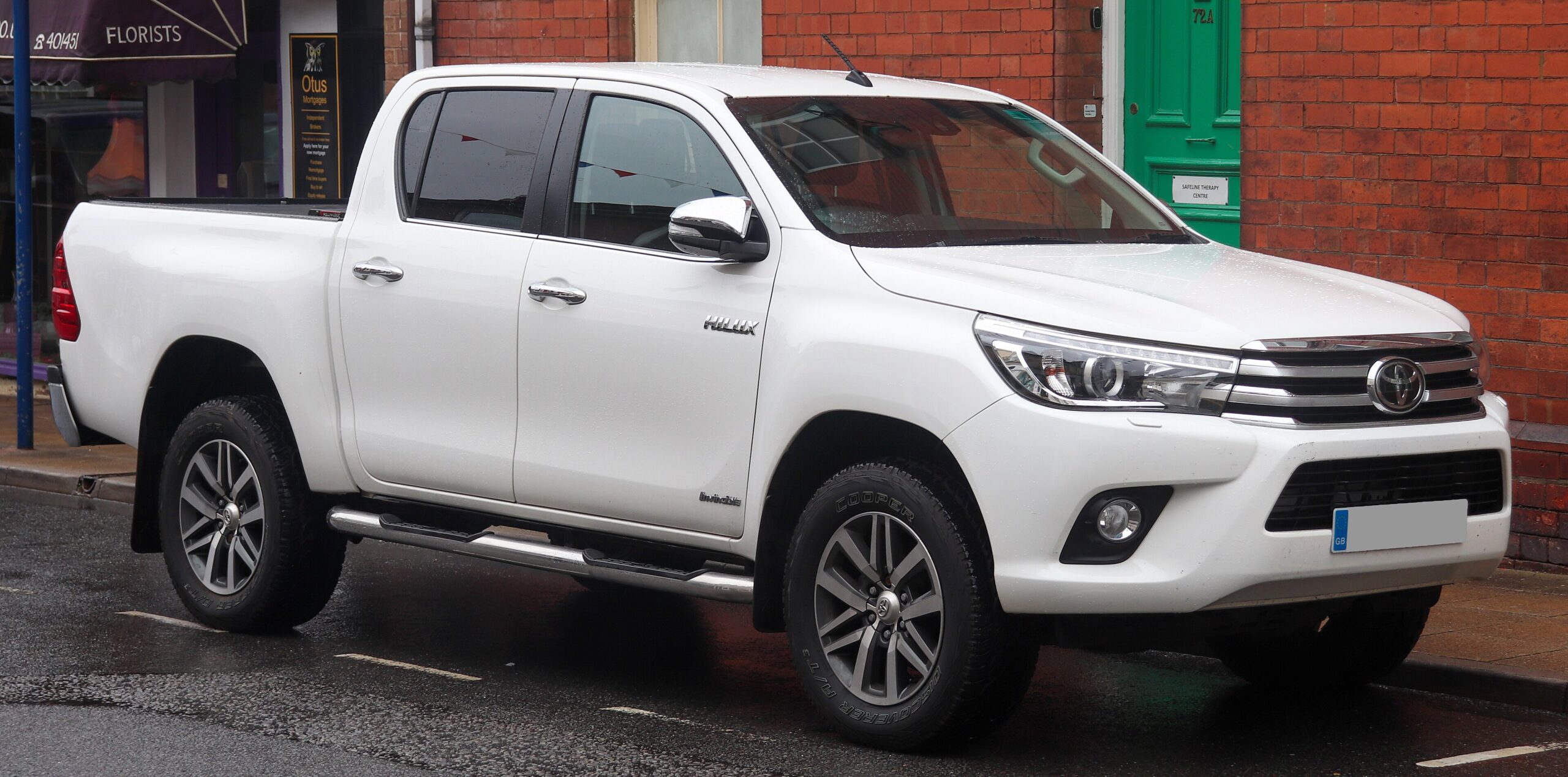
A Toyota Hilux is not a lifestyle purchase in most of the world. It is equipment. It goes where the pavement stops, where the dealer network thins out and where the power grid is a rumor, and it drags a loaded trailer home afterward. Toyota says it has sold more than 27 million of them over more than half a century on that reputation.
The battery-electric Hilux, the first in the nameplate’s history, breaks that reputation in two very specific places.
It tows 3,527 pounds (1,600 kg). The diesel tows 7,716 pounds (3,500 kg). It carries roughly 1,576 pounds (715 kg) of payload. The diesel carries more than 2,205 pounds (1,000 kg). Against the truck parked beside it on the same showroom floor, the electric Hilux gives up more than half its towing capacity and about 600 pounds of load.
That is not an engineering failure.
Toyota spent real money re-engineering a ladder frame to make this vehicle exist, and the company that built its entire commercial-vehicle reputation on durability has not forgotten how towing works. The compromise was chosen. Once you understand what it was chosen for, the ninth-generation Hilux stops looking like an electrification story and starts looking like a regulatory one.
So here is the argument: the electric Hilux was never designed to replace the diesel Hilux. It was designed for a narrow, tightly regulated corner of Europe where a pickup’s hardest job is moving a fleet-average emissions number and clearing a government grant threshold. Toyota, to its credit, came close to saying exactly that in its own press material.
What Toyota Actually Announced
The ninth-generation Hilux had its world premiere in Bangkok on November 10, 2025, which tells you something before a single specification does. It is built at Toyota’s Ban Pho plant in Thailand, on the IMV architecture the company introduced in 2004 and has since used for roughly 14 million vehicles. Toyota’s plans for an electric version leaked days before the reveal, and the finished truck confirmed the leak in every meaningful respect.
The lineup splits three ways. A 2.8-liter diesel with a 48-volt hybrid system makes 204 horsepower and 500 Nm, carries more than a tonne and tows 3,500 kg. A battery-electric version uses a 59.2 kWh lithium-ion pack — 80 cells in five water-cooled modules — feeding front and rear eAxles with silicon-carbide inverters for permanent all-wheel drive. A 2.7-liter gasoline engine survives for Eastern Europe.
Toyota’s European range figure for the electric model is approximately 150 miles, flagged as pre-homologation. At the Bangkok premiere the company quoted more than 300 km on a different measure. Read the test cycle before you read the number.
Charging is respectable for a body-on-frame truck: more than 150 kW on CCS2, 10 to 80 percent in about half an hour, roughly six and a half hours on a 10 kW AC connection.
UK pricing makes the positioning obvious. The diesel starts at £42,845. The electric version starts at £57,845, before a £5,000 government grant. Roughly fifteen thousand pounds separates the cheapest Hilux from the cheapest electric one, and the electric one does less work.
The Battery Cost the Hilux Its Rear Axle
This is the part worth the attention of anyone who cares how trucks are actually built.
A pickup’s rear suspension is traditionally a live axle on leaf springs: one rigid housing carrying the differential, the halfshafts and the wheels, all of it moving together. It is crude, cheap, enormously strong and completely appropriate for a vehicle that spends its working life overloaded.
You cannot do that with an electric rear axle. The eAxle — motor, inverter and reduction gearing in a single case — is too heavy and too delicate to hang off the end of the suspension, and there is nowhere left to put it once a battery occupies the space between the frame rails.
Toyota’s answer was a de Dion rear end, still on leaf springs, fitted to the electric Hilux and to nothing else in the range. A de Dion layout keeps a rigid tube tying the rear wheels together, preserving the geometry a work truck wants, while the drive unit bolts to the frame instead of riding on the axle. The idea is French, it dates to the 1890s, and it reappears here because it solves a problem Toyota did not have until it put a battery in a pickup.
It costs something. The electric Hilux’s break-over angle drops four degrees, to 20, because there is now a battery where there used to be air. Ground clearance holds at 207 mm and wading depth at 700 mm, both credible, but the truck’s ability to crest a sharp ridge without grounding its belly is measurably worse than its siblings’.
The frame was rebuilt around the pack. Toyota added crossmembers and reprofiled others to clear the rear eAxle, reinforced the frame side rails with aluminum impact-absorbing sections, added spot welds through the floor and stiffened the rear anti-roll bar. This is the first time Toyota has placed a battery inside a body-on-frame vehicle, and the problem is not abstract: the most expensive and most fire-sensitive component in the vehicle now lives inside the structure most likely to meet a rock.
Torque Was Never the Constraint
Here is where the electric-truck conversation usually goes wrong.
The electric Hilux is not short on muscle. Two motors, instant torque, 144 kW of system output at the premiere. If towing were purely a question of pulling force, an electric truck would out-tow a diesel every single time.
Tow ratings are not set by torque. They are set by gross combined mass, by braking capacity, and by how long a driveline can shed heat on a sustained grade. Add several hundred kilograms of battery to a chassis with a fixed gross vehicle mass and payload falls by precisely that much. Subtract again for the trailer counted against the combined ceiling. The electric Hilux does not tow less because it is weak. It tows less because it is heavy, and because heat and legal mass limits are indifferent to how much torque a motor makes.
That is the same trade every electric pickup on earth is making right now, including the American ones. Toyota simply chose to publish the consequences instead of engineering around them with a bigger battery.
Toyota Told Us Exactly Who This Truck Is For
Buried in Toyota’s European material is the most revealing sentence of the entire launch. The electric Hilux, the company says, will be particularly suited to single-location operations, such as forestry, industrial complexes and infrastructure sites such as airports and ferry terminals.
Read that list again.
Forestry blocks. Industrial parks. Airports. Ferry terminals. Every one is a fenced site with a gate, a predictable daily mileage and somewhere to plug in overnight. None of them needs 3,500 kg of towing. None of them involves a 400-mile run to a job nobody has surveyed yet.
Toyota did not build an electric version of the truck that made the Hilux famous. It built a depot vehicle wearing a Hilux badge, and it was honest enough to describe the duty cycle in the press release rather than pretend the thing is a drop-in replacement.
The Math That Makes an Electric Hilux Worth Building
So why build it at all?
Because in Europe the Hilux is not a truck. It is a van, legally speaking — and vans have a carbon budget.
The European Union’s CO2 standards for light commercial vehicles set a fleet-wide average of 153.9 g/km for new vans from 2025 through 2029, falling to 90.6 g/km from 2030 and to zero from 2035. Each manufacturer gets its own target derived from the average mass of the vehicles it registers, and for 2025 through 2027 compliance is measured across the three years combined rather than annually.
The diesel Hilux burns 9.7 to 10.0 liters per 100 km. Nothing about that number is ever getting to 90.6 grams. A zero-emission Hilux registered alongside it helps, and every registration helps a little more.
Then there is the direct subsidy. The UK’s plug-in van grant pays up to £5,000 toward a large van weighing between 2,500 kg and 4,250 kg that emits nothing at the tailpipe and can travel at least 60 miles on electric power.
Sixty miles.
The electric Hilux’s roughly 150-mile range clears that bar two and a half times over, which says less about the Hilux than it does about how low the threshold sits. It also explains why Toyota’s UK press release mentions the grant in the same breath as the price.
The 750 Kilograms Almost Nobody Mentions
Now the detail that makes the entire category possible, and that almost never surfaces in coverage of electric commercial vehicles.
An ordinary British category B driving licence normally tops out at a vehicle with a maximum authorised mass of 3,500 kg. Go heavier and you need a heavier licence, more training, and a much smaller pool of employees legally allowed behind the wheel.
For zero-emission vehicles, the UK raises that ceiling to 4,250 kg. Same licence. Same driver. An extra 750 kg of allowance, granted specifically because batteries are heavy.
That headroom is not a footnote. It is the reason an electric pickup can gain several hundred kilograms of battery and still be driven by the same groundskeeper who drove the diesel. Without it, a large share of the electric commercial vehicles now on sale in Britain would be a staffing problem rather than a purchase.
Weight is the hidden tax on every electric work vehicle. This is one of the few places where a government has simply decided to waive it.
Meanwhile, in the Rest of the World
Japan got its new Hilux in May 2026. It is a diesel — the 2.8-liter 1GD-FTV with a six-speed automatic and part-time four-wheel drive — sold in two grades at ¥4,980,800 and ¥5,500,000, built in Thailand and shipped home.
Toyota’s sales target for it: 690 units.
Six hundred and ninety. For the ninth generation of one of the best-selling vehicles in human history, in the country that created it. The Hilux’s home market is a rounding error, which is precisely why the truck is engineered in Thailand’s image rather than Japan’s.
Toyota chief branding officer Simon Humphries framed the lineup with a line that reads like boilerplate until you look at the product plan: “no two regions are the same, and no customer is the same.” An electric Hilux for Western Europe. A 48-volt diesel for everywhere that actually tows. A gasoline four for Eastern Europe. And a hydrogen fuel-cell Hilux promised for Europe and Oceania in 2028, developed from ten prototypes hand-built at Toyota’s plant in Derby, England with UK government backing, carrying 7.8 kg of hydrogen in three tanks for roughly 600 km.
Four powertrains, one badge, and no pretense that any of them is the answer everywhere.
Why You Will Not Be Buying One
Americans get none of this, and the reason has nothing to do with appetite.
The United States charges a most-favored-nation tariff of 2.5 percent on imported passenger vehicles and 25 percent on imported light trucks. A tenfold difference, applied to precisely the category the Hilux occupies. That gap is why the most recognizable pickup on the planet has never had a US showroom, and why Toyota sells Americans a Tacoma instead — a truck built in North America specifically so it never has to cross that line. Volkswagen is currently working the same problem from the other direction.
It also means the American electric-pickup debate has been running as though the rest of the world were not conducting a far more disciplined experiment. US manufacturers sold electric trucks on capability — horsepower, tow ratings, the promise that nothing would be surrendered — and then discovered that hitching a trailer cuts the range roughly in half. The cheapest electric trucks now reaching American buyers are quietly making the same concession Toyota made openly.
What to Remember
Forget the kilowatt-hours. Forget the trim walk.
The Hilux earned its name where the road ends. The electric one was built for places with a fence, a gate and a charger inside it — and Toyota priced it, rated it and marketed it accordingly.
That is not a retreat. It may be the most clear-eyed thing a manufacturer has done with an electric truck yet. Toyota looked at a vehicle that sells 27 million copies on a promise of going anywhere, concluded that battery power cannot yet keep that promise, and shipped a battery version regardless — scoped to the one job it can do well, in the one market whose rules will pay for it.
The harder question arrives in 2035, when the EU’s van target reaches zero and “the diesel one is still available” stops being an answer.
Your turn: if an electric work truck could only do one job properly, which job should it be — and would you trade half the towing capacity to get it?
Would you accept half the towing capacity for an electric truck? Tell us in the comments.