
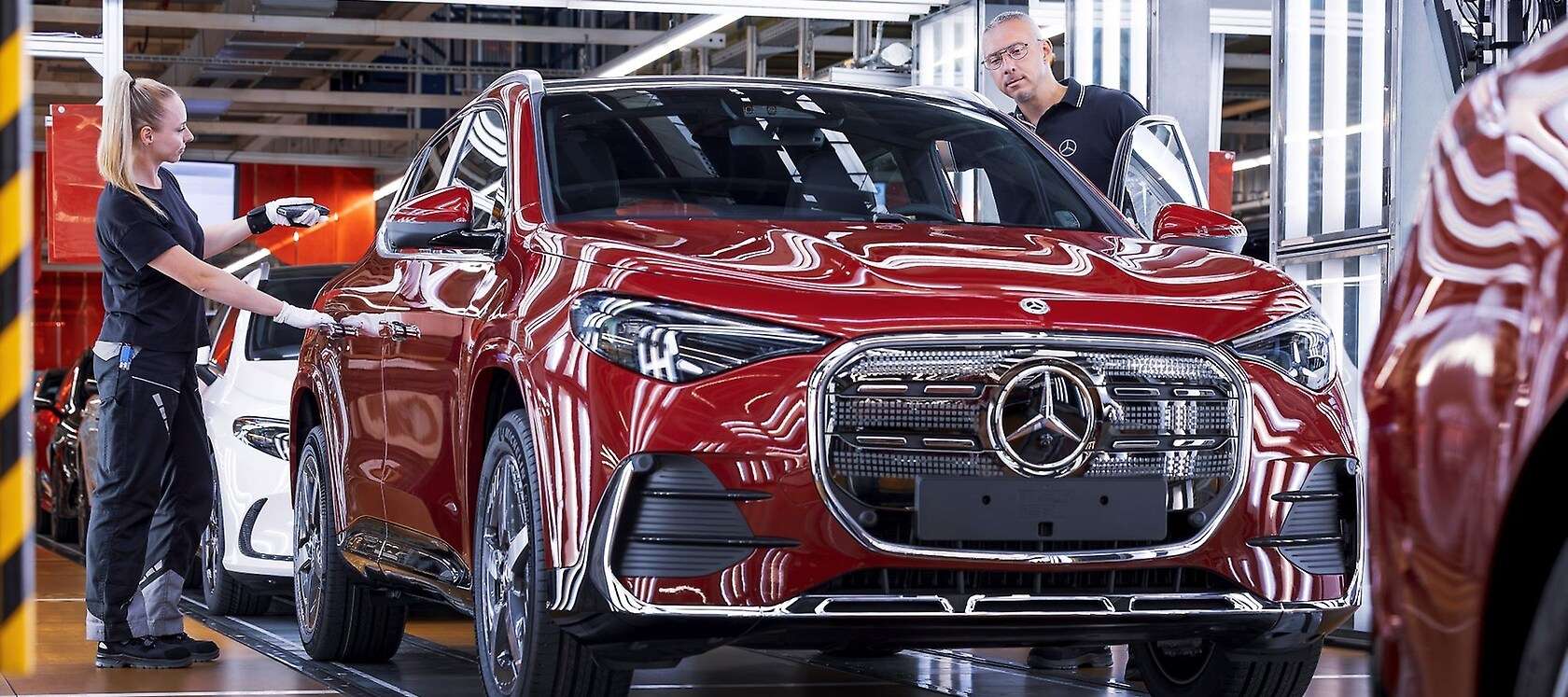
Mercedes-Benz has finally said the quiet part out loud. At a works meeting at its Sindelfingen plant on Monday, September 21, production chief Michael Schiebe told employees the company’s clear goal is to keep all of its German sites. There was a condition attached, though: management and labor must agree on cost cuts. The company made the remarks public the following day.
If there’s no deal, the company said it would have to close “ein deutsches Aufbauwerk sowie ein deutsches Powertrainwerk schließen müssen.” In plain English: one German vehicle assembly plant and one German powertrain plant.
Related Articles
- Somebody Took Apart A Flock Camera And Found 1.6 Million Photos, Including One Of A Flag Patch
- Volkswagen Is Europe’s Biggest Company By Revenue Now. That’s Not The Same As Winning.
No plants were named, and no timeline was given. That’s deliberate. A threat that points at nobody in particular makes everybody nervous, and nervous workforces are easier to negotiate with. This is labor-talks leverage dressed up as a factory announcement. That doesn’t make it empty.
The Shortlist Nobody Wants to Be On
Mercedes’ own production network page makes the math simple. The company’s German vehicle plants are Bremen, Rastatt and Sindelfingen.
The powertrain side is more crowded. It includes Affalterbach, where AMG builds engines; Berlin; Hamburg; and Untertürkheim. There’s also the Accumotive battery subsidiary in Kamenz and MDC Power in Kölleda and Arnstadt. Jawor, the other powertrain site on the list, is in Poland and outside this fight.
Untertürkheim is the heavyweight. Mercedes calls it the largest site in its global powertrain network. It employed 12,500 people as of December 2025. The site builds engines, axles, transmissions, electric drive units, components and battery systems, and it has been making the electric drive units for the CLA and later EVs.
Why a Powertrain Plant Is the Easier Target
This is where the engineering drives the economics. A modern combustion engine is a monument to machining. Blocks, heads, crankshafts, camshafts and valvetrain parts all need precision cutting, assembly and hot testing. That takes a lot of floor space, a lot of specialized equipment and a lot of skilled people.
An electric drive unit is simpler to build. It’s essentially a motor, an inverter and a reduction gearbox in a single housing. There are far fewer moving parts and far fewer machining operations per unit.
So as a carmaker’s mix shifts toward EVs, powertrain capacity built for the combustion era becomes surplus faster than assembly capacity does. Every car still needs a body shop, a paint shop and final assembly, whatever powers it. Engine lines have no such guarantee. It’s not hard to see why Mercedes treats one powertrain plant as expendable in a worst-case scenario.
The Numbers Behind the Ultimatum
Mercedes isn’t bluffing from a position of comfort. According to its Q2 interim report, the Mercedes-Benz Cars division earned just €49 million in EBIT on nearly €23 billion in revenue in the second quarter. That’s a margin of 0.2%, or rounding error for a luxury brand.
Strip out one-time items and adjusted return on sales was 4.0%, down from 5.1% a year earlier. Those one-time items include €752 million in impairments on Mercedes’ Chinese joint-venture stakes.
China is the real wound. Mercedes-Benz Cars sales there fell 30% in the second quarter to 98,624 vehicles. The company blamed intense competition, cautious consumers and model changeovers. Germany, oddly enough, was a bright spot: sales rose 6%.
Here’s the wrinkle labor will certainly point to. In the same half-year, Mercedes paid its shareholders a €3.3 billion dividend and spent €1.8 billion buying back its own shares. Telling workers to put in extra hours for free while shareholders collect billions is a tough sell on a factory floor. Management would counter that the dividend reflects last year’s results, while the cost problem is structural and years deep.
What “Productivity Offensive” Actually Means
The plant threat is the sharp end of a campaign that started in the summer. Mercedes’ Board of Management launched a “productivity offensive for Germany” in June 2026. The stated measures include radically faster processes, leaner structures, more in-office presence, and more working hours without extra pay.
The company also pushed a scheduled worker payment, the so-called transformation component that was due in July 2026, back to 2027. It is also reviewing other pay components and special payments.
Historical context explains why the unpaid-hours demand is so explosive. German metal and electrical industry workers fought for their shorter working week through strikes decades ago, and it remains a cornerstone of the regional collective agreements. Asking people to work longer for the same money is a direct challenge to the union’s signature achievement. It isn’t a minor tweak.
Mercedes has also run out of its gentler tools. A voluntary workforce reduction program for employees in indirect areas in Germany, agreed with the General Works Council, launched in April 2025 and ended on March 31, 2026. The company paid about €1.1 billion related to restructuring in the first half of 2026 alone. The easy headcount savings are gone. What’s left is hours, pay and footprint.
The Footprint Is Already Moving
Look at where Mercedes is building new things. The new electric C-Class went into production in July 2026 in Kecskemét, Hungary, not in Germany. The company’s comprehensively revised GLE and GLS premiered at its Tuscaloosa, Alabama plant alongside the site’s five millionth SUV.
The shrinking has already started elsewhere, too. GLB production at the Aguascalientes plant in Mexico, jointly run with Nissan, ended as planned in May 2026, and the company is negotiating to sell the operation.
That’s a manufacturer actively redrawing its map. As recently as 2022, Mercedes announced that management and employee representatives had agreed on how its European production network would be set up for an all-electric future. That consensus now looks like it came from a different era.
What It Means for Owners and Buyers
If you own a Mercedes, nothing changes today. Your warranty obligation sits with the company, not with any single factory. Replacement parts for current models come through the global parts network. Even if a plant closure were eventually agreed, it would take years to wind down, and production would be moved rather than simply dropped.
Related Articles
- Your Paid-Off Car Can Still Be Seized Over a Debt That Has Nothing to Do With Cars
- Nobody Can Build A Refinery In 90 Days, So The Feds Just Let Fuel Truckers Drive 16-Hour Shifts
There are subtler effects worth watching, though:
- Launch quality. The riskiest moment in any car’s life is when its production moves. New lines, new workers and new supplier logistics mean early build quality can wobble. If a model’s production shifts plants, consider waiting a few months into the new run before buying.
- Build location and pricing. Where a car is assembled matters more than it used to because of trade policy. A U.S.-bound model that moves between Germany, Hungary or the United States can see its landed cost change. That affects your eventual sticker price.
- Resale. Whether a car was built in Bremen or Kecskemét is unlikely to move used-car values much. What would hurt is any wave of quality issues tied to a rushed transition.
The Bottom Line
Mercedes has put a price on keeping its German footprint intact, and the price is paid in working hours. The warning is conditional, and it’s aimed as much at the negotiating table as at any specific building.
But the direction is clear. China profits have collapsed, new models are launching in Hungary and the U.S., and the combustion-era powertrain footprint is shrinking. Even if labor and management reach a deal, the German production system that built Mercedes’ reputation is going to look very different by the end of the decade.
Images Via: Mercedes-Benz