
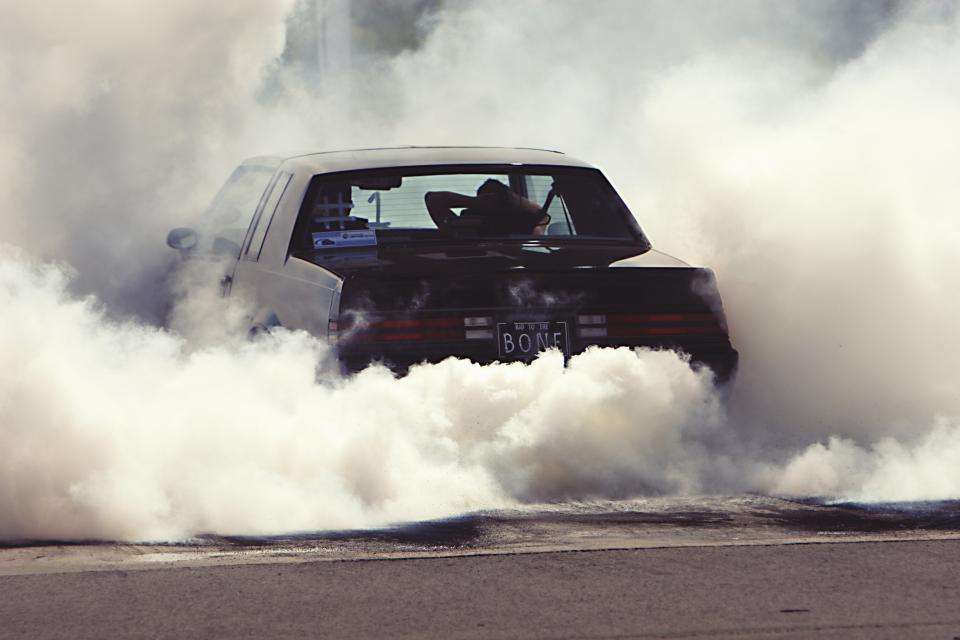
Of the 570 citations Los Angeles police wrote at a single street takeover over Labor Day weekend, not one was for driving.
Every citation fell into one of two piles, according to figures LAPD released after the bust: 442 for spectating at a speed contest, and 128 for juveniles out past curfew. The people accused of doing the driving were handled differently. They were arrested.
That split is the story. For years, the default assumption at a takeover has been that the people doing donuts carry the legal risk and the people filming them are background. In Harbor Gateway, the background got the paperwork: 442 street takeover spectators were cited in a single night.
What happened at Figueroa and Alondra
The crowd gathered at South Figueroa Street and West Alondra Boulevard in the early hours of Saturday, Sept. 5. LAPD put attendance at more than 700 people.
Police were ready for it. Chief Jim McDonnell said at a news conference that a task force of more than 150 officers from LAPD, the California Highway Patrol and the Los Angeles County Sheriff’s Department had tracked earlier sideshows with drones and intelligence work, then moved in and boxed the crowd.
LAPD’s final count:
- 69 arrests, most for participating in the takeover and a few for offenses including battery on an officer and obstruction
- 570 citations: 442 for spectating, 128 for juvenile curfew violations
- About 200 vehicles impounded
- 7 firearms recovered, plus an undisclosed quantity of nitrous oxide
The juveniles cited ranged from 17 down to 11. “Know where your kids are,” McDonnell told parents. He called the event “criminal behavior” and said the operation was “not a one-off.”
McDonnell also said some of the impounded cars were stolen, rented or borrowed. So for some of those 200 tows, the call from the impound lot will reach a rental company or a relative, not the person who drove the car there.
The law nobody seemed to think applied to them
Here is the part that takes the “nobody told us” defense off the table.
Los Angeles has made watching an illegal street race a crime for decades. Section 47.15 of the Los Angeles Municipal Code, “Spectators Prohibited at Speed Contests and Exhibitions of Speed,” has been on the books since at least 2002, when its current version took effect.
It makes it unlawful to be “knowingly present as a spectator” at an illegal speed contest or exhibition of speed on a public street. It also covers people present while one is being set up. The ordinance draws a line: being within 150 feet of the action, or of the preparations, counts as present.
The code spells out what “preparations” look like, and it could pass for a description of a modern takeover: groups showing up at a set location, people lining the street, traffic blocked, cars lined up with engines running, engines revving and tires spinning, and a starter in position.
The penalty is a misdemeanor, punishable by up to six months in jail, a fine of up to $1,000, or both. The ordinance also lets prosecutors bring up a person’s attendance at other speed events in the previous three years to show they knew what they were watching.
LAPD described the 442 citations as being for spectating at a speed contest. The department’s announcement did not break down which code section each one cited.
What California state law says
State law is less direct than the city’s. California Vehicle Code Section 23109 bans engaging in a speed contest or exhibition of speed. It also bans aiding or abetting one. Aiding or abetting carries up to 90 days in jail, a fine of up to $500, or both. The statute does not have a stand-alone offense for simply watching.
Instead, Sacramento has gone after the cars. In September 2024, Gov. Gavin Newsom signed four bills (AB 1978, AB 2186, AB 2807 and AB 3085). His office said they expanded impound authority “including for spectators and those aiding in illegal speed contests and sideshows.” AB 2807 also made “sideshow” and “street takeover” legally the same thing, so nobody can argue over what to call it.
So in California, a spectator’s risk depends on where they’re standing. The state can take the car. The city decides whether watching is a crime, and how close is too close. Los Angeles says 150 feet. Carlsbad has said 200 feet since 2003.
How other states handle street takeover spectators
Outside California, the rules are uneven. Some are narrower than their headlines suggest.
Georgia. O.C.G.A. § 16-11-43.1 makes it a misdemeanor to be “knowingly present and actively facilitating” an illegal drag race, with a minimum $250 fine. The statute gives blocking the roadway with your vehicle as an example of facilitating. Watching alone isn’t enough; the spectator has to be helping. We covered Georgia’s law after the I-285 takeover.
Texas. Transportation Code § 545.4205, added in 2021, makes it a separate offense to use your body, a car or a barricade to knowingly interfere with a police investigation of highway racing or a reckless-driving exhibition. It targets the crowd that closes ranks when officers arrive, not everyone in it.
Cities acting on their own. Some local governments aren’t waiting for their states. Milwaukee’s mayor backed an ordinance in 2025 setting a minimum $500 fine for spectators cited at takeovers that block traffic.
The pattern is the same everywhere. Lawmakers have figured out that a takeover without an audience is just a few people doing donuts in an empty intersection, and the audience is the part that keeps growing.
What comes next in Los Angeles
Harbor Gateway residents had been pushing the city on this before the bust. On Aug. 19, Councilmember Tim McOsker, whose district includes Figueroa and Alondra, filed a motion asking city departments to look at 30-day impounds, tougher administrative citations and ways to bill takeover participants for damage to city property. After the bust, the City Council voted unanimously for a report on enforcement options and the 50 most-affected intersections citywide.
At that meeting, Deputy Chief Mark Green of LAPD’s South Bureau listed the crimes police are now seeing around takeovers: robberies, shootings, assaults with deadly weapons and looting. The most recent addition to his list was removal of fire hydrants. (For another look at what happens to nearby businesses, see the East L.A. AutoZone ransacked during a takeover.)
For now, the 442 citations are allegations. Anyone cited can contest it, and the records don’t yet show how the cases will be resolved. The question for each of them will be the one the ordinance has asked since 2002: were you within 150 feet, and did you know what you were watching?
The first answer is a matter of measurement. The second is harder to argue when there were 700 people and a lot of revving engines.
Should standing on the sidewalk and filming a street takeover carry the same legal risk as helping block the intersection, or should the law draw the line somewhere else?