
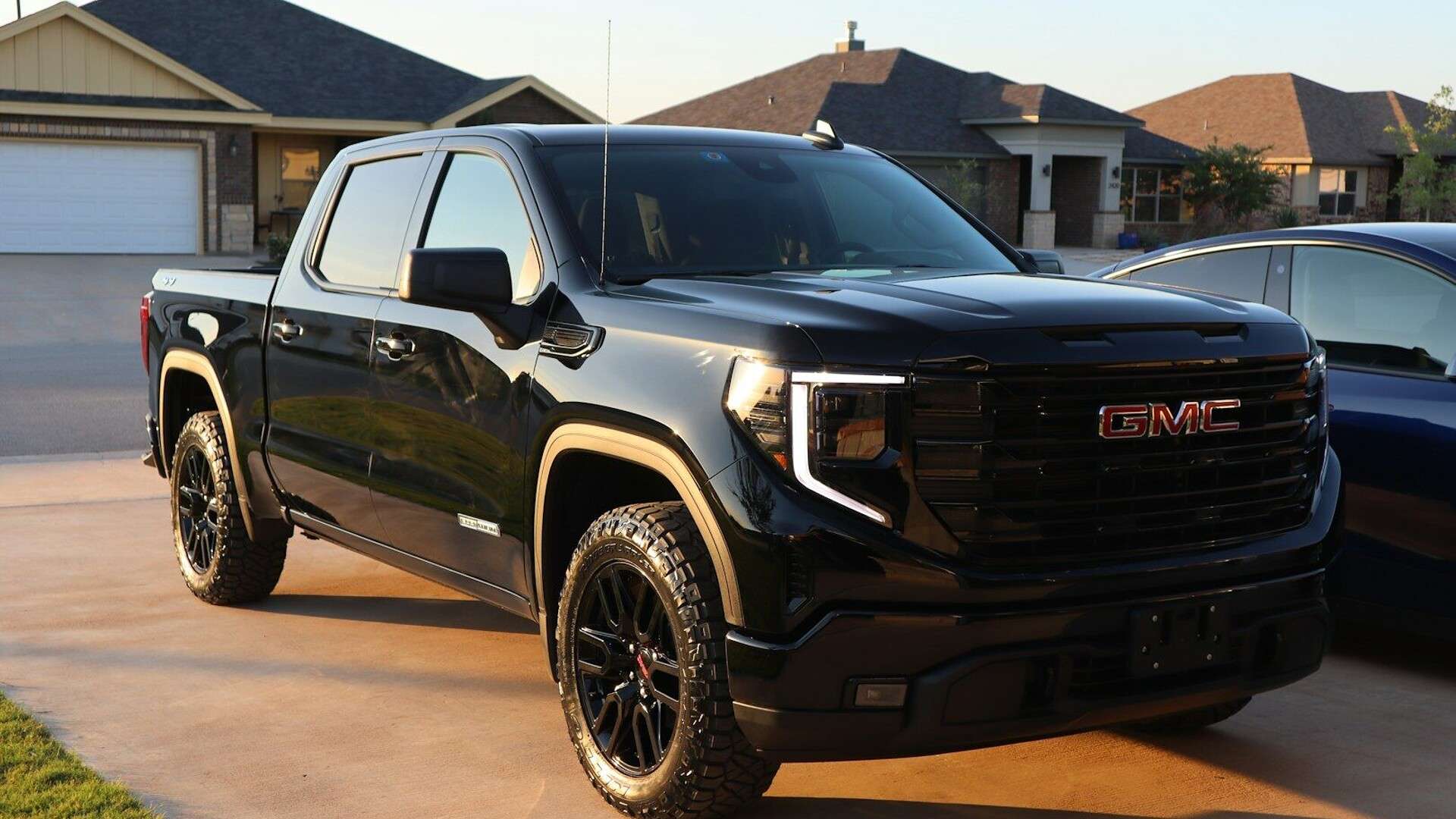
GM has opened another recall on the side-curtain airbags of its previous-generation full-size pickups. Federal recall data lists campaign 26V611000 under the summary “Air Bag Inflator Endcap May Detach.” It covers 1,559 vehicles under GM recall number N262569920: certain 2016 Chevrolet Silverado 2500/3500 and GMC Sierra 2500/3500 trucks, plus 2016–2017 Silverado 1500 and Sierra 1500 models. (NHTSA)
That’s a small population. The story is that this is at least the fifth recall filing since 2020 for the same basic failure in the same part of the same truck family. If you own, buy or flip one of these trucks, you should know what’s going on inside that roof rail.
What’s Up There, and Why It Can Fail This Way
Most people think of an airbag as a pyrotechnic charge that fires and fills a cushion. The roof-rail airbags in these trucks work differently. GM’s filings describe the inflators as holding compressed gas: when the end cap separates or the wall splits, the Part 573 report says “the compressed gas will escape from the inflator” and the end cap or other parts can be thrown into the cab.
Related Articles
- Watch: A Plate Camera Snitched on a Stolen Honda in Miami-Dade. The Chase Ended With It on Its Roof.
- Pirelli Is Dropping $1.2 Billion in Georgia on Robot-Built Tires That Talk to Your Car
So each side of the headliner hides a sealed, pressurized steel cylinder over the door openings, holding that pressure for the life of the truck. A cylinder like that is fine as long as the steel is sound. If moisture gets trapped inside during manufacturing, the inside of the cylinder can corrode while it’s under constant pressure, and eventually the metal gives way.
The history shows why that matters. GM’s first recall for this problem, 20V736, started in June 2020 when a dealer reported an uncommanded roof-rail airbag deployment in a 2015 Silverado. The supplier’s metallurgical and scanning-electron-microscope analysis found corrosion and embrittlement at the inflator end cap. The supplier later identified a production period when moist air may have entered its inflator manufacturing process. The supplier was Key Safety Systems at the time and is now Joyson Safety Systems, with the listed plant in Valle Hermoso, Tamaulipas, Mexico.
From 9,279 Trucks to 410,019 in Eight Months
That first recall covered 9,279 trucks. GM’s filing said the supplier changed its moisture-removal method on September 25, 2015. On that record, the problem had a clear start and end.
That didn’t last. In mid-June 2021, roof-rail inflators ruptured in three 2015 Silverados, one in Florida and two in Texas. All three trucks were unoccupied and not in use. According to the expanded filing, the steel sidewall of each inflator split open. This was a different failure point from the end-cap separation seen earlier. GM absorbed the first recall into a new campaign, 21V504, covering 410,019 trucks with production dates reaching into July 2016, well past the supposed 2015 fix. The cause statement was also revised: corrosion caused by moisture introduced during manufacturing, “aggravated by thermal cycling in high-temperature climate regions.”
That phrase matters most to owners. A pickup cabin parked in the sun in Phoenix or Houston repeatedly heats up and cools down. Each hot day raises the pressure in the sealed cylinder, and each cooling cycle lowers it. For a steel vessel that already has corrosion inside, those repeated pressure swings add stress over time. That explains how an airbag can fail with the truck parked and nobody inside.
2026: A Pattern of Small Follow-Up Recalls
This year has added more campaigns. In March, GM filed 26V166 for 2,819 trucks: 2018 Silverado and Sierra 1500s and 2019 2500 and 3500 crew cabs, with the same end-cap and sidewall description. In May, 26V325 expanded that recall by another 2,785 trucks. Now 26V611 goes back to 2016 and 2017 models that fall outside the large 2021 campaign.
Each of these filings is narrow because GM identifies affected trucks by part traceability, matching VINs to specific inflator production lots. The 2021 report states directly that vehicles built with parts from outside the supplier’s suspect production window were excluded. That’s the right engineering approach for a batch-specific defect. It also means each new field failure from an unexpected batch leads to another small recall. After five campaigns, owners of a 2015–2019 Silverado or Sierra shouldn’t assume their truck is safe just because it didn’t appear in a previous recall.
For perspective, GM’s filings have estimated the defect rate at about 1 percent of each recalled population. Most recalled trucks won’t fail. But the part is a pressurized cylinder mounted near people’s heads, so a 1 percent chance is still a serious risk.
This isn’t only a GM or Joyson issue. GM previously recalled 2014 Chevrolet Cruze and Buick Verano sedans because roof-rail inflators could rupture at a weld joint, which it tied to contamination in the inflator chamber. Different supplier, different car, same kind of component.
What the Fix Involves
Dealers will replace both the left and right roof-rail airbag modules at no charge, according to the federal recall entry and consistent with the 2026 GM campaigns. In earlier campaigns, GM described the replacement parts as coming from outside the supplier’s suspect production window. That’s worth noting: the replacement is the same design built in a different batch, not a redesigned part. (NHTSA)
Related Articles
- Your EV Accidentally Jams AM Radio. The House Just Voted to Make Automakers Keep It Anyway.
- Stellantis Lined Up an Armored-Vehicle Builder for Brampton. Now It Needs the Union to Sign.
The job itself doesn’t require tearing the cab apart. GM’s service bulletin for the 2021 campaign describes an airbag kit containing the left and right roof rail airbag assemblies plus the trim tether clips needed for the repair, with technicians required to record the serial numbers of the new assemblies. In practice, that means disabling the airbag system, lowering the headliner, swapping both modules, and reinstalling the trim. It’s a routine appointment, not a multi-day repair. (NHTSA)
What to Do If You Own One or Are Shopping for One
- Check the VIN, even if your truck was covered before. A truck repaired under 21V504 had its inflators replaced then, but these recalls are lot-specific, so check the current status on NHTSA’s recall lookup or GM’s owner site. If it shows N262569920, schedule the repair.
- Treat unexplained headliner damage as an airbag problem. Both early GM reports involved failures in parked, unoccupied trucks. If you find a sagging headliner, a hole or split near the roof rail, or a curtain that has partly deployed without a crash, don’t drive with passengers until a dealer inspects it.
- Keep records if you’ve already paid for a repair. GM’s filings state that under federal rule 577.11 it will reimburse owners for qualifying repairs according to its reimbursement plan. If an airbag failed and you paid a body shop or insurer to fix it, save the invoices.
- Used-truck buyers should run the VIN before handing over money. The federal prohibition cited in NHTSA’s acknowledgment letters, 49 U.S.C. § 30112(a)(3), applies to manufacturers selling defective vehicles after notifying NHTSA. It doesn’t guarantee that a private seller or independent lot fixed an open recall. These are among the most common used trucks on the market, so an open airbag recall is something to settle before purchase, not after.
- Pay extra attention if you live somewhere hot. GM’s own cause statement cites heat cycling in high-temperature regions as an aggravating factor. A truck that has spent a decade in Texas, Florida, or Arizona has had more of that stress than one from Minnesota.
This recall is small. The pattern isn’t: on 2015–2019 GM full-size trucks, the curtain airbags keep producing recalls, and a clean VIN check from a few years ago doesn’t mean a clean one today.
GM is fixing this lot by lot, each time a new batch fails in the field. Should it replace the roof-rail inflators across this whole truck generation instead, or is chasing the bad batches the right call for a defect it puts at about 1 percent?
Top photo: Somalia Veteran via Unsplash.