
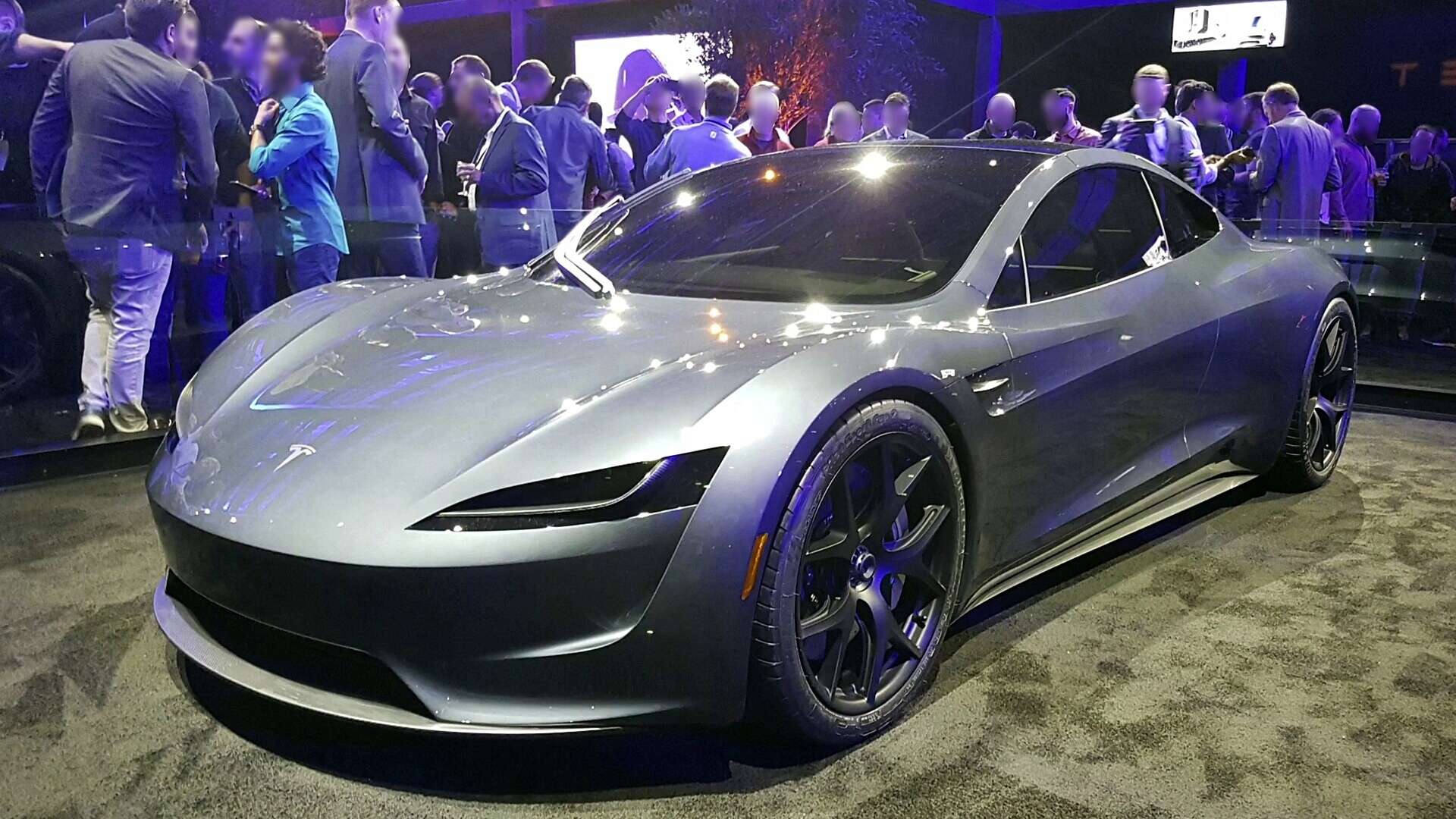
The only version of Tesla’s new Roadster that leaves the ground is the one Tesla’s own website marks “Not approved for public road use.” Tesla calls it the Rocket trim. It seats one person, it is sold by invitation only, and the Roadster page footnotes every flight feature as “Available with the Rocket trim only, which is not available in all regions.”
After Tesla showed the second-generation Roadster hopping and spinning at SpaceX’s Texas test site on Thursday, Oct. 15, Elon Musk wrote on X, “Turns out the future does have flying cars,” the Associated Press reported. What Tesla is selling today is a $50,000 place in line, under a reservation contract that promises the buyer less than the one Tesla wrote for the same car in 2017, for a flying version whose legal path to a public street would run through two federal agencies at once.
Three Roadsters, and only one of them flies
Tesla’s site lists three versions. The Performance model, open for reservations, is “Road ready with seating for two” and uses active aerodynamics plus a fan system that pulls air from under the car to press it onto the pavement. The Thrust augment, a limited release, adds cold-gas thrusters at the rear that Tesla says take the car from 0 to 60 mph in under 1 second. The Rocket augment puts thrusters around the perimeter of the car “that support forward and upward acceleration as well as lateral rotational movement.” Tesla’s copy follows that with “So yes, it can fly,” and then the note that it is not approved for public roads.
Musk gave the car’s limits himself. He said consumer production won’t begin until 2028, and Tesla did not set a price, according to the AP. Thursday’s demonstration car drove itself, Musk said, “to make sure we don’t kill anyone,” and he later told the crowd, “This is not necessarily a safety-optimized car.” Tesla still describes the Roadster as a car for human drivers, and Musk said that in the long run it will be “the only manually driven car that Tesla makes.” That comes from a company that has built much of its pitch around self-driving, including a still-limited robotaxi service.
The $50,000 reservation, clause by clause
Tesla’s reservation page asks for $5,000 at checkout, labeled “Fully refundable,” and another $45,000 within 10 days. The reservation does not take effect until Tesla has both payments, and it is subject to cancellation if the second one is late. The page also says, “Refunds for modifications will not be issued.”
I read the Roadster Reservation Agreement the page links to. It is two pages long, and its version stamp, US v.20261015, matches the day of the event. Here is what it commits Tesla to, and what it doesn’t:
- Price: any estimated price “is only an estimate,” and Tesla says it “cannot confirm the exact price just yet.” The real number arrives when you configure the car.
- Delivery: Tesla writes that the Roadster “is still under development” and “we cannot guarantee when your vehicle will actually be delivered or if it will be delivered.”
- Your money: Tesla will not hold the payment “separately or in an escrow or trust fund or pay any interest” on it. The $50,000 goes into the company’s general funds.
- Refunds: either side can cancel and you get a full refund, but only until you complete your configuration after Tesla invites you to. After that, an Order Agreement takes over, and Tesla has not published one.
- Remedies: Tesla is not liable for “incidental, special or consequential damages,” and your “sole and exclusive remedy” is getting the reservation payment back. Disputes go to a single arbitrator under American Arbitration Association consumer rules, and the agreement bars class claims.
Tesla’s own archive shows how the paperwork has changed. The reservation agreement it posted for this car in November 2017, version v20171116, is a single page with five short sections. It told buyers they had “secured the approximate priority for taking delivery.” The 2026 version says buyers have secured “the approximate priority for configuring and ordering.” The 2017 page has the same no-escrow, no-interest clause, but it has no line saying the car might never be delivered, no cap on Tesla’s liability and no arbitration requirement. Nine years after the first reservations, the new contract says less about delivery and leaves buyers fewer ways to go after Tesla if something goes wrong.
A Roadster reservation holder is an unsecured creditor of Tesla for $50,000, earning nothing on it, with the right to a refund that ends on the day the configurator opens.
Federal law has one definition for cars and another for anything that flies
Tesla’s “not approved for public road use” note does legal work. Federal auto-safety law defines a motor vehicle as one “manufactured primarily for use on public streets, roads, and highways,” in 49 U.S.C. 30102(a)(7). Only those vehicles have to meet the Federal Motor Vehicle Safety Standards and carry the maker’s certification of compliance under section 30112. A car built and sold for the track sits outside that system, which is how track-only cars can be sold without meeting federal crash standards. By labeling the Rocket trim off-road, Tesla keeps the flying version clear of NHTSA’s standards. It also gives up the street.
Aviation law has no such escape hatch for things that leave the ground. Under 49 U.S.C. 40102(a)(6), an aircraft is “any contrivance invented, used, or designed to navigate, or fly in, the air.” Under the FAA’s 14 CFR 91.203, no one may operate a civil aircraft without “An appropriate and current airworthiness certificate” and a registration certificate. The usual exception for small recreational machines, Part 103, does require a single occupant, which the one-seat Rocket trim meets. It also requires a powered ultralight to weigh “less than 254 pounds empty weight.” Tesla has not published the Roadster’s weight, but no battery-electric car comes close to that.
I found no FAA statement on whether it considers a car that hops a few feet off a test pad to be an aircraft, and Tesla’s materials don’t say whether it has asked. That question sits underneath the comments the AP collected from two law professors. “I’m not sure every state is going to allow a driver in the middle of traffic to suddenly elevate himself and fly,” said David Vladeck of Georgetown Law, a former director of the FTC’s Bureau of Consumer Protection. Bryant Walker Smith, a University of South Carolina law professor and former vice chair of a Department of Transportation advisory group on innovation, said the demonstration car used “a technology around for many years and will not be coming to public roads in 2028.”
The Terrafugia record shows how long the road-and-air paperwork runs
The closest precedent is in the Federal Register. Terrafugia’s Transition was a folding-wing light sport airplane that could also be driven, and the company told regulators it would market it “as an aircraft with road-going capability,” not as a “flying car.” To put it on the street, Terrafugia needed relief from four safety standards. NHTSA’s June 29, 2011 notice granted temporary exemptions from FMVSS No. 110 (tires and rims), No. 126 (electronic stability control), No. 205 (glazing) and parts of No. 208’s advanced airbag rules, starting June 1, 2012. NHTSA gave shorter terms than the three years the company asked for, one year for the stability-control and airbag exemptions, and noted Terrafugia’s estimate of about 200 vehicles over the exemption period.
The aviation side needed its own exemption, for the opposite reason. Light sport aircraft are capped at 1,320 pounds maximum takeoff weight, and the crash protection a road car needs is heavy. In an exemption signed May 12, 2016, the FAA let the Transition weigh up to 1,800 pounds, and limited the grant to the Transition “while incorporating FMVSS-based occupant protection features.” That exemption was set to end April 30, 2021. A company that designed its machine around both rulebooks from the start still spent years asking each agency for exceptions to the other one’s demands. NHTSA reviews of unconventional vehicles still run long, as the agency’s 21 questions to Tesla about the Cybercab show.
Cold gas is the simplest thruster and one of the weakest
A cold-gas thruster is a tank of compressed gas, a valve and a nozzle. Nothing burns, which is why spacecraft use them for small, precise attitude corrections. NASA’s Small Spacecraft Systems Virtual Institute describes cold-gas systems as “simple, mature, and safe, although they provide relatively limited total impulse,” and lists their specific impulse at 40 to 110 seconds, with gaseous nitrogen a common propellant. Tesla’s page says its thrusters use all-electric actuators and make “micro adjustments within a fraction of a second” to stabilize the car in flight.
Specific impulse sets how fast a thruster eats its gas. To hold a vehicle in the air, the thrusters must push with a force equal to its weight, and the gas burned per second equals that weight divided by the specific impulse in seconds. Tesla hasn’t published the Roadster’s curb weight, the gas it uses, its tank size or how long it can stay up, so the following is The Auto Wire’s math with a placeholder weight of 4,000 pounds. At 110 seconds, the best figure in NASA’s range, hovering would use about 36 pounds of gas per second. At 40 seconds, it would use 100 pounds per second. Ten seconds aloft would take roughly 360 to 1,000 pounds of gas, before counting the high-pressure tanks to hold it, in a car Tesla built around magnesium, titanium and carbon fiber to save weight. That arithmetic fits the short spurts the AP described, and it is why a Roadster that flies over traffic would be a different machine from the one Tesla demonstrated.
The fan system is older technology. Chaparral’s 2J ran a fan-driven ground-effect setup in Can-Am racing in 1970, and Brabham’s BT46B fan car won the 1978 Swedish Grand Prix before the team withdrew it. Tesla says its version makes enough suction to hold the car upside down “even when stationary,” which helps a car corner and brake but does nothing to lift it; on Tesla’s page, flight is the thrusters’ job.
Tesla’s earnings call, federal dockets and the order agreement are next
Tesla reports third-quarter results on Oct. 21. Whether it says how many Roadster reservations it took, or names a price, will show how much of this event was about cars and how much about the stock, which the AP reported rose Friday morning before falling in a sell-off of AI-linked companies. Smith told the AP that Tesla “pretty uniquely has been able to sell itself on a future that is an order of magnitude greater than reality.”
The regulatory evidence will be public if it exists. An FMVSS exemption request appears in the Federal Register, and FAA exemption petitions get dockets on regulations.gov, the way Terrafugia’s did. Without those filings, the Rocket trim has no route to public roads. The Performance model is the version that would need ordinary FMVSS certification to be registered and driven, and it is the only one of the three that the reservation page offers without a limited-release slot or an invitation. The terms that will matter most are in the Order Agreement Tesla has not yet released, because that is the document that replaces the refund right.
If a Rocket-trim invitation landed in your inbox tomorrow, would you send Tesla $50,000 for a car Tesla says is not approved for public roads, or keep your money until there is a price, a delivery date and a federal approval?