
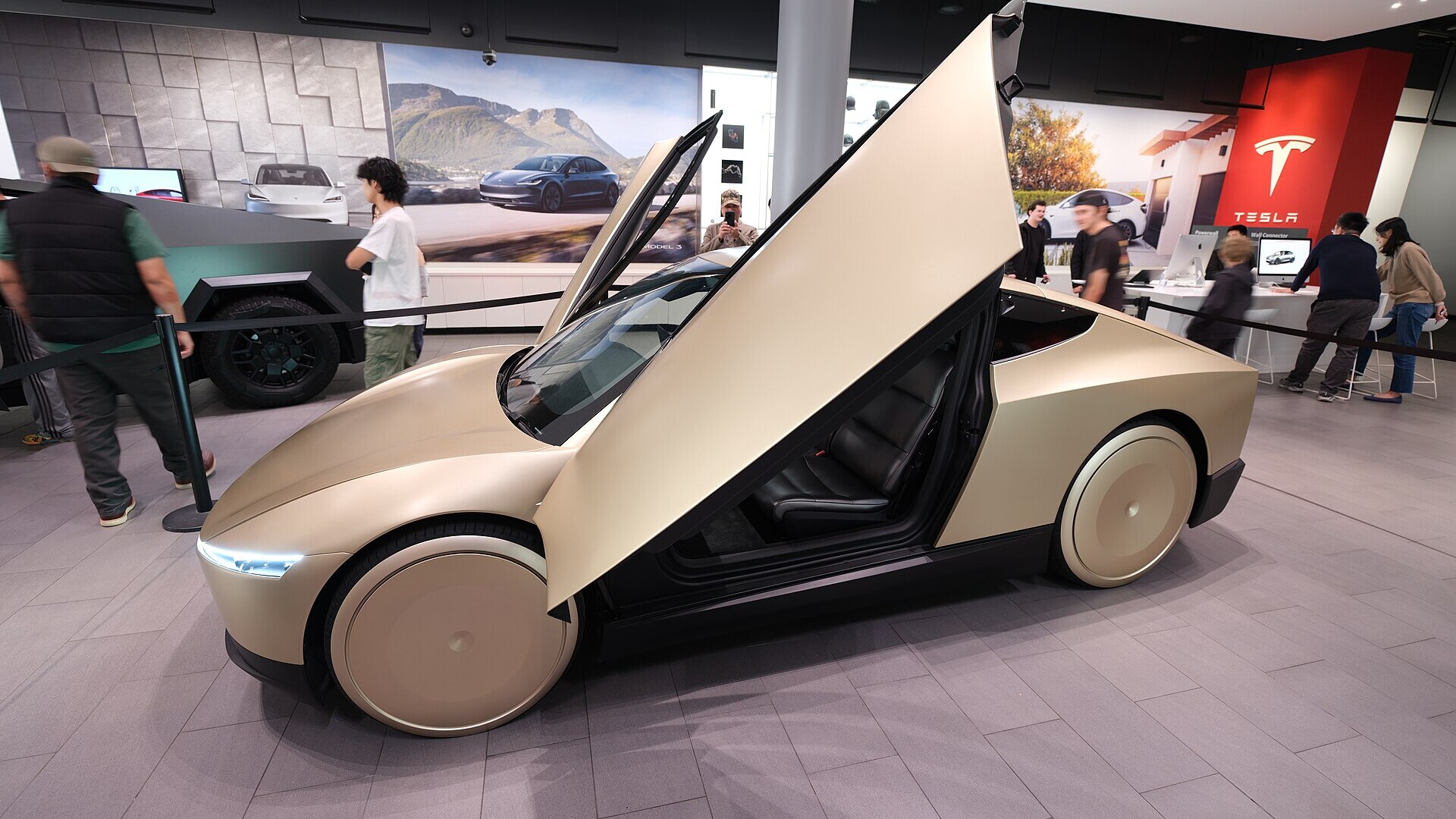
When a person speeds past a school, you ticket the person. When a driverless Tesla does it, the car is following a speed rule Tesla’s engineers wrote and pushed to the whole fleet.
On Oct. 9, the National Highway Traffic Safety Administration’s Office of Defects Investigation opened defect petition DP26010, covering an estimated 1,000 model-year 2026 Tesla Robotaxis, both Model Y and Cybercab. The petitioner alleges that with Tesla’s automated driving system engaged, the cars exceed posted speed limits in active school zones. According to the agency’s summary, the evidence is three links to video. NHTSA’s tally lists four incidents in all, and no crashes, injuries or deaths.
That is a thin file, and petitions this size often end in a denial notice. This one deserves attention because of who was driving. Texas law already sends that citation to the operator, and twice before, NHTSA scrutiny of driving software that broke traffic laws has ended in a safety recall. If the videos hold up, I expect this to end the way those cases did, with an over-the-air change filed as a recall rather than a pile of tickets.
What NHTSA opened, and what its file leaves out
I read the agency’s one-page summary. ODI received the petition on Sept. 23 and opened its review on Oct. 9. Its failure count shows one complaint filed directly with the agency and three reports in an “Other” column, which NHTSA describes as social media reports included in the petition. The summary does not name the petitioner or say which cities the videos came from. It lists the petition under ODI number 11766676, but a search of NHTSA’s public complaint database for that number returned nothing on Oct. 13.
A defect petition is the step before an investigation. Under 49 U.S.C. § 30162, any interested person can ask the agency to decide whether to order a recall, and NHTSA must grant or deny the request within 120 days of filing. Counting from Sept. 23, that lands on Jan. 21, 2027. A grant opens a formal investigation. A denial has to be explained in the Federal Register. In practice the deadline is looser than the statute reads. When an owner petitioned over alleged sudden acceleration in the Model S, Model X and Model 3, NHTSA received the petition on Dec. 19, 2019, and its denial, which blamed the crashes on pedal misapplication, was published on Jan. 13, 2021.
Tesla’s other open NHTSA files
This is at least the second federal file on Tesla’s driverless fleet in five weeks. According to NHTSA, Tesla began offering commercial service in its Cybercab vehicles on Sept. 3, and the agency opened Audit Query AQ26002 that same day. Its order lists 21 requests about how Tesla certified a car with no steering wheel or brake pedal to federal safety standards. The Auto Wire has covered that audit since it opened, along with the Sept. 30 deadline for Tesla’s sworn answers. A separate case, engineering analysis EA26002, opened in March and covers about 3.2 million customer cars with Full Self-Driving over crashes in glare and other low-visibility conditions.
A school speed limit is a number plus a condition
The federal sign manual shows why this is harder for software than a 45-mph highway sign. Under Section 7B.05 of the Manual on Uniform Traffic Control Devices, a school speed limit can be posted as a fixed sign with a plaque listing the hours and days it applies, with a WHEN CHILDREN ARE PRESENT plaque, with a beacon that flashes while the limit is in force, or as an electronic sign that goes blank the rest of the day. The number on the sign is half the instruction. The other half is a clock, a school calendar, a pair of flashing amber lights or a judgment about whether kids are around.
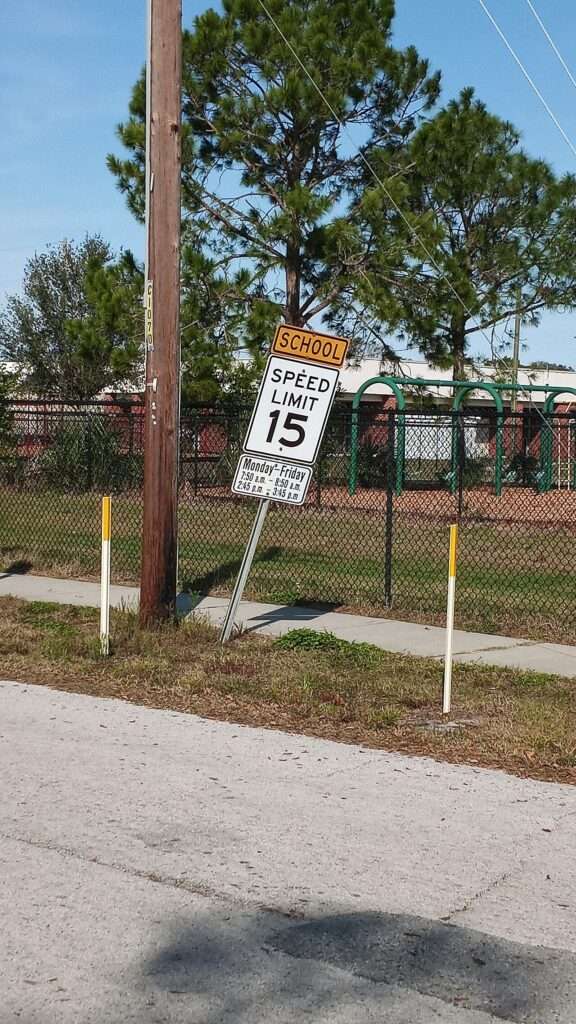
A human driver sorts that out with a glance. A camera-based system has to see that the beacon is flashing, read and interpret the plaque, or already know the zone’s schedule from map data. It has to manage that for every district’s version of the sign. Tesla’s Model Y owner’s manual says FSD (Supervised) decides how fast to go using navigation data, historical data from other Teslas, the speed of other vehicles and posted limits, on top of the speed profile. The traffic input works against it near a school. If the cars around a Robotaxi are doing 35 mph through a 20-mph zone, matching the flow means speeding with them.
Tesla’s speed profiles, and who picks one in a Robotaxi
The same manual lists five speed profiles owners can choose. Sloth, the default, drives “at or below the speed limit.” Chill stays in slower lanes. Standard adjusts speed to match the flow of traffic, and Hurry and Mad Max go faster still. In a customer’s car, the owner picks, and the manual is direct about responsibility: “You are driving Model Y at all times.” A Robotaxi with nobody behind the wheel, or a Cybercab with no wheel at all, has no owner picking a profile. Whatever speed policy it runs, Tesla chose it. Neither NHTSA’s summary nor Tesla’s public filings say what that policy is in a school zone.
NHTSA has called speed-setting software a defect before
Tesla has been here. On Jan. 25, 2023, NHTSA told the company it had concerns about how FSD Beta behaved in four situations and asked Tesla to file a recall. One of the four was how the software adjusted speed in variable speed zones, based on the signs it detected or the speed offset the driver had set. Tesla’s recall report for 23V-085 covered 362,758 vehicles. Tesla wrote that it did not concur with the agency’s analysis but recalled the cars anyway, and the remedy was an over-the-air software update.
Waymo’s school-bus case last year is the closer match. In a Nov. 24, 2025, email, ODI questioned Waymo about a letter from Austin’s school district. The district had documented 19 incidents of Waymo vehicles passing stopped school buses. Waymo’s recall report, submitted Dec. 10, 2025, covered 3,067 vehicles and said the company knew of 12 citations tied to the behavior. By the time the paperwork arrived, Waymo had already pushed the fix to every affected vehicle between Nov. 5 and Nov. 17.
Why the recall paperwork matters when the fix is software
That sequence is normal for a software fleet, and it is why a petition matters even when a fix can ship overnight. The update changes the behavior. The recall filing puts the cause, the vehicle count and the remedy on the federal record. It also gives NHTSA a basis to check whether the remedy worked. If Tesla changes its school-zone behavior without a filing, the public never learns what the cars were doing or why.
In Texas, the ticket is addressed to the operator
Tesla’s second-quarter 2026 update lists Austin, Dallas and Houston as “Ramping Unsupervised,” along with Miami, Orlando and Tampa in Florida. Both states have already settled who the driver is. Texas Transportation Code Section 545.454 says that when an automated driving system is engaged, the system is the operator, including for traffic-law compliance, and that the vehicle’s owner, or the holder of the state’s driverless operating authorization, “shall be issued any citation.” Florida’s Section 316.85 likewise deems the engaged system the operator, and the state’s school-zone speed camera law sends notices to a vehicle’s registered owner when it is caught more than 10 mph over the school-zone limit in the half-hour before and after school starts.
The Texas DMV holds the bigger lever
A fine changes a driver’s behavior because the driver pays it. Against a fleet operator, it is an operating cost unless the state can threaten the right to operate. Texas gave that power to its Department of Motor Vehicles in a 2025 rewrite of the law, S.B. 2807. Section 545.459 lets the department move to suspend, revoke or restrict an authorization when a vehicle is not in safe operational condition and endangers the public. The statute defines that danger as operation that has caused or is likely to cause serious bodily injury. Cities have even less say. Section 545.452 bars Austin, Dallas, Houston and every other political subdivision from imposing its own regulation on automated vehicle operation.
California sends notices instead of fines
California took a different route. AB 1777, passed in 2024, lets police issue a notice of autonomous vehicle noncompliance starting July 1, 2026, and requires the manufacturer to give it to the state DMV within 72 hours. Our report on one of the first of those notices explains how that system works without a fine. Tesla’s Bay Area service still uses a safety driver under a state charter-party permit, according to its second-quarter update, so California’s notices are not the system in play for Tesla.
Dates and filings to watch before January
The first is NHTSA’s decision to grant or deny the petition, due by about Jan. 21 under the statute. A grant would open a formal investigation and a document request to Tesla. A denial would come with reasons published in the Federal Register. The second is Tesla’s third-quarter earnings report, which the company has scheduled for Oct. 21, its first scheduled chance to address the petition. The third is whether any change to Robotaxi speed behavior near schools arrives with a recall report, as Waymo’s school-bus fix did, or as an unannounced software release.
Owners of FSD-equipped Teslas sit in a different legal seat. The law treats them as the driver and the manual says they are driving at all times, so a school-zone ticket earned on Standard or Hurry goes on the owner’s driving record, not Tesla’s, and can follow the owner to the next insurance renewal.
If a Robotaxi gets caught doing 35 in a 20 school zone, what should Tesla owe: a ticket like anyone else, or a recall that puts the fix on the record?