
LKQ said on October 23 that its European segment earned an EBITDA margin of between 4.1% and 5.1% in the third quarter, down from 10.0% a year earlier, and that CEO Justin Jude had left the company the same day. The parts distributor published those preliminary numbers six days before it was due to report full results, which is not how companies usually handle a quarter they consider routine.
What LKQ disclosed
Third-quarter revenue came in at $3.32 billion against $3.50 billion a year earlier, and organic revenue from parts and services fell 5.4%. Adjusted diluted earnings per share landed between $0.47 and $0.53, compared with $0.84 in the third quarter of 2025. The company also took $111 million of non-cash impairment charges, which pushed it to a net loss from continuing operations attributable to LKQ stockholders of $16 million to $32 million. A year ago that line showed $178 million of net income.
LKQ withdrew its full-year 2026 guidance, appointed Salvatore Abbate as CEO effective December 15, and said Andy Hamilton was leaving his job as president and managing director of LKQ Europe. Until Abbate arrives, an interim Office of the CEO made up of Chairman John Mendel and Audit Committee Chair Sue Gove will run the company. The board also engaged Alvarez & Marsal to advise on European operations, with an initial focus on customer service levels, stabilizing operations and cost discipline. The release blames Europe, including disruption from an ERP implementation in Germany and volume declines in the United Kingdom and Benelux. North America performed in line with expectations, and Specialty came in modestly below.
Europe’s sales declined less than in the spring, and its margin fell further
The second-quarter report gives the comparison. Europe’s organic parts and services revenue fell 12.6% in that quarter, and the segment earned a 7.5% EBITDA margin on $1,455 million of revenue. In the third quarter organic revenue fell 9.8%, a smaller decline, while the margin dropped to a range of 4.1% to 5.1%. Sales got somewhat less bad and profitability got a good deal worse.
The release does not break down why, and the full report due October 29 may. A distributor carries a mostly fixed base of branches, delivery vans, drivers and warehouse staff, so lost volume costs more than the gross profit on the missing parts. Cost of fixing a botched system rollout comes on top. Even so, a margin that fell while the sales decline narrowed points toward problems in how the business is running, not only toward weak demand, and the list of tasks assigned to Alvarez & Marsal, with service levels first, fits that reading. That is my interpretation of the sequence, not a statement from the company.
An ERP system is the thing that knows which branch has the part and which van is carrying it. A repair shop orders a brake caliper in the morning because the car is on a lift, and it expects the part within hours. If the system cannot promise availability, mispicks or books the delivery late, the shop calls the next wholesaler, and a shop that finds a second reliable supplier tends not to give up that habit once the first supplier recovers. In July, Jude said, “Europe fell short of expectations, with results affected by the ERP implementation in Germany.” CFO Rick Galloway described a slower-than-expected recovery after the rollout.
Guidance cut July 30, withdrawn October 23
On July 30, LKQ lowered its 2026 adjusted diluted EPS outlook to $2.60 to $2.90 from $2.90 to $3.20, and its free cash flow range to $625 million to $775 million from $700 million to $850 million. Eighty-five days later it withdrew all of it. Adjusted EPS has slid from $0.84 in the third quarter of 2025 to $0.67 in the second quarter of 2026 to a range of $0.47 to $0.53 now.
The impairments raise a timing question. The company’s quarterly filing for the period ended June 30 said it identified no triggering events or other indicators of impairment for North America or Europe in the first six months of 2026. Three months later it recorded $88 million of goodwill impairment and $23 million of impairment on net assets held for sale. The release does not say which reporting unit carried the goodwill charge or which assets are held for sale, so any assignment to Europe would be a guess until the full report is out.
Those charges are also why LKQ can report a GAAP loss of $0.06 to $0.12 per share and a positive adjusted figure in the same release. Adjusted net income of $119 million to $135 million adds back the impairments, $34 million of amortization of acquired intangibles and $24 million of restructuring and transaction-related expenses. The adjusted number is still well below the $216 million of a year ago.
A leadership change during a sale review
On January 26, the board announced a formal review of strategic alternatives, including a possible sale of the entire company, with BofA Securities as financial advisor and Wachtell, Lipton, Rosen & Katz as legal counsel. The company said at the time that it was separately continuing a process to explore a sale of Specialty. In the October release, the board said its review of strategic alternatives continues.
Abbate, according to LKQ’s appointment announcement, was CEO of Veritiv when Clayton, Dubilier & Rice bought it for $2.6 billion in 2023, and before that held operating and commercial roles there. He has a distribution and logistics background, and in the announcement he said he intends to move quickly. Nothing in the filings links his hiring to a sale. But a board that has been shopping the company, or parts of it, for nine months has an obvious reason to want its largest foreign segment delivering parts on time before any buyer sees the numbers. That is analysis, not something LKQ has said.
Does this reach your parts counter?
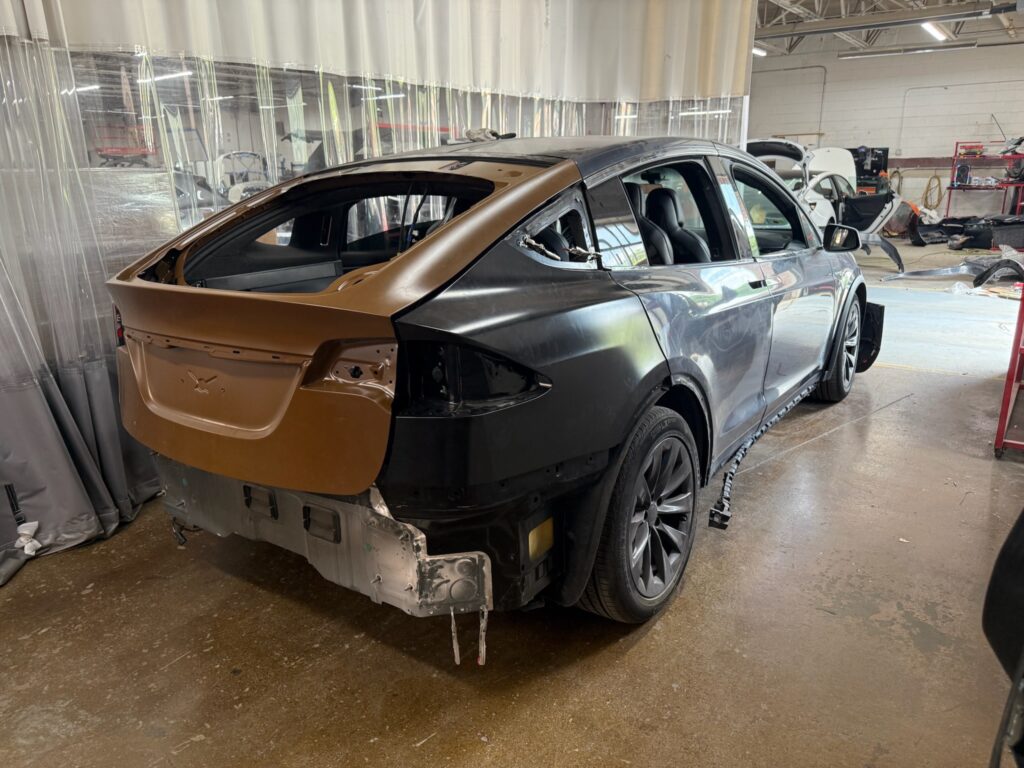
North America was where LKQ showed its only recent good news: in July the company said the segment returned to positive organic growth, up 0.5%, for the first time in nine quarters, and in October it said the region performed in line with expectations despite softer market conditions. Nothing in the release points to service problems in North America. The exposure for US readers is indirect, and it comes down to whether a distributor spending money on a European turnaround, and possibly changing owners, keeps its North American priorities where they are.
Oct. 29 is the next test: whether Germany delivers on time, and which reporting unit took the goodwill hit. After that, watch how far Alvarez & Marsal’s remit stretches beyond Europe, and what Abbate does on December 15.
If a software cutover left your shop without parts deliveries for a few weeks, would you go back to that distributor once it was fixed, or stay with the supplier that kept your bays moving?