
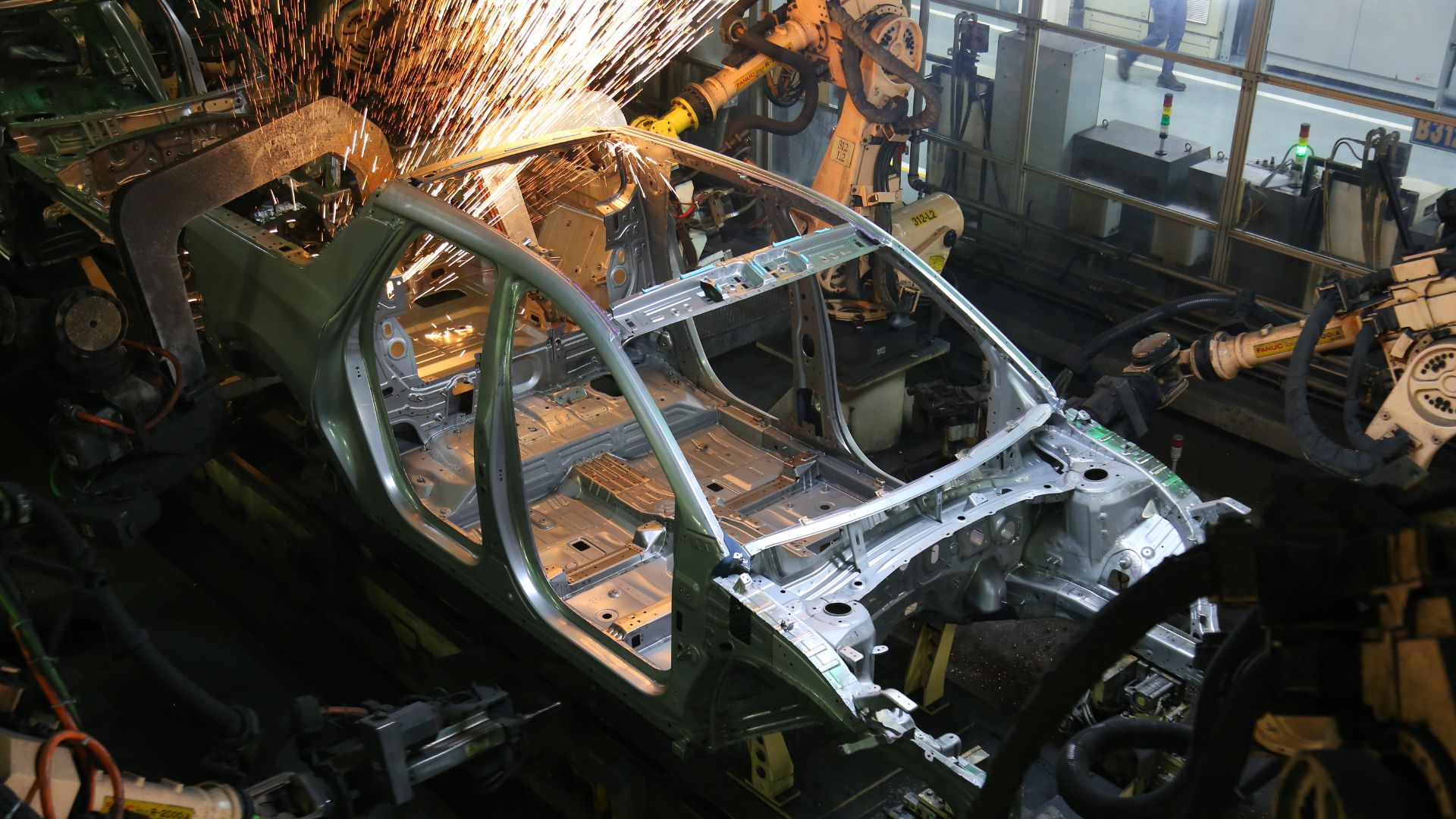
Bartow County, Georgia doesn’t get much attention, and for a few weeks this summer that was exactly the point. A joint venture between Hyundai and SK On quietly pushed its battery plant into full production, loaded cells onto trucks, and started shipping them off to build electric Hyundais, Kias, and Genesis models. No ribbon-cutting fanfare, no protests, no federal agents. Just batteries, rolling out the door on schedule.
Garage-worthy EDC gear, on sale this week.
That last part matters more than it should, because 250 miles away, on the Georgia coast, Hyundai’s other battery plant is still digging out from the largest single-site workplace immigration raid in the history of Homeland Security Investigations.
Same company. Same goal. Wildly different outcomes.
That gap is the real story here.
What Actually Opened in Bartow County
Hyundai SK Battery Manufacturing America, or HSBMA, is the formal name for the plant that just started running. Hyundai and SK On each put up roughly half of a combined $5 billion to build it, with Georgia kicking in $641 million in incentives back when the joint venture was announced in 2023. The site covers close to three million square meters and employs about 3,500 people. Mass production started in June, and cells are already headed to Hyundai Motor Group Metaplant America in Savannah, where Hyundai Mobis turns them into battery packs for Hyundai, Kia, and Genesis EVs built on American soil. At full ramp, HSBMA is expected to hit 35 gigawatt-hours a year, enough cells for roughly 300,000 vehicles.
250 Miles Away, a Very Different Summer
Now compare that to Hyundai’s other Georgia battery venture, a joint operation with LG Energy Solution built directly on the grounds of the Savannah Metaplant. On September 4, 2025, federal and state agents, including Homeland Security Investigations, the FBI, DEA, ATF, and Georgia State Patrol, raided that site and detained 475 workers, more than 300 of them South Korean nationals. Homeland Security called it the largest worksite enforcement operation ever conducted at a single U.S. location.
The Billion-Dollar Reason Everyone’s in a Hurry
Here’s a detail most people outside the battery industry never see: HSBMA’s 35-gigawatt-hour target isn’t just a production goal, it’s a tax bill waiting to be collected. Under Section 45X of the Inflation Reduction Act, domestic battery cell manufacturers can claim up to $35 in federal tax credit for every kilowatt-hour they produce. Run that math against HSBMA’s full capacity and you get a plant capable of generating well over a billion dollars a year in manufacturing tax credits alone, independent of what Hyundai charges for the cars themselves. That credit is paid for making the battery, not for selling the car. It’s a big reason every battery joint venture racing to open across the Southeast over the past three years has been in such a hurry to reach full production, and it’s why Hyundai kept pushing through 2026 even while HSBMA was still ramping up.
Why You Can’t Just Hire Your Way Out of This
Standing up a lithium-ion gigafactory isn’t like commissioning a stamping press. It takes months of on-site work from specialists who know how to calibrate electrode winding and stacking equipment, dry-room humidity systems, and electrolyte-fill and formation-cycling lines, where a fraction of a percent of stray moisture can ruin an entire batch of cells. The United States had barely built any of this equipment domestically before the last five years, so nearly every gigafactory racing to open under IRA-era incentives, Hyundai’s included, has leaned on temporary specialists from Korea and Japan to get the lines running. There isn’t a clean visa category for that kind of short-term, highly technical work. H-1B visas are capped and allocated by lottery. Standard business visas explicitly exclude the kind of hands-on labor that installing and calibrating factory equipment requires. Companies have been threading that needle for years. In Ellabell, immigration enforcement decided the needle had been threaded incorrectly.
The Admission Nobody Wanted to Make
The fallout made that contradiction hard to ignore. Within two weeks of the raid, Hyundai announced a $2.7 billion expansion of the very plant that had just been raided, a clear sign money was never the constraint. The Savannah Economic Development Authority’s own president told reporters the returning Korean workers were the only people who could install the equipment and train the Americans who would eventually replace them. South Korea’s president, Lee Jae-myung, warned the raid would leave companies “very hesitant” about future investment. Within days, even the White House softened its tone, saying foreign companies were welcome to bring in skilled workers to train Americans, as long as those workers eventually went home. Hyundai’s own CEO said the raid alone would delay the plant’s opening by at least two to three months.
The Credit That Disappeared While This One Grew
There’s a second irony sitting underneath all of this. The consumer-facing federal EV tax credit, the $7,500 one meant to get more Americans into electric Hyundais and Kias, expired for good on September 30, 2025. So as HSBMA ramps toward a production credit worth well over a billion dollars a year, the incentive that was supposed to help sell the cars those batteries go into is already gone. Georgia’s battery boom didn’t slow down when that happened, and that tells you something: the manufacturing side of this industry was never really being built around today’s buyer. It was built for whoever owns a battery plant a decade from now.
We covered the Ellabell raid itself in real time back in September, and it’s worth revisiting now that the fuller picture has come into focus. It’s also worth reading alongside our recent piece on Toyota staking three separate vehicle lines on a single unproven factory, because Hyundai’s battery strategy is effectively the opposite bet: two joint ventures, two Korean partners, two locations 250 miles apart. That kind of redundancy protects against a fire, a flood, or a supplier going bankrupt. It did nothing to protect against a labor problem that showed up at the border instead of the loading dock. None of this is happening in isolation, either. Auto tariffs and trade politics are already reshaping what it costs to build a car in America, and a supply chain leaning on temporary foreign specialists is exposed to exactly the kind of policy whiplash we’ve been tracking all year.
What This Actually Proves
Georgia didn’t secure the Bartow County battery plant with $641 million in incentives. It kept that plant on schedule because, this time, nobody detained the people who knew how to run it.
That’s the sentence worth remembering here, not the gigawatt-hours or the incentive totals. America has gotten good at writing checks for battery factories. It still hasn’t figured out how to legally let in the small number of people capable of making those factories actually work. Until that changes, every new battery plant opening in the Southeast is a coin flip between Bartow County’s quiet summer and Ellabell’s September.