
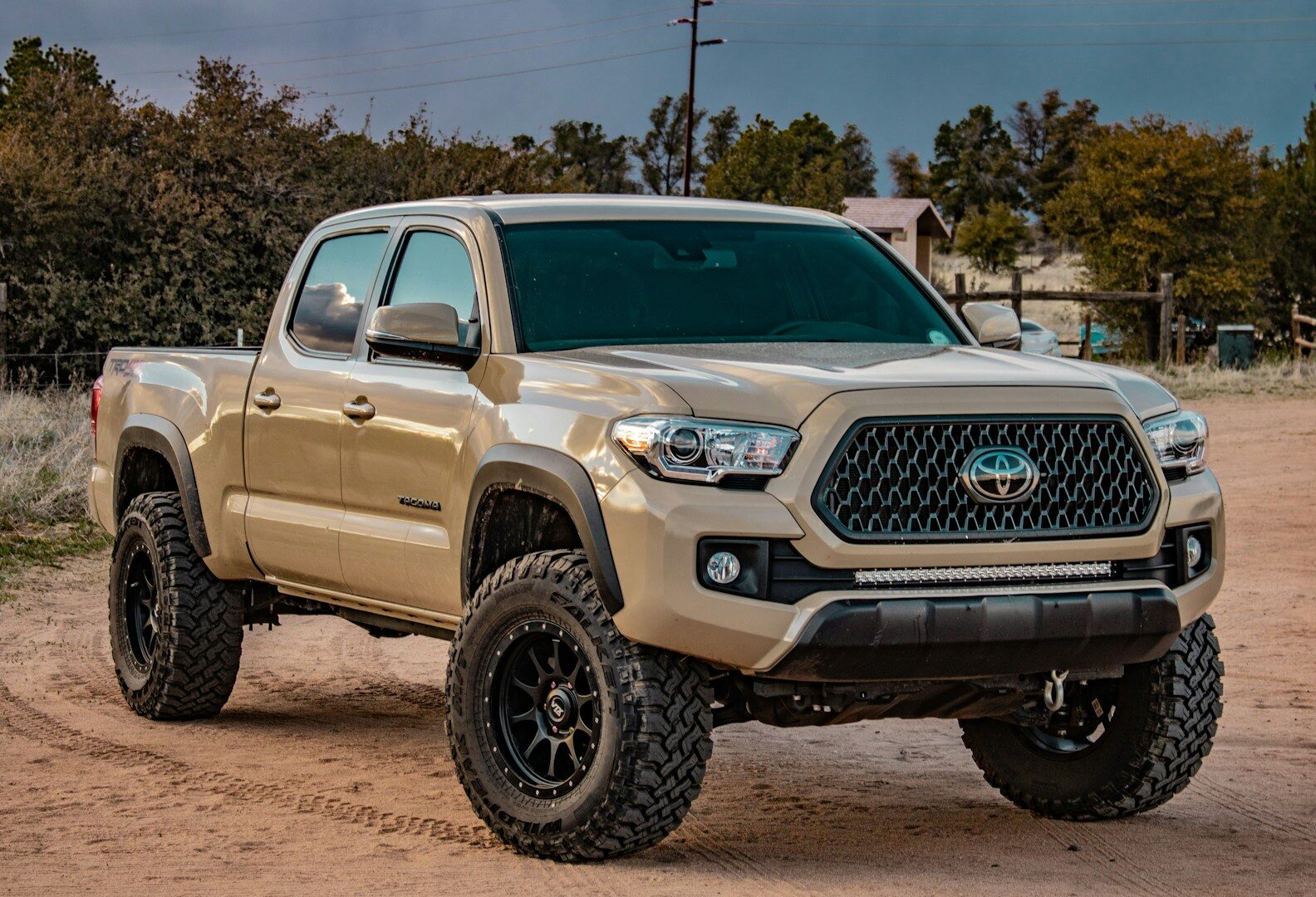
The rust is the easy part of this recall. Toyota’s engineers found it, the paperwork went to Washington on August 6, and there is already a redesigned component carrying the word “improved.” That work is finished.
Now somebody has to build 193,120 shock absorbers.
Four corners, 48,280 trucks. That is the arithmetic nobody runs when a recall notice hits the wire, and it is the only number in this story that actually determines when a Tacoma owner gets their truck fixed. We covered the defect itself two weeks ago. This is the part that comes after.
Buyer’s guide: Best Accessories for Toyota Tacoma Owners
What Toyota actually filed
NHTSA campaign 26V514000 covers 43,827 model-year 2024–2025 Tacomas and 4,453 model-year 2024 Tacoma Hybrids, all of them TRD Off-Road grade, with roughly 3,500 more in Canada. That is 48,280 trucks. Wire copy circulating this week says 48,420; the filing’s own components add to 48,280. Toyota carries it internally as campaigns 26TB14 and 26TA14.
The defect: metal flanges on the front and rear shocks can corrode and fail, allowing the external oil reservoir to separate from the damper body.
The consequence language deserves a second read, because it is not about the person driving the truck. A detached reservoir, Toyota tells the government, “can create a road hazard, increasing the risk of a crash.” Toyota is describing a part that becomes somebody else’s emergency at 70 mph.
And the remedy language deserves a third read. Dealers will “inspect and replace the front and rear shock absorber assemblies, as necessary, free of charge.”
Hold onto those two words.
The letter date is set by lawyers. The repair date is set by a factory.
NHTSA’s record lists owner notification beginning September 21. Toyota’s own announcement says early October. Neither of those dates is a promise that parts exist.
Under 49 CFR 577.7, an automaker must mail owner notification no later than 60 days after it files its Part 573 defect report. Toyota filed on August 6. Sixty days lands in early October. The dates attached to this recall are not a production schedule. They are a compliance deadline.
The rule is candid about the gap, too. If the remedy is not available when notification goes out, the manufacturer sends a second notification once it is. That is not a loophole. That is the federal government conceding, in the text of the regulation, that telling owners about a defect and being able to repair it are two different events on two different calendars.
Tacoma owners are not the first to live in that gap this year. BMW told 29,000 hybrid owners about a fire risk well before it could tell most of them what to do about it.
Bilstein has exactly one production plant in North America
This is where the recall stops being a paperwork story.
Toyota’s own launch material for the fourth-generation Tacoma is specific about what the TRD Off-Road grade gets: “monotube Bilstein remote reservoir shocks for extended wheel travel and greater heat dissipation,” complete with an end stop control valve. That is not a commodity twin-tube damper. It is a monotube with a piggyback reservoir and a hydraulic bump stop engineered into it.
Bilstein — thyssenkrupp Bilstein — describes Hamilton, Ohio as its only North American production facility, running around the clock and splitting output across three groups: original equipment, aftermarket, and special purpose vehicles.
Read that list again. The operation best positioned to build recall dampers for Tacoma owners is the same operation building the aftermarket Bilsteins those owners buy when they lift the truck. Recall parts do not get a dedicated factory. They get a slot in a queue that already has paying customers in it.
Toyota has not said where the replacement units will be produced, and Bilstein’s German operations are considerably larger than Ohio. The point survives either way: a remote-reservoir monotube is a specialty part built on specialty tooling. There is no warehouse in Kentucky with 193,120 of them on a rack.
For contrast, look at the last big Tacoma campaign. In early 2025, Toyota recalled 106,061 Tacomas over rear brake hoses that packed-in mud could wear through — more than twice as many trucks, a fraction of the manufacturing problem. A brake hose is a commodity. A remote-reservoir damper is not.
Single-source dependency is not a Toyota problem or a Bilstein problem. It is the industry’s default setting, and it stays invisible until the day it isn’t. Honda spent this month unable to build Civics because of a plant 600 miles from the earthquake that caused the trouble.
You cannot put a corrosion test on overtime
Here is the detail that surprises people who have never sat through a supplier validation review.
“Improved component” means the part changed — a different plating spec, a different flange treatment, a different material where two metals meet. A changed part has to be re-validated. And corrosion validation is one of the very few tests in this industry that runs in real time.
Salt fog testing under ASTM B117, and cyclic corrosion protocols like SAE J2334, are measured in hundreds of hours and frequently in thousands. You can buy more chambers and run them in parallel. You cannot make a 1,000-hour test finish in 300. If Toyota’s fix required a new coating specification, weeks of calendar were consumed before a single saleable part existed — and none of that time is visible in a recall notice.
Which brings us back to those two words in the remedy: as necessary.
That is not weasel wording. It is a rationing mechanism. Inspection lets dealers triage the fleet: the three-year-old truck in Phoenix with clean flanges goes home unchanged, the one in Buffalo gets four new dampers. It stretches constrained inventory across a national campaign. It also means two owners with identical trucks can leave the same service drive with entirely different outcomes, and both technicians will have followed the procedure correctly.
When parts are tight, service departments start making choices customers never see. A Kia store got caught this month pulling parts off one customer’s SUV to finish another’s repair. That is what a parts shortage looks like from inside a service lane.
What Tacoma owners should actually do
- Run the VIN now, not in October. Toyota.com/recall and NHTSA’s recall lookup both take a VIN. The letter is the last step in this process, not the first.
- If the letter arrives before the parts do, that is the system working as written. Expect a second notice when the remedy is available. Do not read the first letter as an appointment.
- Already paid to replace a leaking or detached reservoir? Toyota’s General Reimbursement Plan covers exactly this scenario on prior campaigns. Keep the invoice and the old parts if you still have them.
- Already running aftermarket suspension? The recall covers the original assemblies. A dealer cannot replace hardware that is no longer on the truck, and swapping back is on you.
- Inspect the reservoir mount yourself if the truck sees winter road salt. You are looking at the joint where the reservoir meets the damper body, not the shock tube.
- Confirm the repair actually happened. Recall work is not automatically correct work, as Nissan owners learned when hoods kept flying open after the fix.
Toyota’s filing does not tell anyone to stop driving these trucks, and it is worth saying plainly that it doesn’t. If you want the wider picture of what else is open right now, our running rundown of active U.S. safety campaigns is here.
The bill for putting desert-race hardware on a window sticker
There is a larger lesson buried in a 48,280-truck campaign.
A decade ago, a remote-reservoir damper was something you bought after the truck, from a shop that specialized in it. Today it arrives on the Monroney. The fourth-generation Tacoma ships three separate off-road suspension philosophies depending on badge: Bilstein remote-reservoir monotubes on TRD Off-Road, FOX QS3 three-way internal bypass shocks on TRD Pro, Old Man Emu units on Trailhunter. All of it descended from equipment designed for people who race across Baja on purpose.
The performance transfers cleanly. The durability assumptions do not. A reservoir exists to manage heat — more oil, more surface area, less fade during sustained high-speed abuse. Heat is the problem it solves. Salt is the problem it introduced. Nearly every TRD Off-Road buyer will meet the second condition on a February commute. Very few will ever reach the first.
That mismatch is now Toyota’s to underwrite, at four dampers per truck, at a moment when the company is already rearranging where the Tacoma gets built. Enthusiasts won the argument about factory off-road hardware years ago. This recall is one of the invoices.
Finding this defect was engineering. Fixing it is manufacturing — and manufacturing does not answer to a 60-day clock.