
A nine-year-old girl in Santa Monica is fine. She stood up, walked to the curb, and didn’t need to go to a hospital. Seven months later, that’s still the least interesting part of this story.
The interesting part is what happened next: a federal agency spent half a year trying to get Waymo to explain, in writing, exactly how a robotaxi decides what speed counts as safe near a school. Waymo finally answered this month. Then it blacked out almost every word.
What Actually Happened Near That School
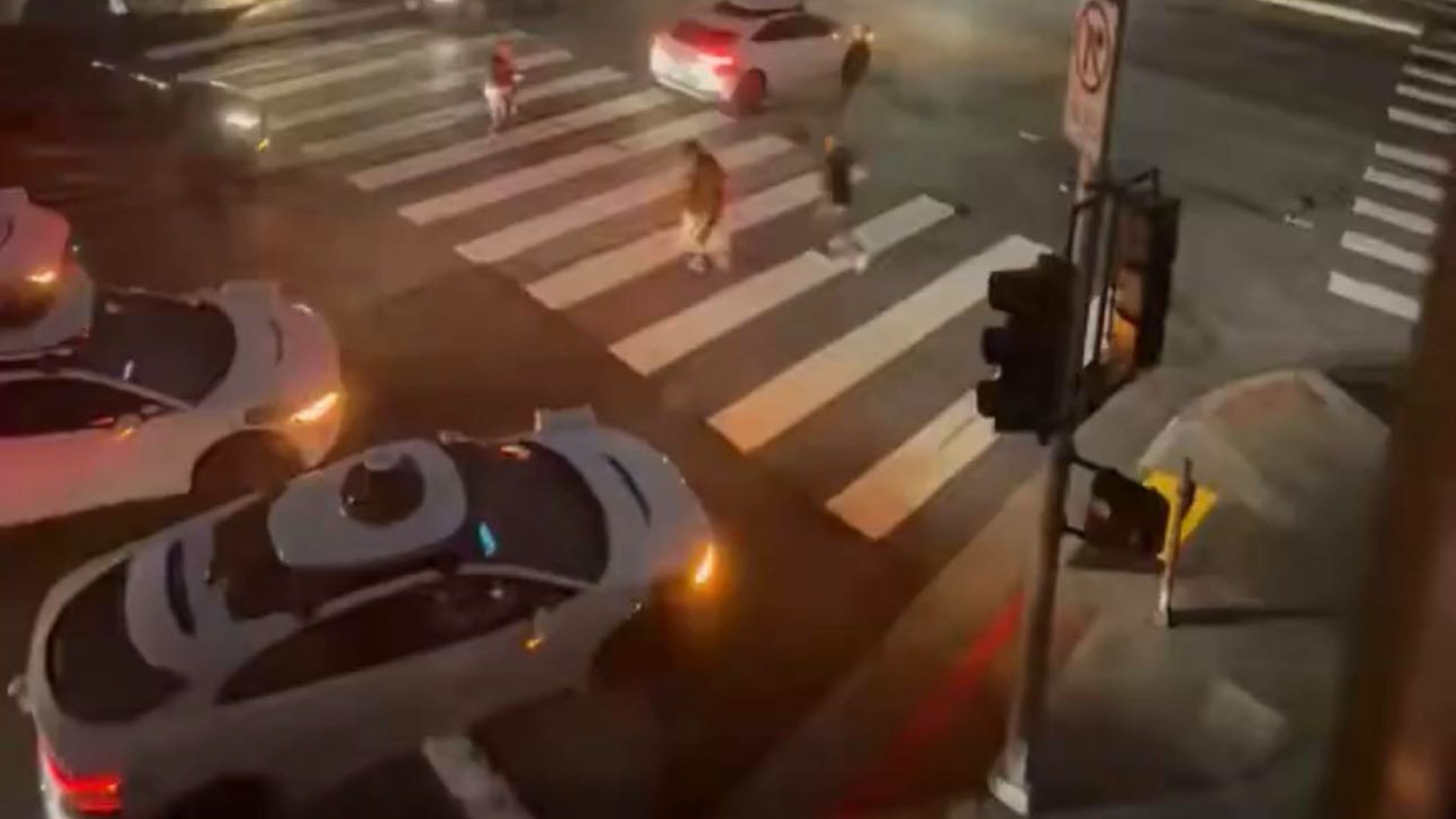
On the morning of January 23, 2026, one of Waymo’s Jaguar I-Pace robotaxis was moving through a Santa Monica neighborhood during school drop-off when a child ran into the street from behind a double-parked SUV. The car’s sensors picked her up as soon as she cleared the SUV’s blind spot. It braked hard, cutting its speed from 17 mph to roughly 6 mph before making contact near its front-right headlight assembly, according to the National Transportation Safety Board’s preliminary report. She fell, got up, and walked to the curb. No ambulance was needed.
NHTSA opened a Preliminary Evaluation one week later and sent Waymo twelve questions in March, most of them aimed at one subject: how the company’s software sets speed and caution levels around schools. Waymo asked for more time in May, asked NHTSA to clarify some of its own questions, and didn’t finish responding until July and August, seven months after a crash that put nobody in a hospital.
It Didn’t Fail to See Her. That’s the Scary Part.
The popular assumption about robotaxi crashes is that the car simply missed something a human wouldn’t have. This one didn’t. Waymo’s own account, and the physics of the incident, show the system detected the child, identified her as a hazard, and cut its speed by nearly two-thirds in a matter of seconds. It still made contact.
That’s not a sensor failure. It’s a stopping-distance problem, and it’s one that automatic emergency braking systems across the entire industry share, not just robotaxis. Detecting a hazard and fully avoiding it are two different engineering problems, governed by different physics, and the gap between them is measured in feet, not software updates. A system can work exactly as designed and still not be fast enough to stop, which is a far more uncomfortable finding than “the car didn’t see her.”
The Real Story Is the Redaction, Not the Crash
Here’s what almost nobody is talking about. When Waymo’s answers to NHTSA finally hit the agency’s public docket, they were entirely blacked out, citing confidential business information. That includes the questions about how Waymo’s software sets speed and caution thresholds near schools, which is to say the actual logic behind the number that determines how fast a driverless car is willing to go past your kid’s school.
For more than a century, that number has been public. It’s stenciled on a yellow sign, set by a city traffic engineer, and enforceable by any cop with a radar gun. Waymo’s equivalent of that number is proprietary source code, and under current law, the company gets to call it a trade secret even while it’s evidence in a federal safety investigation.
That’s not a loophole Waymo invented. NHTSA regulates automated vehicles largely through crash-reporting rules and case-by-case defect investigations, because there is no Federal Motor Vehicle Safety Standard that tells a robotaxi’s software how many miles per hour is acceptable near a crosswalk full of eight-year-olds. Human drivers get a posted number. Robotaxis get a calibration decision made inside a company that also gets to decide what counts as a trade secret.
There’s Nothing Here to Recall
It’s worth saying plainly: this Preliminary Evaluation may never produce a recall, because there may be nothing to recall in the traditional sense. A steering knuckle either cracks or it doesn’t. A judgment call about how cautious to be near a school is a calibration, not a broken part, and Waymo has already shown NHTSA how flexible that distinction can be. Its 4,000-vehicle construction-zone recall earlier this year didn’t pull a single car off the road, because the fix was a software update, not a repair. Expect the same shape here if this ever resolves: a policy change quietly pushed to the fleet, not a stop-sale.
This Wasn’t a One-Off
Santa Monica isn’t the only place Waymo’s relationship with school-zone traffic has drawn scrutiny. Austin’s school district has separately accused Waymo robotaxis of repeatedly rolling past stopped school buses, months before this investigation went public. Individually, these look like isolated glitches. Together, they read like a company whose driving policy around children is still being tuned in production, on public streets, one incident report at a time.
None of this shows up in Waymo’s aggregate safety numbers, which by the company’s own account now cover more than 220 million fully autonomous miles with dramatically fewer pedestrian injuries than human drivers over the same roads. Those numbers are real, and they matter. But a nationwide crash rate can’t tell you what a specific car did on a specific street outside a specific school, which is exactly why a single low-speed bump generated seven months of federal paperwork that a statistically stellar safety record did not prevent.
What to Remember
The lesson here has nothing to do with whether robotaxis are safer than people, on average, over millions of miles. They may well be. The lesson is that the specific decision of how fast is safe near your kid’s school used to belong to a public sign, and now it belongs to a redacted paragraph in a federal case file. For a hundred years, that number was something anyone could read. Now it’s something even the government has to ask permission to see.