
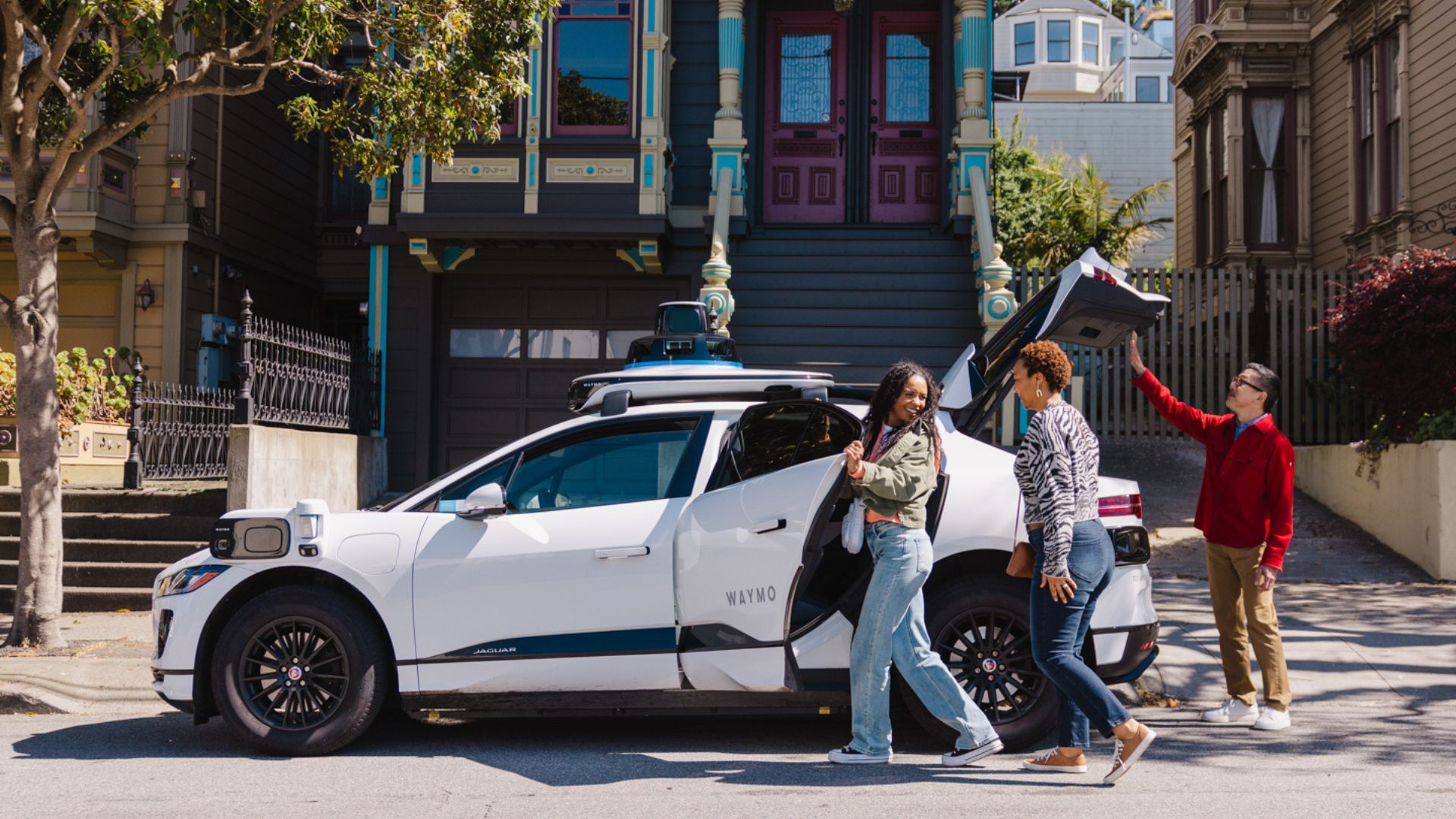
The rifle police say they pulled out of a driverless Jaguar I-PACE in San Francisco’s Outer Richmond had no serial number. The ride did.
That contrast is the whole story. A robotaxi trip is an account, a linked payment card, a pickup point, a destination, a timestamp, and video recorded inside the cabin. The firearm in that car was built to leave no trail. The car was built to leave nothing but trail. And when the people operating it decided something was wrong at four in the morning, Waymo called SFPD, brought the vehicle to the curb, and waited with the doors shut.
Autonomy is sold as the removal of the driver. This arrest is a useful reminder of what moved into the empty seat.
What authorities say happened
According to a Waymo spokesperson, company employees became aware of a firearm inside one of its driverless vehicles on Sept. 3, pulled the car over, alerted emergency services and cooperated with police. San Francisco Police Department spokesperson Allison Maxie said officers were sent to the 800 block of 40th Avenue just before 4 a.m. and carried out what she described as a high-risk vehicle stop. A search turned up an AR-styled rifle she characterized as a ghost gun, along with suspected marijuana and mace. Two passengers, one male and one female, were arrested and booked into the Juvenile Justice Center. Their identities are being withheld because of their age, and the case remains open.
The ghost gun label carries real weight in California. Under the state’s current framework, summarized in the Attorney General’s ghost gun reference guide, knowingly possessing an unserialized firearm is itself a crime under Penal Code section 23920, separate from any question of who may legally own a rifle or how it was built. Unserialized is the point: no maker, no buyer, no paper. Which is exactly what makes the vehicle around it so interesting.
Nobody was driving. Somebody was still watching.
Waymo does not hide this, though most riders have never read it. The company’s own support documentation on cameras and microphones states that there is a camera inside the car, that support staff may review interior video under certain circumstances, and that they may access live video during a trip in urgent situations. The stated purposes include cleanliness, lost items, emergencies and, in the company’s phrasing, verifying compliance with the rules riders agree to.
Read that last one twice, because the rider rules include a line most people scroll past: do not bring weapons into the car. A rule that a camera can enforce is not really a rule. It is a detection system with a terms-of-service wrapper.
The microphone detail is the part worth knowing. By Waymo’s account, interior microphones are on only during voice calls with Rider Support or when a rider deliberately turns them on, and the exterior audio hardware exists to hear sirens, not conversation. So this almost certainly was not a company listening in. It was a company looking in, or a rider using the support button, which is a meaningfully different thing and a better answer than the one most people will assume.
The car has a police hotline. Your car has a horn.
Here is the piece of the robotaxi industry that almost nobody outside a police department thinks about. Waymo runs a standing first responder program with a dedicated phone line, 1-877-503-0840, staffed for exactly these moments. The company says its first responder team carries more than 120 years of combined experience in the field and has trained more than 35,000 first responders at over 150 agencies.
No automaker maintains anything like that on behalf of the people who buy its cars. Ford does not run a hotline where an officer can call and have your doors unlocked. Waymo does. Its California law enforcement interaction protocol for the I-PACE tells officers the vehicle is designed to pull over and stop when it finds a safe place to do so, that windows can be rolled down and doors unlocked so a remote Waymo representative can speak with police, and that agencies can call that number to have the car opened if there is time.
That capability has mostly made news when it failed. We covered the Waymo that drove through a work zone and kept going while CHP tried to stop it, and the one that wandered past police tape into an active felony scene in Los Angeles. The Outer Richmond stop is the same wiring running the other direction. The remote humans who could not always be reached when police wanted a car stopped are the same remote humans who stopped this one before police even knew it existed.
Volunteering is not the same as being subpoenaed
This is the legal distinction that will matter long after this particular case closes.
Waymo’s law enforcement protocol says the company provides data to law enforcement in response to proper legal process, naming search warrants and subpoenas, and routes those demands to a dedicated legal address. In its August statement on privacy, the company said it complies with requests supported by valid legal authority and may challenge requests it believes are overly broad, and that it does not sell data collected by its vehicles’ cameras and sensors.
None of that describes what happened here, because nobody asked. The company’s privacy policy also permits disclosure to protect the rights, property or safety of Waymo, its customers or others. That is not a warrant standard. It is a judgment call, made by an employee at a screen, in real time, about people who are sitting in a car they do not own.
The constitutional protections Americans associate with their vehicles were written around the assumption that the vehicle belongs to the person in it. A robotaxi breaks that assumption cleanly. The passenger is a guest in someone else’s property, and the owner is a corporation with cameras, a compliance department and a phone number for the watch commander. Whatever a court eventually decides about footage from these cars, the practical reality is already settled: the entity best positioned to report you is the one giving you the ride.
It is worth noting the same company redacted its answers when federal regulators asked how its software handles school zones, as we reported when Waymo blacked out its responses to NHTSA. Disclosure, for any fleet operator, is a choice about audience. Volunteering a tip to a police dispatcher costs nothing. Explaining your speed logic to a federal investigator costs a great deal.
California wrote the rulebook for this in July, and almost nobody noticed
As of July 1, 2026, under AB 1777, driverless vehicles operating in California must carry a two-way device allowing first responders to communicate with a human at the company, a change the California Highway Patrol flagged in its summary of new 2026 laws. The same law created something stranger: a notice of autonomous vehicle noncompliance, issued to the manufacturer rather than to a driver, because there is no driver to hand a citation to. The DMV prints it as form OL 325, and agencies have to request copies on department letterhead.
Think about what the state conceded by writing that. California decided the responsible human in a driverless car is not in the car. It is a person at a desk, reachable by phone, employed by the company. Legislators built that channel so police could reach in. Nothing in the design stops it from working the other way, and on Sept. 3 it did.
The age detail nobody has explained
Both passengers were booked into a juvenile facility, which means both were under 18. Waymo’s rider rules require riders to be 18 or older to ride alone and prohibit letting minors ride without an adult. The one exception, teen accounts for ages 14 to 17, exists only in metro Phoenix and requires a parent to link the account and attach a credit card.
San Francisco has no such program. So that trip was hailed by an account belonging to someone who is supposed to be an adult, tied to a payment method, a phone and an email address. The old version of this story involves borrowed keys and a car nobody can trace to a specific evening. The new version involves borrowing an identity, and identities leave receipts.
That is the quiet enforcement problem sitting inside every robotaxi fleet. The account is the driver’s license now, and it can be handed around a group of teenagers as easily as a set of keys, right up until the moment a camera notices who is actually in the back seat.
Why this matters if you never set foot in a robotaxi
Because the cabin-facing camera is not staying in the robotaxi. Federal regulators have been working toward requirements for advanced impaired driving prevention technology under an NHTSA rulemaking that explicitly contemplates systems capable of detecting a driver’s condition. Insurers already sell discounts for telematics that grade your braking. License plate readers log where your car has been whether you consent or not, which is why we have spent this year covering a deputy who ran one woman’s plate 1,639 times and a camera installer who called police on a reporter for watching him work.
The robotaxi is not a departure from that trend. It is the most honest version of it. Every modern car is becoming a witness. Waymo simply skipped the pretense and put the witness on the payroll, gave it a camera, a phone line and instructions about when to use them.
What to remember
Two teenagers allegedly brought an untraceable rifle into the single most thoroughly documented vehicle on an American street. Whatever else this case produces, it produced that.
The driverless car’s least discussed feature is not that it drives. It is that it remembers, and that somebody employed by the manufacturer can watch it remember, stop it at the curb and make a phone call, all before the passengers understand the ride is over.
The rifle had no serial number. The ride did. In five years, that sentence will describe most cars on the road.
Would you trust a self-driving car enough to let it call the cops on you? Let us know in the comments.