
Richmond Mayor Danny Avula’s reason for dropping Flock Safety’s plate cameras had less to do with the cameras inside Richmond than with the ones across the line. Neighboring Henrico County had just ended its contract for 122 of them. With Henrico out, Avula told CBS 6 Richmond on Oct. 10, “Flock specifically is now less useful as a tool,” and the city will not renew when its contract runs out in July 2027.
The day before, Reuters reporters Krystal Hu and Helen Coster reported the Flock Safety layoffs: the company plans to cut about 18% of its roughly 1,500 employees, around 270 people, following a voluntary buyout program. Their sources spoke on condition of anonymity because the plan had not been announced, and Flock declined to comment. According to Reuters, the company runs about 120,000 cameras across 49 states, has raised more than $950 million, and was valued at $7.5 billion in a March funding round.
Flock grew by selling cities a network. A police department paying for a few dozen cameras could also search plate reads from the towns around it when those towns agreed to share, so every new customer made every existing subscription more useful. That is why the company could reach 120,000 cameras in under a decade. It also means the network can lose value faster than it loses cameras, because each city that leaves takes coverage away from its neighbors too. Avula said that on the record. The job cuts are where that math starts to show up inside the company.
Henrico’s 122 cameras covered 1.73 miles, and Richmond still felt the loss
Henrico announced on Oct. 6 that it would end its Flock contract within a week. The county said its cameras covered about 1.73 miles of road, or 0.05% of county roadways, according to the Virginia Center for Investigative Journalism, which counted it as the largest Flock network in Virginia to be canceled. Board of Supervisors Chair Roscoe Cooper said the county “cannot ignore the potential for misuse of system data by others.” Henrico said it owed no penalty because its agreement allowed early termination.
A footprint that small can matter because of where plate readers earn their keep. A stolen car or a suspect’s vehicle is most useful to police at the moment it crosses from one jurisdiction into another, and a reader at a county-line intersection logs that crossing for both sides. “Crime doesn’t stop and start at the city-county line,” Avula said. Richmond’s own website lists 99 fixed plate readers plus two that can be moved, CBS 6 reported. Those 99 are worth less to Richmond detectives when the next county over goes dark, and Goochland County’s sheriff had already cut ties with Flock in September.
The sharing that made the product attractive is also what customers now worry about most, as Cooper’s “by others” suggests. Flock’s August changes point the same way. In an Aug. 13 post, founder and CEO Garrett Langley announced a feature that lets a city restrict which offense types other agencies can use to search its cameras, with stolen vehicles and missing persons allowed and immigration enforcement blocked as the example. The company also cut its recommended default data retention from 30 days to seven. Each change makes a single city more comfortable and the national network a little less searchable. Sen. Josh Hawley’s bill would cap retention at 10 days, so Washington is now arguing over the same dial.
Texas drivers helped pay for thousands of these cameras through their insurance
In Texas, the money behind the network came partly from car owners. The Motor Vehicle Crime Prevention Authority, a small state agency with a governor-appointed board, is funded by a fee that every company writing auto insurance in the state pays: $5 per motor vehicle year for policies written since May 29, 2023, according to the Texas Comptroller. A Texas Department of Insurance rule says the insurer “is authorized to recoup some or all of this fee from the policyholder,” and requires a notice in at least 10-point type when it does, per 28 Texas Administrative Code § 5.205. If you insure a car in Texas, look for that line on your declarations page or bill.
The Texas Tribune reported that the authority directed at least $30 million toward more than 3,200 Flock cameras, with another $10.9 million earmarked for subscriptions on more than 2,600 cameras in 2027. Gov. Greg Abbott blocked that money in late August. By Sept. 24, the Tribune counted at least 900 Flock cameras shut off in at least 14 Texas cities and counties. Abbott also had the Texas Department of Transportation stop permitting new plate readers on state roads, which we covered alongside Florida’s order pulling them off state highways.
Flock’s cameras are sold as a recurring subscription, and a grant keeps that bill out of a city’s general fund. Once the grant goes away, the renewal becomes a line item a city council has to vote on in public. Laredo’s council voted 7-2 to put a nonbinding question on the May ballot about spending $1 million a year to keep 165 cameras running. By The Auto Wire’s math, that is about $6,060 per camera per year.
Kyle shows how quickly that vote can turn. On Sept. 5, the council voted 6-1 to keep its contract even though its $205,000 grant for 2026 never arrived, the Tribune reported. About a month later, it voted 4-3 to disable the cameras citywide until a nonbinding referendum in May, KUT reported. Police Chief Jeff Barnett said the department would comply and told the station he expects fewer stolen vehicles to be located. That is the trade car owners are being asked to weigh. Flock says its technology helped detect more than 20,000 stolen cars in July alone, a company figure that has not been independently audited.
Harris County, Madison Heights and Aurora switched cameras off before their contracts ended
Some customers are not waiting for renewal dates. On Oct. 8, Harris County Precinct 4 Commissioner Lesley Briones had staff cover and shut off 61 Flock cameras on precinct property, 13 plate readers and 48 security cameras across nine parks and facilities, FOX 26 Houston reported. “But I cannot wait to act. These Precinct 4 cameras are offline,” Briones said. Plate readers are on the Harris County Commissioners Court agenda for Oct. 15.
Madison Heights, Michigan, had only three plate readers, covered and unused since Sept. 23. The city said it waited for Flock to show that proper safeguards were in place, did not get that assurance, and will not renew. “Without clear and reliable safeguards, the City cannot continue the operation of the ALPR system at this time,” the city said, according to WXYZ.
In Aurora, Colorado, police turned off 12 Flock cameras in the parking lots of five Aurora Public Schools high schools on Oct. 6 after city council members asked, Colorado Politics reported. Aurora police had credited one of those cameras with spotting a stolen car, spray-painted black, after an armed carjacking. They were switched off anyway. Police Chief Todd Chamberlain said Flock would remove them within three weeks unless the school board signs its own contract.
A correct plate read still put a theft summons on a Colorado woman’s doorstep
On Oct. 5, Chrisanna Elser, a financial planner from the Denver area, sued Flock, the towns of Columbine Valley and Bow Mar, a Columbine Valley police sergeant and the town’s police chief in U.S. District Court in Colorado. Courthouse News Service describes it as a class action, and the complaint asks the court to block what it calls Flock’s “warrantless collection, cataloging, retention, sharing, and searching” of drivers’ movements.
On Sept. 27, 2025, a sergeant served Elser a petty-theft summons accusing her of taking a $25 package from a Bow Mar doorstep. Denverite reported that the accusation rested on a Flock hit showing her truck in town around the time of the theft. The charge was dropped after Elser sent the police chief footage from her Rivian truck showing she never stopped in Bow Mar.
Flock’s defense is that the camera did its job. A spokesperson told Courthouse News that “the Flock system accurately identified the location of Ms. Elser’s vehicle” and blamed human error. That is consistent with the company’s own guidance, which says “an alert is a lead, not a conclusion, which should be confirmed by an officer.” A plate reader records that a car passed a pole. It cannot record who was driving, whether the car stopped, or what anyone did. In Elser’s case, the evidence that filled that gap came from her own vehicle’s cameras. The same thing happened to the woman whose undamaged Dodge Durango got her out of jail after 13 days. And a federal judge in Oklahoma recently ruled that a Tulsa deputy’s search of a month of plate-reader data violated the Fourth Amendment.
Dates that will show whether more neighbors leave
Harris County’s Commissioners Court takes up plate readers on Oct. 15. If the full county follows Precinct 4, the Houston area gets its own version of the Henrico problem. In Richmond, the mayor’s office said Avula would address the question of ending the contract early, rather than in July 2027, at the police department’s quarterly crime briefing on Oct. 13. Kyle and Laredo vote in May. Texas still has $10.9 million earmarked for 2027 Flock subscriptions with no word from Abbott’s office on whether the freeze ends.
Flock has its own deadline. By the end of 2026, every law enforcement customer must require case codes for searches and adopt the company’s Audit Assistance monitoring, according to its August post. Those are the controls cities like Madison Heights said they wanted. They arrive after a buyout and about 270 job cuts, and after a Reuters/Ipsos poll found 47% of Americans oppose Flock cameras in their community and 38% support them.
For drivers, the practical effect will be uneven. A car could pass through readers in one county and none in the next, with stolen-car alerts that stop at a city limit, and in Texas some of the cameras that remain were bought with money from a fee on insurance policies. Each city that exits weakens the case for the city beside it, and Richmond has shown that a mayor will say so out loud.
Do your county’s plate readers catch enough stolen cars to justify logging every trip you make? And do you know who can search that log?
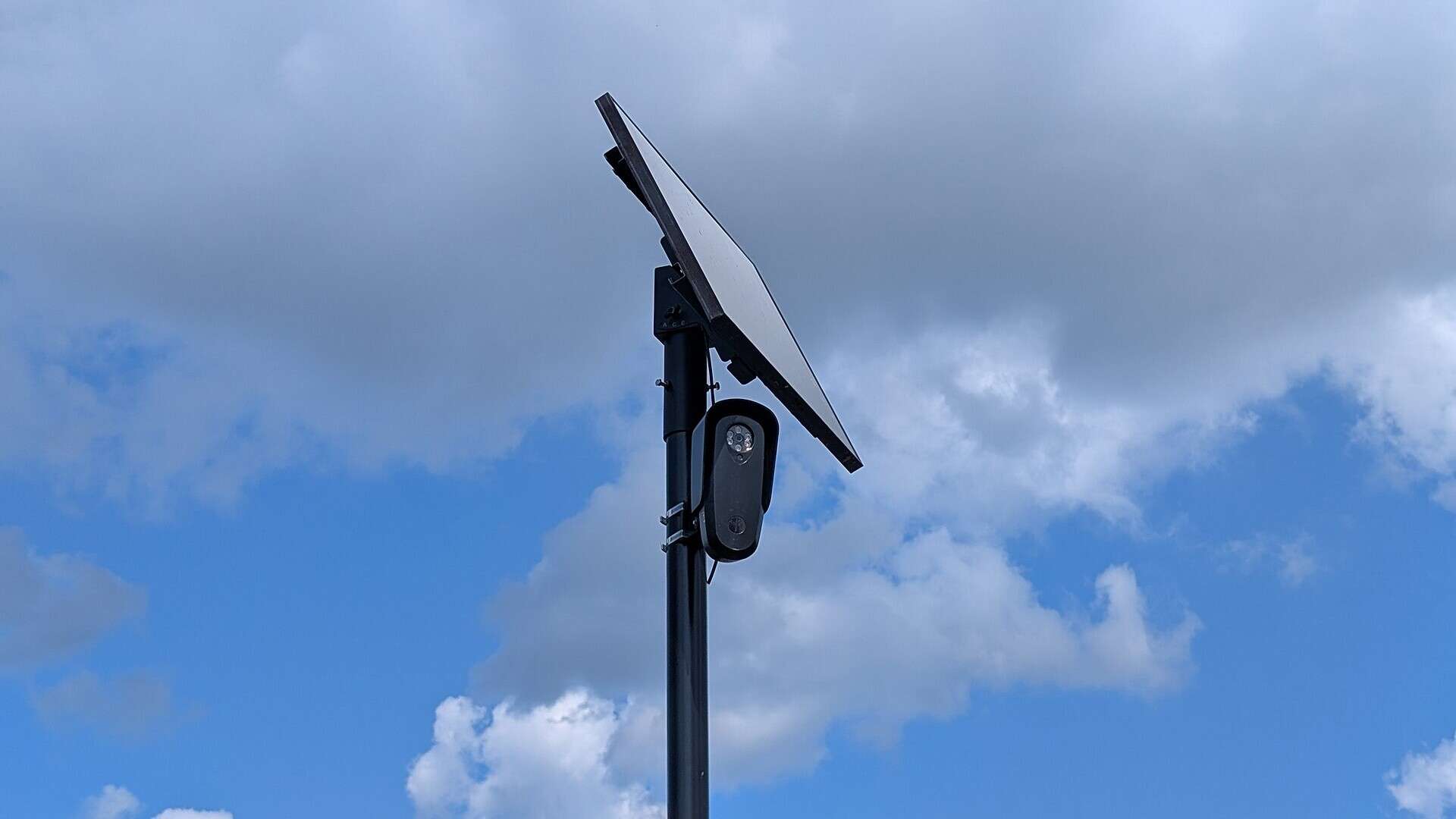
Featured image: Flock Safety plate reader in Eatontown, New Jersey. Photo: MiracleMiles / Wikimedia Commons (CC BY 4.0)