
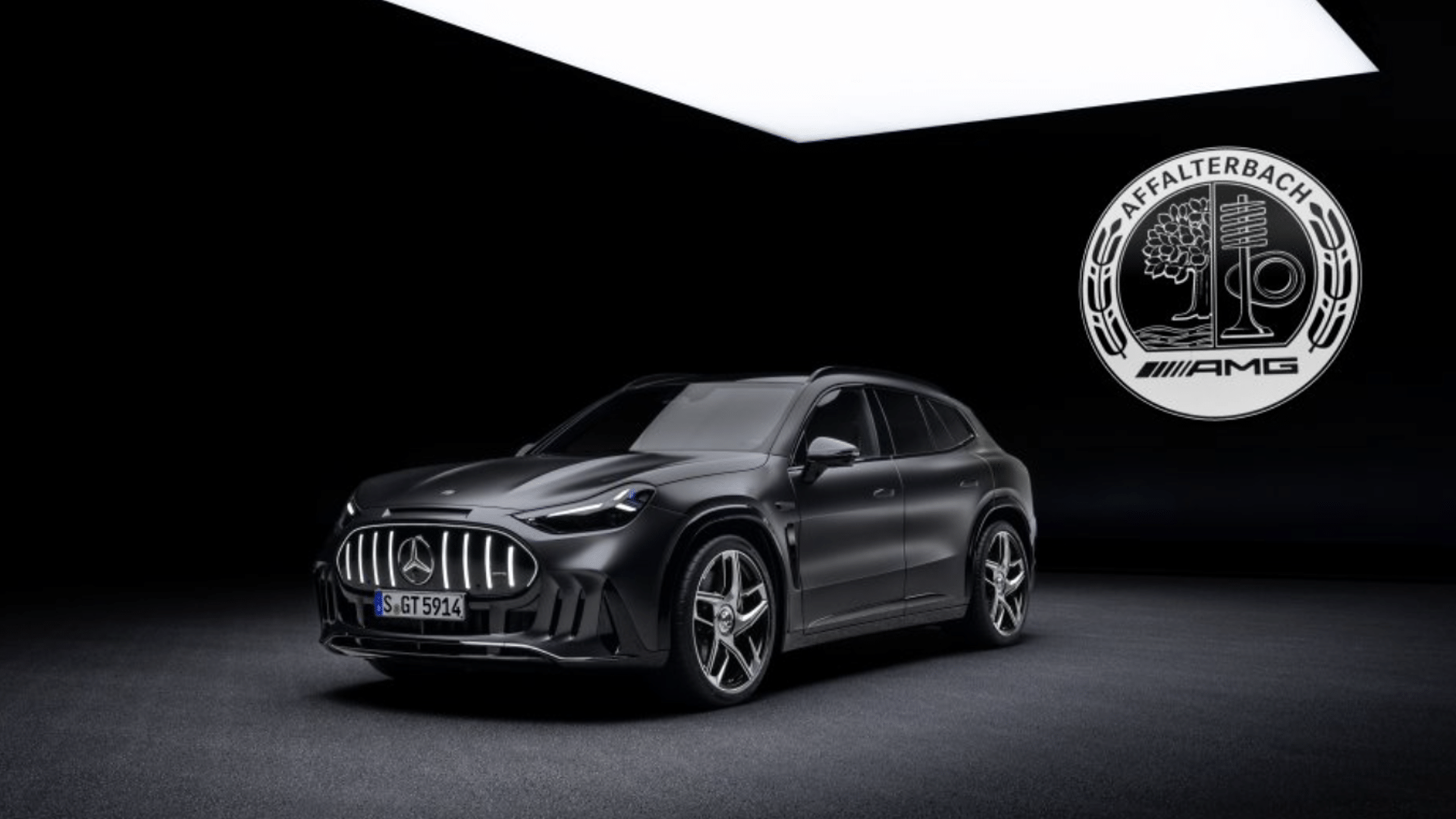
AMG built its first full-size SUV from scratch, put no engine in it, and then spent real effort making it sound like it has one. The GT SUV debuted October 17, and Mercedes-Benz USA’s release says it reaches U.S. dealers in summer 2027, with the GT 63, GT 55 and GT 53 available at launch. No U.S. pricing appears in it.
The 1,153 hp number comes with fine print
The headline figure belongs to the GT 63, and it’s peak output. Mercedes lists continuous output at 711 hp, plus a boost duration of 63 seconds. That boost is summoned by pulling both paddles at once. Read that as a sprint allowance, not a baseline. Continuous output is what counts on a track day or towing a heavy load up a grade.
The same release claims 2.4 seconds to 60 mph with one-foot rollout, or 2.6 without, both estimates. Curb weight is 2,695 kg, about 5,940 pounds by my conversion. A 1,475 lb-ft launch has to deal with all of that mass, which is why the hardware matters more than the number.
What’s underneath
The GT 63 and GT 55 use three axial-flux motors: two in a rear unit, one up front. The front motor acts as a booster that decouples under light load, so it spends most cruising time as dead weight, not drag. The GT 53 skips the exotica for two synchronous motors and a two-speed rear transmission, making 536 hp.
Related Articles
- Car-Mart Built Its Loans Around Payday. Now Its Own Lenders Have It on a Seven-Day Leash
- Porsche’s Mission S Previews a Supercar Above the 911 With No Center Screen. Your Phone Snaps Into the Dash Instead
The battery is where the engineering is. Mercedes describes an 800-volt pack, 128 kWh usable in the top two models, built from cylindrical cells that are directly oil-cooled. Each cell is 4.1 inches tall and an inch across. The pack is integrated into the body structure and protected by a housing that forms part of the crash concept.
My read on ownership: a structural, oil-immersed pack is the kind of design that pushes repairs toward dealer-level module work. After a crash, expect a bill with a lot of zeros. Nothing in the release addresses repairability, so treat that as informed skepticism, not fact.
Charging claims are preliminary
The headline is 710 kW DC. Mercedes puts 10–80 percent at 12 minutes on the big battery, and says up to 454 km of WLTP range in as little as ten minutes. At a 400 kW charger, the 128 kWh models need 16 minutes.
The footnotes matter here. The company says the figures are preliminary and not yet confirmed by an officially recognized testing body. Range is WLTP, which runs more generous than EPA, and no EPA estimate has been published. A 710 kW claim also needs a charger that can deliver it. That’s a car-side spec, not a guarantee about the plug at the end of your road trip. The car does switch between 800- and 400-volt modes and supports five DC standards, including NACS.
The suspension swaps anti-roll bars for plumbing
AMG Active Ride Control+ replaces mechanical anti-roll bars with hydraulic elements controlling pitch and roll. The release says it reduces front-end dive under braking and lift under acceleration. It’s standard on the GT 63 and optional on the GT 55. Rear-axle steering is standard on all three: up to 6 degrees, opposite the front wheels below 50 mph, parallel above.
Hydraulically interconnected dampers and air springs are a lot of plumbing. If you’re buying used in 2032, that’s the line item to get inspected.
The sound
AMGFORCE Sport+ plays what Mercedes calls meticulously documented engine sound, and it is careful to say it isn’t “synthetically generated.” It’s based on over 100 measurements taken with 16 microphones on reference vehicles including the AMG GT R (C 190). The GT 63 and GT 55 get V8; the GT 53 gets a six-cylinder. Add simulated gear changes through the paddles and a seat that vibrates.
Related Articles
- GM Is Ditching the Rented Building Where It Built the First Chevy Volt Battery, the Same Week It Approved a $20 Billion Buyback
- Tacoma’s Speed Cameras Caught Nearly 400,000 Drivers in Four Weeks. A Weighted Lottery Picks Which 200 a Day Pay $145
I’d argue “recorded, not synthesized” is a semantic win. A speaker still produces the noise. But it’s a defensible distinction, and the sound slider, running from “Classic” to “Futuristic,” at least admits what’s going on.
What it costs to stop
The GT 63 gets carbon-ceramic brakes at both ends as standard. The GT 55 has steel brakes, with ceramics optional, and the GT 53 is steel only. Ceramic rotors resist fade, but replacement is notoriously pricey. At 5,940 pounds, the ceramic option on the 55 deserves a long look once pricing arrives.
Bottom line for buyers
The GT SUV is 200.2 inches long on a 119.7-inch wheelbase, holds 21.4 cubic feet of cargo plus a 2.8 cu ft frunk, and weighs nearly three tons. Ask for continuous power, wait for certified charging numbers and an EPA range, and ask a dealer what the pack and the suspension cost when they fail. The recorded V8 is the cheap part.
Would you take a recorded V8 in a 5,940-pound electric SUV, or is the whole point of an AMG that the noise comes from something that burns?
Images Via: Mercedes Benz