
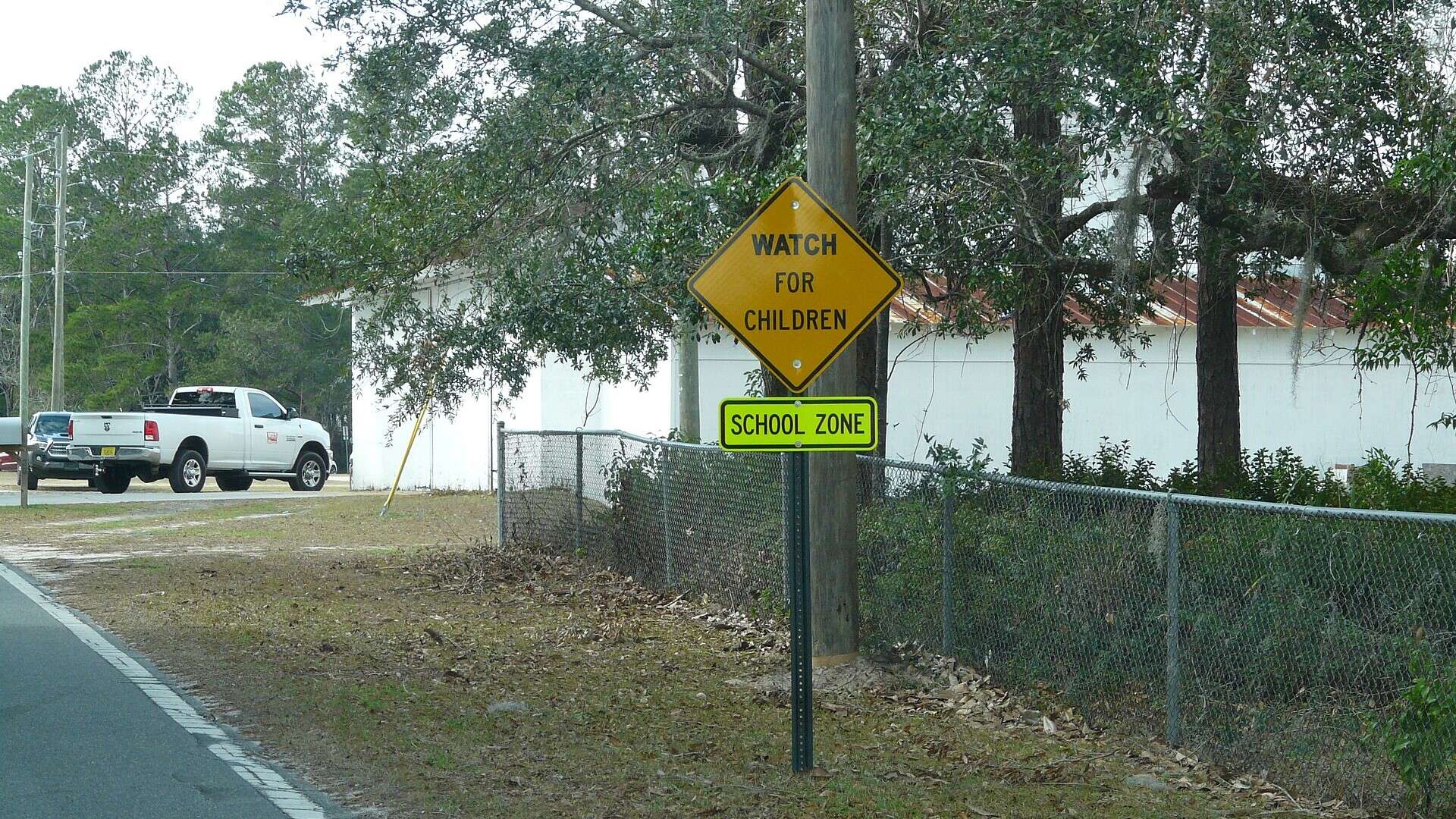
A Palm Beach County judge has thrown out a Wellington school-zone speed camera ticket because the camera system never received approval from the Florida Department of Highway Safety and Motor Vehicles, CBS12 News reported on Oct. 20. Without the state’s sign-off, the judge found, the camera’s speed reading couldn’t be used in court. Without the reading, there was no proof the driver was speeding.
The decision covers one driver. The judge did not find that Wellington’s cameras measured anyone’s speed wrong, and no camera has to come down. But the argument that won applies well beyond one village. As of September 2025, 34 Florida jurisdictions were running 646 school-zone speed cameras, according to the department’s own December 2025 summary report. The weak spot the judge found sits in the state law that authorized all of them, and it comes from how lawmakers wrote one exemption in 2023.
Florida’s two rulebooks for speed-measuring devices
Florida regulated speed-measuring equipment long before anyone bolted a camera to a pole near a school. Section 316.1905(1) of the Florida Statutes says any electronic, mechanical or other device a peace officer uses to determine a vehicle’s speed “shall be of a type approved by the department” and must be tested for accuracy at least once every six months, under procedures the department sets. The department is DHSMV. It handles approvals under Rule Chapter 15B-2 of the Florida Administrative Code, and its public list of approved speed-measuring devices reads like the trunk inventory of a Highway Patrol cruiser: Stalker radar and lidar units, Kustom Signals, several LTI 20/20 models, DragonEye. I found no Jenoptik product on that page. Jenoptik is the company Wellington names as its camera vendor on the village’s School Zone Safety Program page.
When the Legislature passed HB 657 in 2023, letting counties and cities mail $100 notices to drivers caught going more than 10 mph over a school-zone limit, it wrote cameras their own testing rule. The Governor approved the bill on May 31, 2023, and it took effect July 1 of that year, according to the final House bill analysis. The new language became Section 316.1906(3), which says a speed detection system “is exempt from the design requirements for radar or LiDAR units established by the department.” In place of the six-month test, a camera must run a self-test of its accuracy at least once every 30 days, with a log of the results, and the agency or its contractor must perform an independent calibration test at least once every 12 months. Those logs and calibration results are admissible in court.
Wellington’s defense rests on that subsection. Village Manager Jim Barnes told CBS12 the cameras meet the 30-day self-test and annual calibration requirements, and he pointed out that the judge found nothing wrong with the speeds they measured. The village argued in court that no DHSMV approval was needed. The judge ruled that it was.
The written order wasn’t available when this story was filed, and the CBS12 report doesn’t say which statute sections the judge relied on. Reading the two sections side by side, though, the gap is visible. The 2023 law exempts cameras from the department’s design requirements. It doesn’t say cameras are exempt from the separate requirement in 316.1905 that a speed device be a type the department has approved. The new subsection’s admissibility sentence opens with “Notwithstanding subsection (2),” which refers to the radar-officer rules inside 316.1906 itself, such as the requirement that an officer make an independent visual estimate of speed. It says nothing about 316.1905. The two sections also set different clocks: six-month accuracy testing in one, 12-month independent calibration in the other. Wellington’s own FAQ says its radars are “certified annually by a third party,” which matches the newer rule and not the older one.
Why most Wellington drivers won’t benefit from the ruling
A camera ticket in Florida starts as a notice of violation, not a court case. Under Wellington’s published process, the notice goes by mail to the registered owner, costs $100 and doesn’t touch the driving record. The owner has 30 days to pay, request a hearing or file an affidavit. Ignore it and it becomes a uniform traffic citation: a $206 penalty filed with the Palm Beach County Clerk of Courts, recorded on the driving record, and handled in county court. Ignore that, and the village warns of a license suspension.
The economics push nearly everyone toward paying the $100. DHSMV’s December 2025 report counts 645,104 school-zone notices issued statewide from the start of the programs through Sept. 30, 2025, and 3,457 contested ones. The department labels those figures preliminary. By my math, that is a contest rate of about half of one percent. A legal argument that only works for drivers who fight their tickets will reach a small fraction of them, and Barnes told CBS12 the village is not changing how it processes citations or reviewing pending or already-paid ones because of this decision.
That is the population The Ticket Clinic wants to grow. “This ruling could affect many other cases,” attorney Ted Hollander told CBS12, adding that his firm has more cases coming up. A county court decision doesn’t bind other judges, so each driver who raises the argument will be asking a judge to agree with a colleague, not to follow an order.
Where each $100 school-zone notice goes
The stakes for Wellington are measurable. The village issued 21,937 notices between Sept. 15, 2025, and June 30, 2026, with 5,290 of them at Wellington High School, according to the village annual report as cited by CBS12. The program collected about $1.45 million in the fiscal year that ended June 30, and about $723,000 of it went to Wellington. The rest was split among the camera vendor, the school district, state funds and the sheriff’s school crossing guard program.
The state split is set in Section 316.1896(5). Of every $100, the county or city keeps $60 for running the camera program and other public safety work, $20 goes to the state’s General Revenue Fund, $12 goes to the county school district for school security and student transportation, $5 goes to the School Crossing Guard Recruitment and Retention Program, and $3 goes to the Criminal Justice Standards and Training Trust Fund. Wellington’s roughly $723,000 works out to about half of what its program collected, and CBS12’s account lists the camera vendor among the recipients of the rest.
The resident and the attorney CBS12 interviewed both described the program as a way to make money. Wellington’s numbers argue the cameras are also doing what the law intended. The village told CBS12 that violations declined over the year and that measured speeds were lower in April 2026 than in April 2024 at all 11 monitored locations, with the biggest drops during morning drop-off. Nothing in this ruling disputes that. The judge’s problem was a missing state approval, which is a paperwork defect with a paperwork fix.
Three ways Florida could close the camera approval gap
Barnes said Wellington intends to challenge the decision, potentially through a request for reconsideration or an appeal. An appeal is the path with the widest effect. A higher court ruling in either direction would carry more weight than a single county judge’s decision, and the other jurisdictions running school-zone cameras would have an answer to point to.
The second path runs through DHSMV. If the department issued certificates of approval for the camera systems cities already use, as it has for about two dozen radar and lidar models, the argument would lose most of its force for tickets issued after that date. Tickets issued before it would still be open to challenge.
The third is the Legislature, which could add one sentence to 316.1906(3) saying cameras are also exempt from the approval requirement in 316.1905, or reconcile the six-month and 12-month testing clocks. The state has already been sorting out which roadside cameras it wants, and we covered how plate readers were pushed off state highways while ticketing cameras kept spreading. School-zone camera money now flows to school districts and crossing-guard programs in every jurisdiction that runs one, which gives lawmakers a reason to fix the wording quickly.
Florida isn’t the only place where an automated ticket depends on paperwork as much as physics. Philadelphia’s cameras billed a Dallas man for a Mercedes using a plate from his old Buick, and Chicago’s system wrote a ticket every 17 seconds in 2024. A camera that writes thousands of notices a year multiplies every procedural gap by the same number.
For Wellington drivers with a pending notice, the practical point is narrow: the argument exists, one judge accepted it, and it has to be raised to count. For everyone else, the thing to watch is whether Wellington’s appeal or a DHSMV approval gets there first, and whether the Legislature takes the question away from the courts entirely.
If a speed camera’s reading was accurate but the device never got the state’s formal approval, should the ticket stand?