
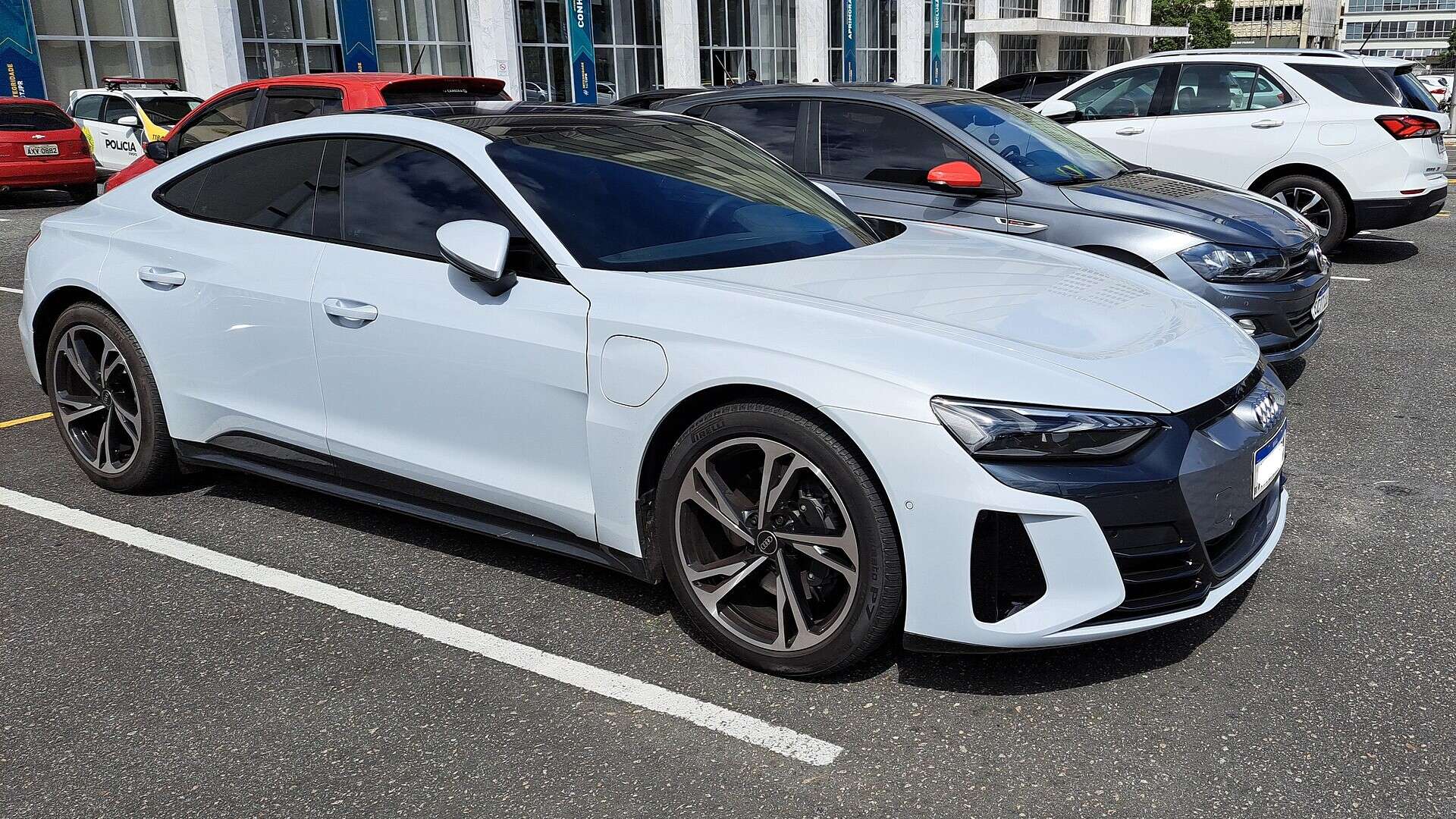
Paragraph 36 of Audi’s newest German patent application describes pressing a metal part against the road so the friction throws sparks when the car hits a set speed or acceleration, or when the driver brakes. Earlier in the same document is a proposal that would matter more to whoever ends up owning the car: mount the electric motor on rigid steel so its vibration and noise travel into the cabin, and preferably leave the motor’s sound insulation out entirely.
The filing, DE 10 2025 107 436 A1, lays out a long menu of ways to make an electric car feel like something other than an appliance. Read start to finish, it treats EV character as something that has to be bought back with lost refinement and with hardware that wears out, and it leans on a pedestrian-safety argument that regulators in the U.S. and Europe have already turned into law.
What Audi filed with the German patent office
Audi AG filed the application with the German Patent and Trade Mark Office on Feb. 27, 2025, and the office published it on Aug. 27, 2026. The listed inventors are Dr. Dirk Bäder of Fellbach and Dr. Michael Grabowski of Ingolstadt. The German title describes a motor vehicle with an electric motor plus a vibration-transmission element, an effect-generating device, or both.
An A1 document is an unexamined application. The office keeps a new application secret for 18 months before publishing it, and examination starts only after someone files a request and pays a 350-euro fee. Publication shows what Audi wanted on the record. It does not show what Audi will build or what it will be allowed to claim, and a filing can drift a long way from its headlines once people start reading it.
The application has 10 claims, two of them independent. Claim 1 covers an EV with an element that carries vibration or sound made by the electric motor into the cabin, out to the street, or both. Claim 4 covers an EV with a device that produces a visual effect based on the car’s operating state. The rest hang off those two: a clutch that disconnects the motor from the driveshaft or wheels (claim 2), a control unit that simulates gearshifts and gear ratios (claim 3), an electric-arc generator (claim 5), a spark generator (claim 6), headlights that wink or blink (claim 7), exterior screens or light strips that pulse with the driving situation (claim 8), a display along the edges of the windshield that blurs or distorts with speed and acceleration (claim 9), and a scent dispenser (claim 10).
Audi wants the motor’s own noise, not a speaker’s
Most attempts to give EVs a soundtrack run through loudspeakers and shakers, and Audi already owns one. U.S. Patent 12,570,308, granted March 10, 2026, from a German filing dated Dec. 1, 2021, covers vibration elements and the traction motor itself generating haptic signals tied to the drivetrain’s operating state, with a loudspeaker able to add matching sound. Audi’s new application cites two rival German filings along the same lines: a Mercedes-Benz application for simulating a combustion car’s vibrations and sounds while driving and shifting, idling and starting, and a Hyundai and Kia application that derives virtual engine effects from calculated gear-tooth pressures in a modeled powertrain.
The new filing goes the other way. It names the motor mount as the vibration-transmission element, built from rigid parts that carry structure-borne noise, such as a hollow steel section running from the motor toward the cabin or the outside of the car and passing through the motor bay’s sound insulation. The text then calls it particularly preferred to omit the motor’s sound insulation so vibration and noise travel better, and says the car can be built without it.
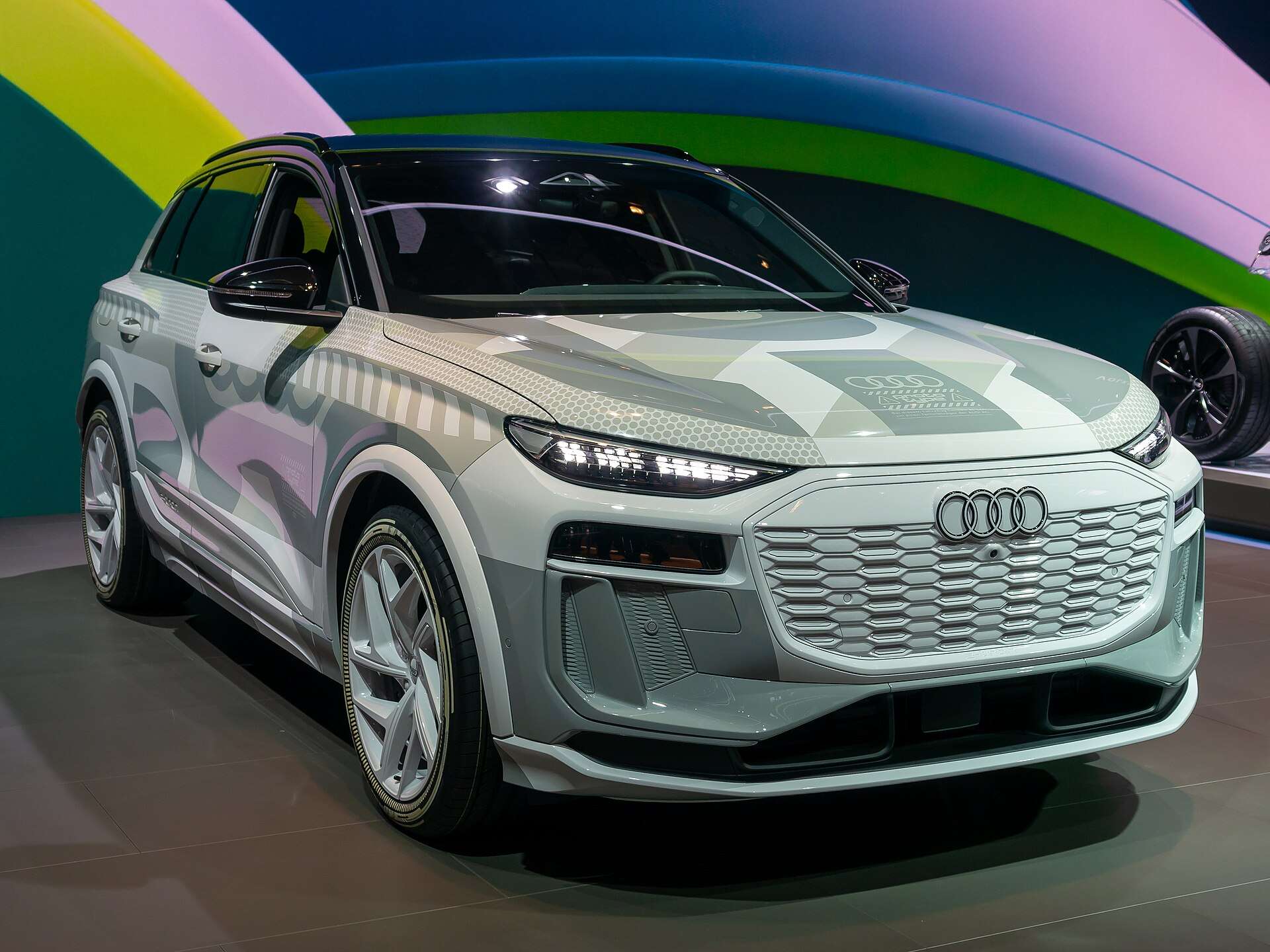
That is an odd thing for a company that sells quiet as a luxury feature to put in writing. Rubber mounts and acoustic insulation are there because an electric motor’s raw noise isn’t pleasant. The magnetic forces in a motor repeat at multiples of its electrical frequency, which climbs with pole count and shaft speed, so they land far higher than an engine’s firing pulses. By The Auto Wire’s arithmetic, a four-cylinder four-stroke at 2,000 rpm fires about 67 times a second, while an eight-pole motor at 6,000 rpm runs at an electrical frequency of 400 Hz, with its vibration orders stacked at multiples of that. Bolt that hard to the body and the floor carries a whine. Audi’s text says the vibrations can fall in the audible range, but it never explains how a hard-mounted motor would produce the sensation drivers associate with a combustion engine.
The clutch has a similar gap. The filing says its purpose is to let the motor keep spinning while the car is stopped, producing vibrations and sounds reminiscent of an idling engine, and to let the driver rev it in place the way sports-car owners blip a throttle. That takes a disconnect in the driveline, something to actuate it, and a motor turning with nothing to propel, powered by the battery while the car sits at a light. The document gives no figure for that energy cost.
Sparks, arcs, scents and a part built to grind away
The software side reads like a wish list from a combustion-car owner. Paddle shifters would step through simulated gears, with sound, vibration and acceleration changing at each shift and a rev-matched downshift made audible and felt. Stored maps would simulate turbo lag. A button, or an AI that predicts the driver wants more power, could release a short burst of extra torque. The filing says the simulated transmission is meant to help drivers adjust faster when they move from a combustion engine to an electric motor.
The visual claims run from mild to strange. Interior and exterior lights would pulse faster and brighter as motor speed rises, and lights flashing briefly near the underbody and tail would stand in for misfires and flames. A color-changing paint could turn reddish under hard driving. Matrix headlights could wink at an owner the car recognizes by camera, key or phone. The arc generator would create a plasma discharge between two electrodes behind protective glass, its intensity set by motor or road speed, mounted on the sides of the car, near the underbody, or in the center console in the driver’s view, responding to the accelerator.
The spark generator is where the document stops simulating anything. It lists electrical discharge, metal rubbing on metal, or a flint, and then a sacrificial metal component pressed onto the road so abrasion throws sparks during set accelerations, speeds or braking. A sacrificial part is a consumable by design. The application doesn’t say what it is made of, how long it lasts, what it does to the pavement, or who pays to replace it. For an owner, that is a new line on the service invoice for a feature whose job is to destroy itself. For the driver behind, it is hot metal coming off the road at speed.
The scent claim covers diffusers that release calming fragrances in traffic jams and energizing ones under sporty driving, including what the filing calls the smell of electrosmog, plus scents meant to simulate misfires.
The safety case is already written into U.S. and EU rules
Audi frames the package around two problems. Its background section says EV development has concentrated on performance and on reducing noise, that quieter EVs may be noticed less in traffic, and that EVs lose emotion and character. The stated goal is to make an electric car more perceptible.
The first problem already has rules. In the U.S., Federal Motor Vehicle Safety Standard 141 requires hybrids and EVs up to 4,536 kg gross vehicle weight rating to emit alert sound when stationary with the propulsion system on, in reverse, and at speeds below 30 km/h (18.6 mph). It also bars anyone under NHTSA’s authority from disabling or altering that equipment except to repair a malfunction or fix a defect. In Europe, Regulation (EU) No 540/2014 required an acoustic vehicle alerting system on new types of hybrid and electric vehicles from July 1, 2019, and on all new ones from July 1, 2021.
Those rules target the low speeds where cars and pedestrians share crosswalks and parking lots, and a spark shower or a pulsing light strip adds little there that the mandated alert sound doesn’t already provide. Some of the effects would create regulatory work of their own. The U.S. lighting standard, FMVSS 108, prohibits added equipment that impairs the effectiveness of required lamps, a test any flashing underbody or tail effect would have to pass. The safety argument covers the low-speed noise, and everything else in the filing serves the second problem.
Why German premium brands keep filing these
For a premium brand, character has always been part of the price. A performance Audi with a combustion engine had a sound, a shift and a pull near redline that buyers could feel on a test drive, and those cues helped justify the badge. An electric motor delivers its torque instantly and quietly in almost any EV, which strips away much of what separated an expensive car from a cheaper one in the first five minutes behind the wheel. Mercedes, Hyundai and Kia, and now Audi twice, have put money into patents on rebuilding those cues, and the simulated gears and turbo-lag maps in this filing are the same effort carried further.
The two halves of the filing carry very different costs. Simulated shifts, pulsing lights and scent profiles are mostly software running on lights, speakers and actuators a car may already have. Stripped insulation, a decoupling clutch and a metal part ground against the road add parts, weight, warranty exposure and a permanent change in how loud the cabin is for every passenger on every trip, including the ones who never touch the paddles. Audi, like other automakers filing hardware-heavy ideas, has every reason to patent broadly and build narrowly.
What to watch in the patent records and at Audi dealers
The first signal is the German register. If Audi files an examination request and pays the fee, it wants an enforceable patent on at least some of these claims. If the application sits unexamined, it mostly serves to keep competitors from patenting the same ideas.
The second is foreign filings. Under the Paris Convention, Audi had 12 months from Feb. 27, 2025, to claim that date in other countries, a window that closed Feb. 27, 2026. A U.S. or Chinese counterpart appearing in those offices’ publications would show which markets Audi has in mind.
The third is the showroom. If any of this reaches production, expect the cheap software half first, as a drive mode or an over-the-air add-on. A hard-mounted motor with its insulation removed would show up somewhere far easier to check than a patent: the decibel reading at highway speed in the first road tests.
If your next EV offered simulated gearshifts and real motor noise in exchange for a louder cabin, would you take that trade, or should electric cars stay quiet?
Related: Ford Patented a Hood That Folds Into a Workbench. It Still Has to Crumple.
Top photo: Audi e-tron GT. Photo: Mateusmatsuda via Wikimedia Commons, CC BY 4.0.