
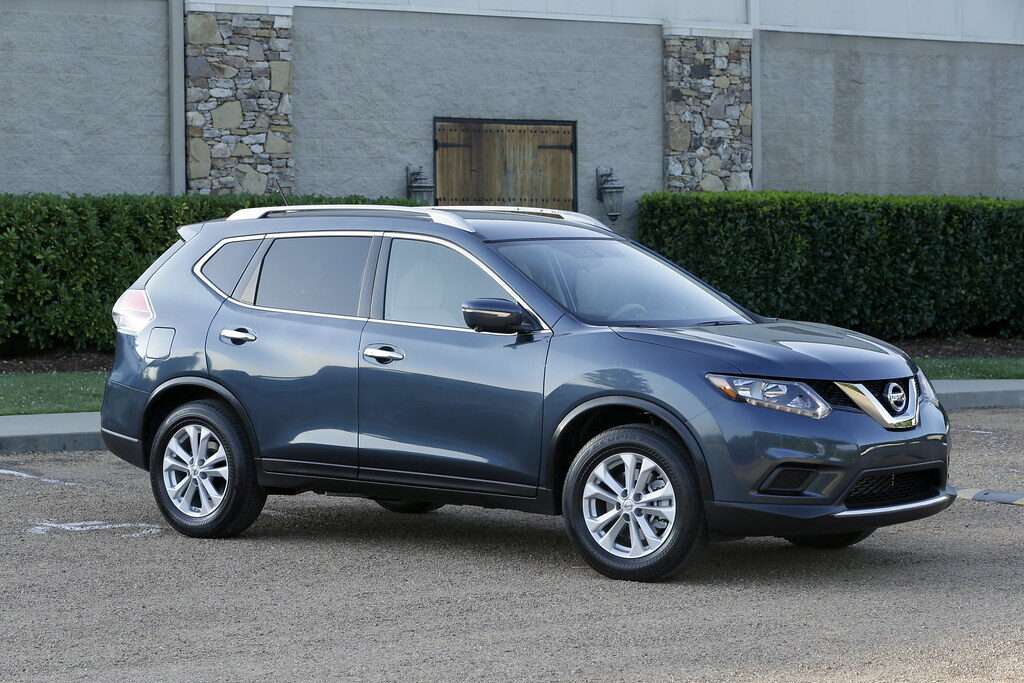
Nissan put numbers on the 2027 Rogue Hybrid this week, and the one it wants shoppers to remember is $37,065. That Nissan Rogue Hybrid price buys an SV all-wheel-drive with the $1,575 destination charge included, and it drops the company’s first American e-Power model straight into the middle of the compact crossover market.
The number Nissan would rather you skip past is $43,065. That is the SR all-wheel-drive with the SR Technology Package, and by Nissan’s own launch calendar it is the only Rogue Hybrid you can actually buy this fall. Every other trim, the $37,065 one included, arrives in early 2027.
The Nissan Rogue Hybrid price ladder, and what actually arrives
| Trim | Price (with destination) | On sale |
|---|---|---|
| Rogue Hybrid SV AWD | $37,065 | Early 2027 |
| Rogue Hybrid SR AWD | $39,065 | Early 2027 |
| Rogue Hybrid SV AWD, SV Premium Package | $39,165 | Early 2027 |
| Rogue Hybrid SR AWD, SR Technology Package | $43,065 | Fall 2026 |
| Rogue Hybrid Platinum AWD | $45,065 | Early 2027 |
Staggered trim launches are ordinary practice. The size of this gap is less ordinary. Six thousand dollars separates the advertised entry point from the only version that will sit on a lot this year, and a buyer who walks in during the launch window does not get to choose the cheap one. For context on how little room shoppers have left, new-car transaction prices crossed $50,000 again this month.
Supply is thinner than the launch sounds
The first Rogue Hybrids are not built here. Nissan is importing them from Japan and shipping roughly one or two cars to each of its approximately 1,050 US dealers when the model reaches showrooms in November. Inventory is not expected to reach about 6,000 units until March 2027, when the remaining trims join the lineup. That is a soft opening, not a launch wave, and it is the same tension running through Nissan’s renewed push to build a million cars a year in Japan while American tariffs make every shipped car more expensive.
Nissan’s rivals do not have that problem. Toyota and Honda already have hybrid crossovers on lots in volume, and Toyota spent the last year adding RAV4 Hybrid capacity in Kentucky precisely because demand kept outrunning the line. Even so, RAV4 supply has been tight enough that Toyota has been rationing build slots into 2027, which is the one opening a trickle of imported Rogues might exploit.

What e-Power actually is, and what it is not
e-Power is a series hybrid. A turbocharged 1.5-liter three-cylinder engine never turns the wheels; it exists only to feed a 1.67-kilowatt-hour battery that powers two electric motors, one per axle. Combined output is 225 horsepower, and there is no plug. Nissan’s own testing puts it at 38 mpg combined, 40 in the city and 36 on the highway, though those are not final EPA figures.
Read that mileage next to the competition and the pitch changes shape. The RAV4 Hybrid is rated at 43 mpg combined and the CR-V hybrid at 40. Nissan is not arriving with the efficiency crown. It is selling electric-car throttle response without a charging cord, at a moment when the whole industry has quietly swung back toward hybrids, as Honda did when it poured $472 million into Alabama engine capacity instead of more EV tooling.

Why Nissan moved the date twice
Rogue sales fell 11 percent in 2025 to 217,896 units and the model’s segment share slipped to 7.6 percent, all while hybrids, plug-ins and EVs climbed to roughly 24 percent of US light-duty sales in the second quarter of 2026. Nissan pulled the e-Power launch forward twice, landing it about nine months ahead of the original plan. The brand’s broader US numbers have been recovering, up around 10 percent in the first half of the year against a roughly 3 percent industry decline, but that recovery happened without a mainstream hybrid in the lineup at all.
The production promise underneath the price
Nissan Americas chairman Christian Meunier told CNBC the company is maxing out its US capacity and that a third shift is the next step, helped along by the Rogue launch. Smyrna, Tennessee builds the Rogue and other Nissan and Infiniti crossovers on two shifts today. Adding a third shift at each US assembly plant would take Nissan to roughly a million vehicles a year, up from nearly 487,000 in 2025, and the company wants 80 percent of what it sells here built here by 2030. There is no new factory in the plan.
The timing is where accounts diverge. Meunier described a spring production launch for the gas 2027 Rogue at Smyrna with US hybrid manufacturing following next year. Reporting in early September, citing Automotive News, put the gas car’s Smyrna start in summer 2027 and domestic hybrid output in early 2028. Either way, every e-Power Rogue sold before that switch crosses the Pacific first.

What the Nissan Rogue Hybrid price means if you own one, or want one
If you already drive a Rogue, nothing mechanical changes. Your 1.5-liter variable-compression turbo and CVT carry on exactly as before, and the e-Power system is a different architecture that shares none of it. The part worth watching is residual value. A redesigned, electrified Rogue landing while the outgoing car is still being sold tends to press on the older model’s trade-in numbers, and that pressure usually shows up over the following year rather than at the announcement.
If you are shopping, the calendar matters more than the sticker. Buying during the fall launch means paying $43,065 for a loaded SR in a market with one or two cars per store, which is the weakest negotiating position a buyer can occupy. Waiting until early 2027 opens up the $37,065 SV and the $39,065 SR, and it puts you in front of dealers with actual inventory. The current gas Rogue still starts at $31,035 if the electrified version is not the point for you, and the next-generation gas car is expected later in the cycle.
One more caution worth holding onto: that 38 mpg figure is Nissan’s, not the EPA’s. Wait for the window sticker before building a fuel-cost argument around it.
The short version: the Nissan Rogue Hybrid price that matters is the one attached to the trim your dealer can actually order, and for the next few months those two numbers are not the same.