
Volvo Cars, whose largest shareholder, Geely Sweden Holdings, held about 78.65% of its shares and votes at the end of 2024, has written permission from the Commerce Department to keep importing and selling connected cars in the United States. Mercedes-Benz, whose two Chinese shareholders together hold 19.67%, has no such permission. Under the Senate’s Chinese-vehicle bill as it was introduced, the German company is the one that would need it.
That outcome comes from two different ways of measuring Chinese influence. The Commerce rule now in force asks who has the power to run a car company. The bill asks what share of its stock sits in Chinese hands, and it adds unrelated holders together. The bill’s Republican co-sponsor and the chairman of the Senate Commerce Committee now say Mercedes will not be banned. The simplest way to keep that promise is to borrow the control test the regulators already use, and the bill’s sponsors have not yet said whether they will.
Commerce cleared Volvo and turned down Polestar
On May 26, Volvo Cars announced that it had received a specific authorization from Commerce’s Office of Information and Communications Technology and Services, which lets Volvo Car USA keep importing and selling connected vehicles here. The company said the decision followed “constructive discussions” with Commerce and other U.S. officials about its governance, technology and data security. Volvo builds cars at its Charleston-area plant in South Carolina, which it says represents more than $1.3 billion in investment and more than 2,000 jobs.
A month later, on June 25, Polestar, the performance-EV brand Volvo and Geely founded together, said the Bureau of Industry and Security had declined to authorize it to sell vehicles in the U.S. from model year 2027 on. Its Form 6-K filed that day says the company will keep selling existing stock of the Polestar 3 and Polestar 4 and will keep its service network open to customers. It also says 94% of Polestar’s retail volume in the first quarter of 2026 came from outside the U.S. That is a measure of how little U.S. volume Polestar had to lose.
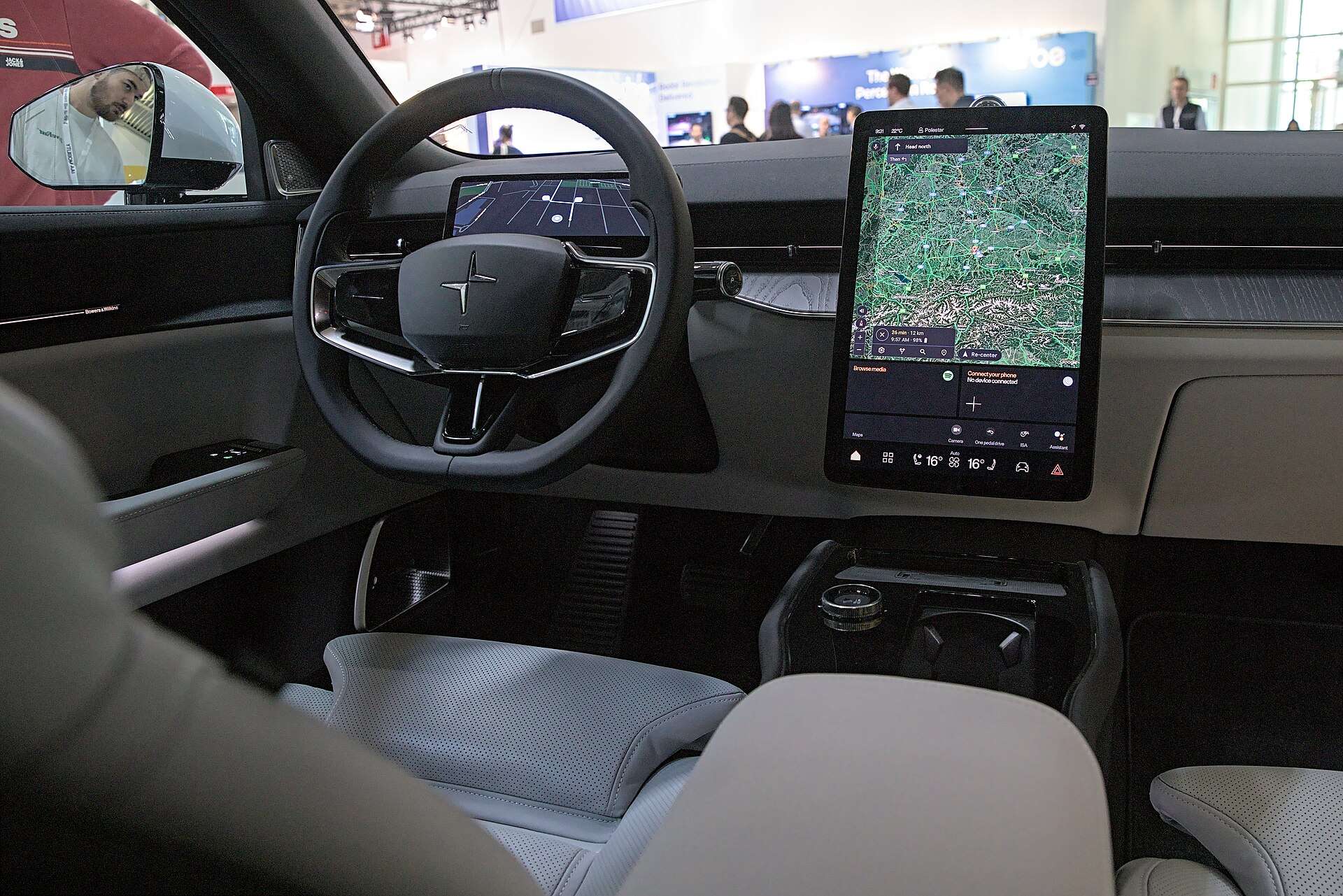
The two brands share a factory, too. Polestar began assembling the Polestar 3 at Volvo’s Ridgeville, South Carolina, factory in August 2024. So one building near Charleston now turns out cars from a brand Commerce cleared and a brand it refused. Neither company has released the department’s reasoning, so the line between the two decisions can only be inferred from what Volvo says it discussed: governance, technology and data.
The Commerce rule tests control, with no percentage in it
The rule behind both decisions was finalized on January 14, 2025. It bars vehicle connectivity system hardware and automated driving system software with a sufficient link to China or Russia, with software prohibitions starting in model year 2027 and hardware in model year 2030, or January 1, 2029, for units without a model year. It also bars manufacturers with that kind of link from selling new connected cars with those systems in the U.S. starting with model year 2027, even if the cars are built here. That last clause is why a Chinese-owned factory in America would not solve a Chinese automaker’s problem.
Who counts as linked is spelled out in the definitions at 15 CFR 791.301. A company is covered if a foreign adversary owns or controls it, and control means the power “to determine, direct, or decide important matters affecting an entity,” whether that power comes from “a majority or a dominant minority” of voting interest, board seats, proxy voting, a special share, contracts, or “formal or informal arrangements to act in concert.” The definition sets no percentage. A regulator applying it has to look at how a company is run, which is why a majority-owned company can still win an authorization by showing what its owner does and does not touch. BIS training material on the rule lists what an applicant for a specific authorization must supply, including the nature of its China or Russia nexus and the internal controls and security standards it uses.
The Senate bill counts shares and adds them up
The Connected Vehicle Security Act of 2026, S. 4429, was introduced on April 29 by Sen. Bernie Moreno, R-Ohio, and Sen. Elissa Slotkin, D-Mich. It would write the Commerce rule into law and widen it. Section 4(a)(1)(B) of the introduced text prohibits importing, building or selling a connected vehicle on and after January 1, 2027, if its maker is an entity in which “more than 15 percent of the equity interest, voting interest, board representation, or other indicia of control, whether directly or indirectly, is owned or controlled by an entity, or combination of entities” organized in or based in China, Russia, Iran or North Korea. The Senate Commerce Committee approved the bill on July 22, Slotkin’s office said. The Auto Wire was not able to review the committee-approved text, so the section numbers and dates here come from the introduced version. Our earlier reporting found the same bill reaches well past cars, down to airbag components.
The phrase “combination of entities” is what catches Mercedes. According to the company’s shareholder structure page, based on voting-rights notifications as of June 30, 2026, state-owned BAIC Group holds 9.98% of Mercedes-Benz Group AG’s registered share capital, and Geely founder Li Shufu holds 9.69% through Tenaciou3 Prospect Investment Limited. Neither stake reaches 15%. Together they come to 19.67%. The third-largest known holder is the Kuwait Investment Authority, at 5.33%.
Mercedes has no quick way back under the line. It lists 962,903,703 shares in its capital stock. By The Auto Wire’s math, the 4.67-point overshoot equals about 45 million shares, and those shares belong to two investors Mercedes cannot order to sell. The usual tool a company uses to reshape its share register, a buyback, works backward here: every share Mercedes buys and retires raises the percentage held by every investor who did not sell, BAIC and Li Shufu included. Moreno conceded the problem on September 29. “There’s concern that, can they get to 15% without debilitating their company?” he told reporters, according to a Reuters report published by CNBC.
Volvo’s authorization would carry into the bill’s regime
Majority Chinese ownership puts Volvo far over the bill’s 15% line too, but Volvo walks in with paperwork. Section 4(c)(1)(B)(i) of the introduced bill says, except as provided in the clauses that follow, “any general or specific authorization issued under subparagraph (A) or subpart D of part 791 of title 15, Code of Federal Regulations, before January 1, 2030, shall remain in effect until January 1, 2032, unless modified, suspended or revoked.” Volvo’s May authorization was issued under that subpart. As I read the text, Volvo keeps selling into 2032 unless Commerce pulls the authorization.
Mercedes has announced no authorization under the rule, so it has nothing to carry forward. A new one under the bill would require the Commerce Secretary to find, “based on clear and convincing evidence and a written risk assessment,” that the vehicles pose no undue risk, then notify Congress at least 60 days before the authorization takes effect. If Congress enacts a joint resolution of disapproval in that window, the authorization dies. That puts any Mercedes waiver in front of the same Congress that wrote the 15% line.
Moreno told the committee on July 22 that Mercedes would have until 2030 to comply with the ownership limit and could seek a waiver, according to a Reuters account of the markup. The introduced text’s vehicle ban starts January 1, 2027, so if the 2030 date holds, it came from changes made in committee. On September 29, Moreno also said talks were under way on how Volvo could keep selling here, and he named Aston Martin, 17% owned by Geely, and Lotus, majority owned by Geely, as brands that could be barred.

Alabama, Cadillac and one senator’s hold
Mercedes has said it employs more than 10,000 people in the U.S. and runs assembly plants in Alabama and South Carolina. Sen. Katie Britt’s office said on April 1 that Mercedes would put $4 billion more into its Alabama operations over the next several years and that the Vance plant had built more than 5 million vehicles, about two-thirds of them for export. The introduced text prohibits manufacture as well as sale, so as written it would reach the Vance assembly line, export production included, and not only Mercedes showrooms.
The fight over the clause has also turned into a fight about motives. At the July markup, Commerce Committee Chairman Ted Cruz, R-Texas, said “We would never consider” banning Mercedes and that the bill would need changes before becoming law. He also accused General Motors of backing the 15% threshold to help Cadillac. “GM is pushing for this provision to get Mercedes-Benz out of the market,” Cruz said, according to the Reuters account. GM did not immediately respond to Reuters. Sen. Rand Paul, R-Ky., told Reuters he would let the bill move only if the clause came out, adding, “A bill shouldn’t directly attack one company.”
Moreno and Slotkin said on September 24 that they would try to pass the bill by unanimous consent the following week, a route any single senator can block. The Senate’s floor log for September 30 records no action on it before the chamber adjourned, with the next scheduled vote set for Monday, November 9. Meanwhile, the White House has signaled openness to Chinese automakers building plants here, a position the bill’s backers oppose.
What Polestar, Volvo and Mercedes owners should watch
Polestar owners keep access to the company’s service network under its June statement, but a brand with no new U.S. model years ahead is a different proposition at trade-in time. Anyone leasing a Polestar 3 or 4 should ask the leasing company how it is setting the residual value before signing, and anyone buying from remaining inventory should get the service commitment in writing from the selling retailer.
For Mercedes shoppers, nothing changes at the dealership this year. The things to watch are in the amended text when it appears: whether “combination of entities” survives, whether the 15% figure is raised or limited to state-owned holders, and whether a control test like the one in the Commerce rule replaces the fixed number. If the fix is a waiver, Mercedes’ U.S. sales would depend on Congress declining to overrule the Commerce Secretary every time the authorization comes up.
For Volvo, the date that matters is January 1, 2032, when authorizations carried over from the rule would expire under the introduced text. Section 8 also orders Commerce to start a rulemaking in 2030 on whether exclusions and exceptions granted under the rule should continue. That date falls inside a six-year loan or a long lease written this year. It would not touch Volvos already in driveways, but it would matter to the residual values lenders set and to the dealers who sell the brand.
Should Washington judge a carmaker by how much of its stock Chinese investors own, or by who controls its software and the data its cars send home?